
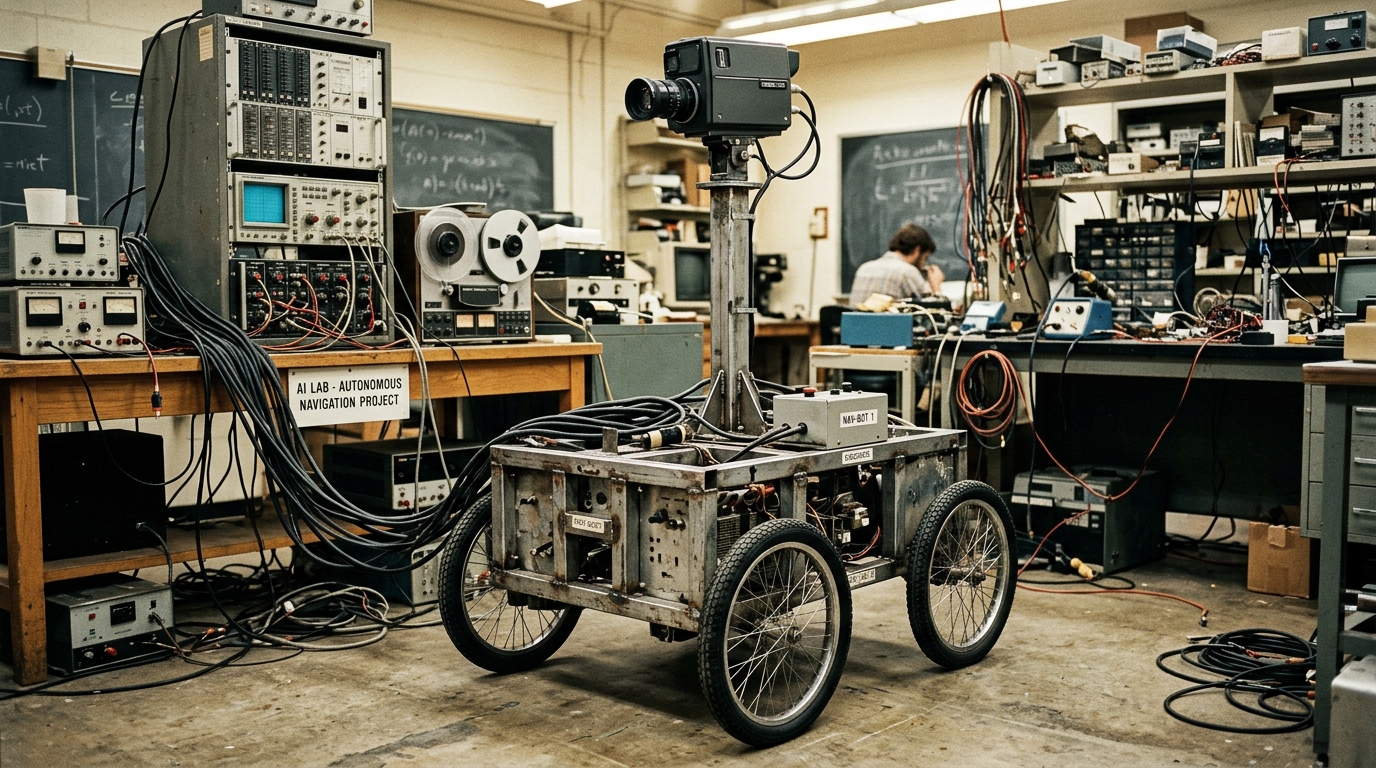
Imagine a robot that takes five hours to cross a room, barely covering the length of a tennis court, stopping constantly to ponder its next move. It would be amusing, even prompting serious doubts about the future of autonomous robotics. Yet this image of extreme slowness hides a story far more compelling than the caricature of a stumbling machine. The Stanford Cart, this experimental cart born in California laboratories at the end of the 1960s, was long mocked for its snail-like pace. But it was neither its sluggishness nor its flawed trajectory that sent it to the museum: the truth is simpler, and far more revealing of the mechanisms governing scientific research.
- The protocol “see then move” required a photo and a complete recalculation for every meter traveled, forcing pauses of ten to fifteen minutes between each movement.
- The project ended because federal funding through DARPA disappeared, as priorities shifted in the late 1970s, not due to a technical failure.
- Its innovations in visual navigation and trajectory calculation continued through the CMU Rover at Carnegie Mellon, before the cart was showcased at the Computer History Museum in Mountain View.
- Five hours, twenty meters: the performance that had everyone laughing
- The real reason for the abandonment: a disappearing budget line
- Why this budget story still matters today
Five hours, twenty meters: the performance that had everyone laughing
The Stanford Cart doesn’t advance like a car or even like a simple radio-controlled toy. It progresses in fits and starts, stopping, recalculating, then moving again. Each move of barely one meter requires a new photograph, taken by its sole black-and-white camera, followed by a full analysis before deciding the next action. Between strides, the machine waits ten to fifteen minutes, the time it takes for the distant computer, linked by radio, to digest the images and rechart a path. The machine doesn’t glide along a smooth trajectory: it stumbles, quite literally, as if someone were moving with eyes closed, lifting their eyelids a fraction of a second at each step.
This protocol, which the researchers of the era modestly referred to as see then move, imposed colossal computation times given the computing power available at the time. The onboard processor bore no relation to the chips that equip today’s smartphones. Crossing a room crowded with chairs in five hours for twenty meters may seem absurd from our hyper-connected era, but it was already, in 1979, a genuine technical achievement. Trajectory errors did occur: the cart veered, corrected, and restarted. But these imperfections were part of the normal process of experimental research, not a crushing failure.
The real reason for the abandonment: a budget line that disappeared
The Stanford Cart project depended on federal funding, notably through DARPA, the agency tasked with supporting research deemed strategically important. Such funding follows cycles, adhering to priorities that evolve over the years, and results from political decisions largely invisible to the general public. A project can enjoy generous support for years, then suddenly find itself without credits, not because it failed, but because priorities simply shifted direction.
By the late 1970s, funding priorities indeed shifted. Money was gradually redirected toward other approaches deemed more promising in the near term, leaving the Stanford Cart stranded. The cart lost its financial backing, but not its scientific relevance. No commission ever declared the project useless or obsolete. No official report attributed the stop to technical limits. The case simply closed because the credits no longer existed to sustain the experiments—a scenario as frustrating as it is common in the world of research.
It is worth noting that the researcher Hans Moravec, who joined the project specifically to develop visual navigation, faced his own setback in 1973 when the cart slid down a ramp, damaging its electronics with battery acid. Despite this incident, work continued, and in 1977, engineer Victor Scheinman helped outfit the Cart with a stereoscopic vision system via a camera mounted on a mobile rail. These advances demonstrate that the team kept innovating to the end, far from any technical dead end.
Why this budgetary story still matters today
The Stanford Cart prefigured concepts that are absolutely essential: visual-sensor navigation, real-time trajectory computation, and autonomous error correction. These foundations resurfaced decades later in the autonomous vehicles that now roam our roads. The project did not simply stop: it continued via the CMU Rover, a more refined robot built at Carnegie Mellon to extend the work begun at Stanford, evidence that the cart’s scientific legacy far outlived its own existence.
Its funding interruption illustrates a recurring phenomenon in research: the lifespan of a project depends far more on the economic and political climate than on its intrinsic scientific value. A cart capable of seeing, analyzing, and autonomously deciding its path was not a failure. It was a solid proof of concept, but its fate was decided far from the laboratories, in offices where decisions are made about who gets what, and for how long. Today, after spending time at the Computer History Museum in Mountain View, California, having previously been displayed at the Digital Computer Museum in Boston in 1987, the Stanford Cart tells a universal story: an idea ahead of its time, slowed not by its limits, but by the calendar of human priorities.
Five hours, twenty meters, a cut budget: that is the precise summary of this adventure. The slowness drew smiles, the missteps amused, but it was truly a funding decision, as mundane as it is administrative, that ended the Stanford Cart’s journey. A lesson that still resonates today, as many promising research projects likewise depend on unpredictable budget cycles. So, how many dormant innovations are simply waiting for the right moment to reemerge and finally prove their full potential?
