
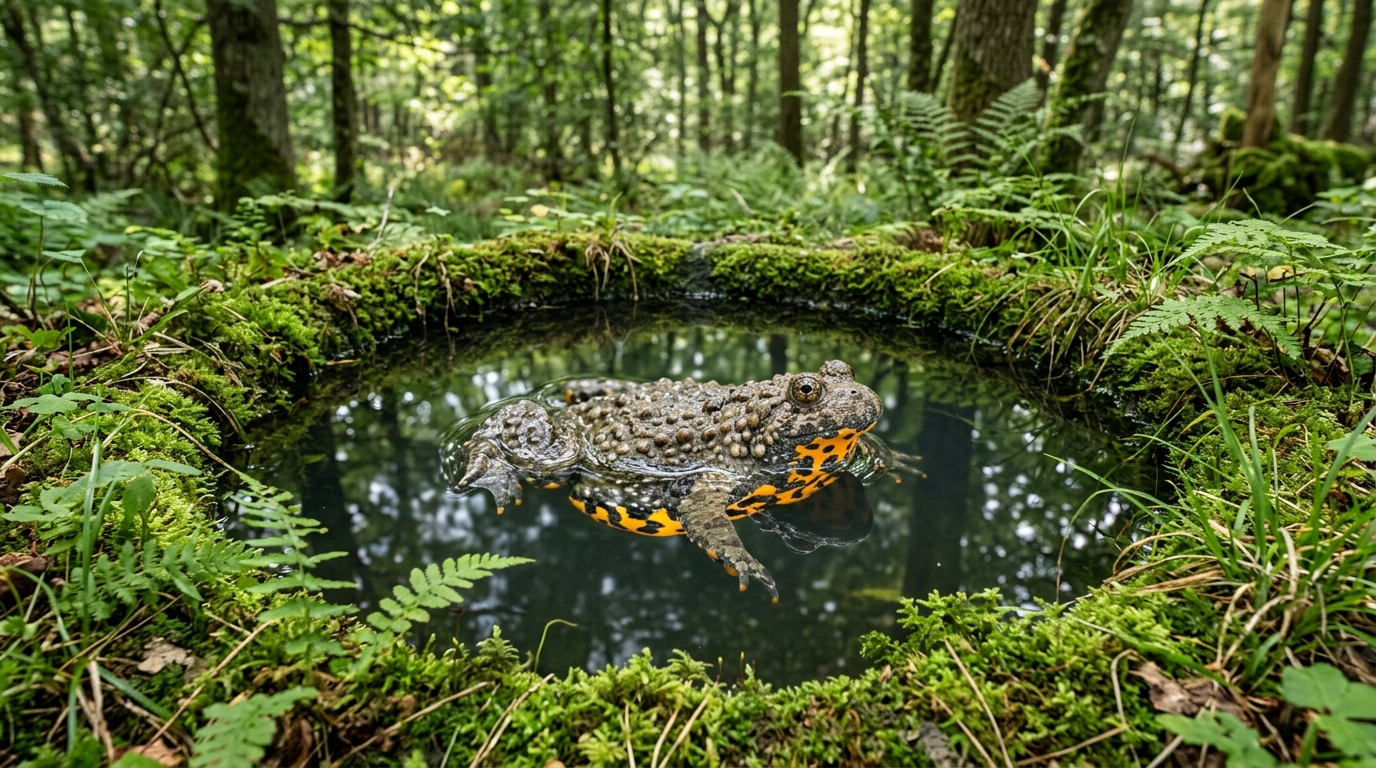
In 1919, the French state banned any reconstruction across nearly 10,000 hectares around Verdun, deemed too dangerous and too ruined to live in. A century later, this “red zone” abandoned by people has become an unlikely refuge: its artillery craters filled with water now host one of the last thriving populations of the yellow-bellied toad, an amphibian in decline across the rest of France.
- The Verdun forest, left to nature since 1919, now shelters over 13,000 yellow-bellied toads thanks to artillery craters turned into ponds.
- The former military ouvrages also serve as refuges, notably for bats with 1,800 greater horseshoe bats recorded in the fortified undergrounds.
- This balance remains fragile, threatened by the drying of ponds, tourist traffic, and the absence of toad underpasses that causes toads to be killed on roads.
- When shell holes become perfect ponds
- The yellow-bellied toad, a species disappearing everywhere but here
- Why banning habitation ended up saving a species
- A sanctuary born of bombs, threatened by peace
There is something vertiginous about walking today in this forest in northeastern Meuse, especially in this season when mist settles among the trees and leaves begin to carpet the ground. You tread across a landscape still scarred by the First World War, each dip in the terrain reminding you of the impact of a shell fallen more than a century ago. And yet, it is precisely this chaotic topography, shaped by the violence of the Great War, that allowed a small, unassuming creature to thrive where it retreats almost everywhere else.
When shell holes become perfect ponds
Hard to imagine, surveying this lunar landscape, that those thousands of craters dug by bombardments would one day turn into prime habitats. After the armistice, the farmland in the area was so degraded and polluted by the remnants of the war that it was deemed unusable. The state then bought back these 14,000 hectares and planted a deciduous forest, without realizing it was laying the foundations for a singular ecosystem.
The countless craters, now filled with rainwater, form a string of temporary and permanent ponds that dot the forest floor. It is precisely these wet depressions scattered along the ridges that drew in a species in search of a very particular habitat: small, shallow bodies of water intermittently sunlit, without predators established for the long term. Unknowingly, the artillerymen of 1916 had sketched the perfect shelter for a threatened amphibian.
The yellow-bellied toad, a species disappearing everywhere but here
The yellow-bellied toad is no ordinary toad. Recognizable by its belly speckled with bright yellow contrasting with a gray-brown back, it counts among France’s most threatened amphibians, a victim of drying wetlands and intensified farming. Yet, according to data from the National Forests Office, this Verdun forest now shelters more than 13,000 individuals, making it one of the largest populations in the Hexagon.
Certain areas prove particularly favorable, notably Bois des Caurres, where the species is even described as common, a term rarely attached to this toad elsewhere in France. Not far away, Bois Le Comte still preserves ancient beech trees that predate 1916, silent witnesses to a forest that has regained its rights. The toad is not alone there: crested newts share the same water points, while around twenty varieties of orchids colonize the surrounding undergrowth, a sign of an ecosystem of remarkable richness for this northern half of the country.
Why banning habitation ended up saving a species
This paradox deserves close attention: it is indeed the ban on living there, on farming, and on rebuilding that allowed nature to reclaim dominance without any human interference for decades. Where wetlands elsewhere were drained to make way for fields or housing, Verdun’s red zone stayed fixed in its inaccessibility, giving time for vegetation and wildlife to recolonize the land freely.
The old military ouvrages also play a valuable role for other species. The fortifications’ underground galleries, once built to shelter soldiers, now serve as winter refuges for bats. In a recent winter count, no fewer than 1,800 greater horseshoe bats were recorded there, a striking population for this species, which is also sensitive to disturbance. The Douaumont plateau, for its part, has naturally recolonized about 200 hectares still set aside, a case considered exceptional at this scale in northern France.
A sanctuary born of bombs, threatened by peace
This involuntary refuge remains fragile, however. The yellow-bellied toad, despite its sizeable population, depends entirely on the continued presence of wetlands, which remain relatively scarce across the forest. Any change in forest management, a progressive drying of some ponds, or increased tourist traffic could quickly destabilize this balance painstakingly rebuilt over a century.
The crested newts cohabiting with the toad are paying the price already: in the absence of toad underpasses, devices that allow amphibians to cross roads safely, some individuals are regularly crushed during seasonal movements. A reminder that even in this sanctuary born from chaos, coexistence between preserved nature and human presence, even minimal, remains a constant balancing act.
Thus Verdun’s forest tells a story with a double edge: a scarred territory that, against all odds, has become one of the last strongholds of a species in danger. It also prompts reflection on our relation to spontaneous nature, the kind that reclaims its rights as soon as humans step back. Will we, tomorrow, deliberately protect other spaces to give threatened species what Verdun has given them by accident—a century of absolute quiet?
