
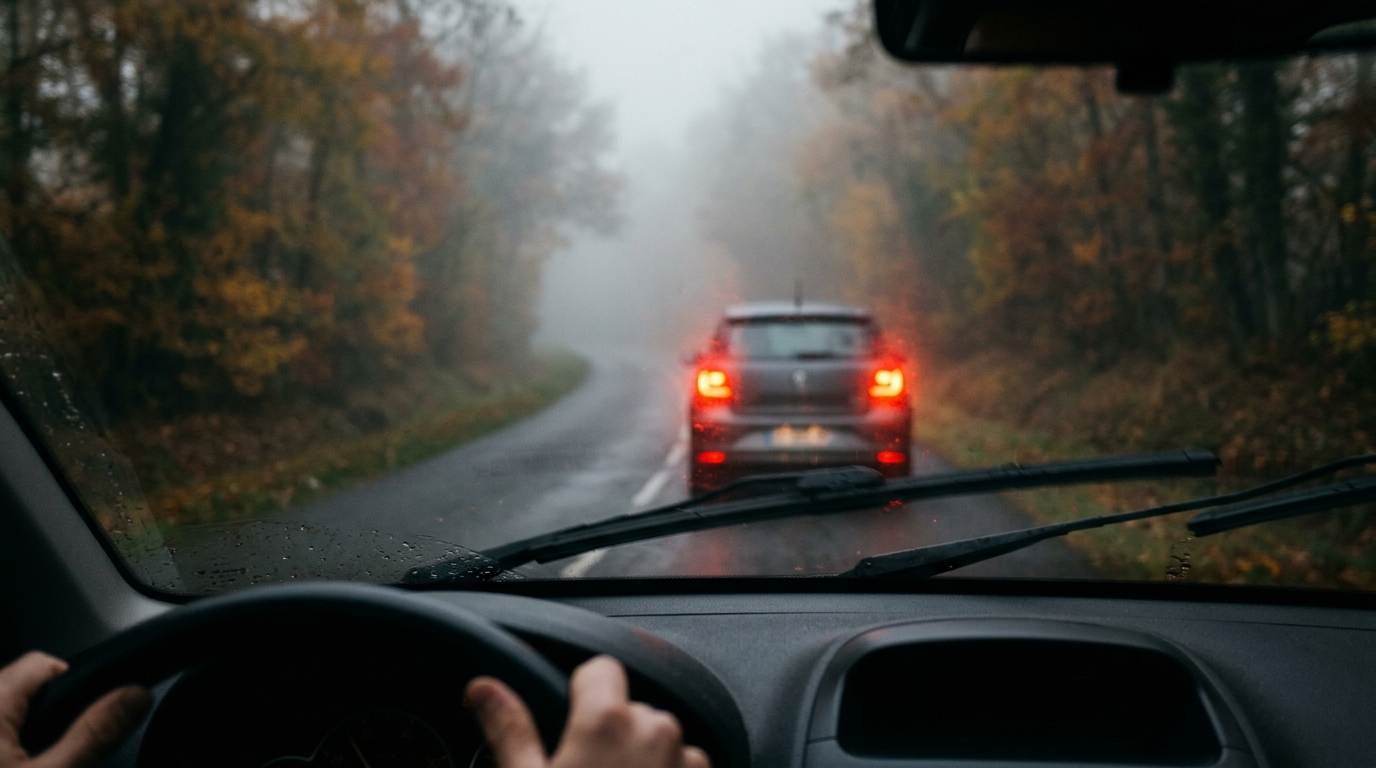
Following the taillights of the car in front seemed like common sense in foggy weather. Yet the police no longer advise it at all, and the reason isn’t simply a shift in doctrine: it lies in the way our brain interprets what it sees, or rather what it no longer sees. As this time of year returns with fog patches in the early morning, across plains as well as damp valleys, this change in guidance deserves a closer look.
- Fog distorts speed perception, giving the illusion of traveling slower than you actually are.
- As soon as visibility falls below 50 meters, the maximum allowed speed drops to 50 km/h, even on highways.
- You should switch on fog lights ahead of time, increase safety distances, and rely on the speedometer rather than visual cues.
- Why following taillights is a brain trap
- The fog distorts our perception of speed and distances
- The right reflexes to adopt when visibility drops
Why following taillights is a brain trap
The idea seems logical: if the driver in front advances, I can follow safely. But this reasoning rests on a dangerous illusion. In reality, riding on the taillights of another car is a brain trap. As soon as visibility reaches 200 meters, the driver begins to lose the usual references for gauging their own speed and has less time to react to an obstacle. The rear fog lights, meanwhile, are very dazzling: they should be used only in fog or snow, never in rain. When used outside of this context, they hinder rather than improve the visibility of other road users.
The fog distorts our perception of speed and distances
Here’s the heart of the problem, and this is where the contradiction becomes obvious: we know we must slow down in fog, but what we see can give the impression that we have already slowed enough, even though that is not the case. Fog reduces contrasts and masks the visual references that normally help estimate our own movement. The landscape then seems to pass by more slowly, which gives the brain the false impression of driving slower than reality. Result: we tend to drive faster without realizing it, as demonstrated by a Nature study published in 1998, where drivers on a simulator accelerated as the scene grew foggier. Yet the law is clear: as soon as visibility drops below 50 meters, the maximum permitted speed falls to 50 km/h, even on the highway.
The right reflexes to adopt when visibility drops
Faced with this illusion, it is wiser to rely on reliable references rather than sensations. The first reflex is to turn on the ahead fog lights in addition to the low beams. The second, essential, is to keep a safety distance much larger than usual. It is also necessary to openly slow down, trusting the speedometer rather than the impression of speed, especially in the early morning when fog is thickest in the plains and humid valleys. In this period, ground temperatures can drop between 0 and 3 degrees, which also favors white frost and, sometimes, patches of black ice in addition to fog: enough to further reduce grip. A few simple precautions help limit the risks:
- Avoid as much as possible rural roads, where fog forms more easily due to vegetation and soil moisture
- Delay your departure if the situation allows, rather than plunging into thick fog at dawn
- Never use rear fog lights outside of fog or snow, and certainly not in rain
- Increase the distance from the vehicle in front instead of closing in to see better
- Rely on the speedometer rather than the visual impression given by the landscape
In autumn, the depressional conditions frequent across Europe tend to favor clouds and rains that promote the formation of fog. With October 2026 expected to continue the humid trend of previous months, these mists are likely to remain common, especially early in the morning.
Following the taillights of the car in front gave the impression of a safety net, but it is precisely this illusion that the brain cannot outsmart on its own. Truly slowing down, keeping distances, and relying on objective references rather than sensations remains the best protection against fog. The next time visibility drops on the road, the question to ask may not be “do I see far enough?” but rather “am I really sure I have slowed down enough?”
