
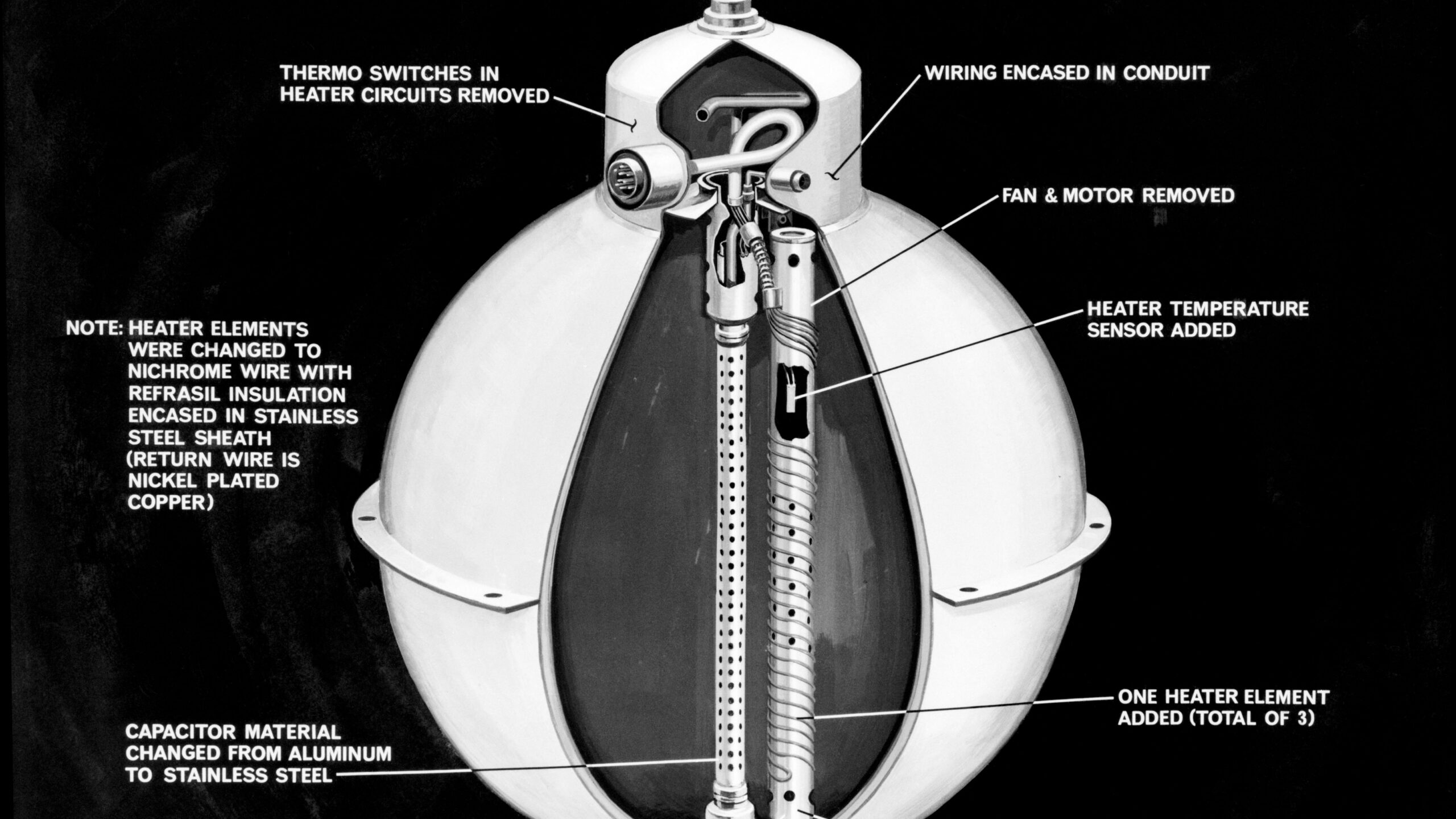
According to NASA’s summarized investigation report, the explosion of Apollo 13’s Oxygen Tank No. 2 traces back to a tiny component: a thermostatic switch designed for 28 volts, left in a circuit that had been raised to 65 volts. The spacecraft was then about 200,000 miles from Earth, roughly 322,000 km, equivalent to eight times around the planet at the equator.
The damage had been done long before liftoff, on the ground.
What doomed that tank wasn’t the 5 cm drop it suffered during handling, nor the spark from a fan. Both events are indeed part of the investigation, and cannot be dismissed. But they sit within a chain whose central link is a thermostat never upgraded to the new voltage, the one the tank’s heater was supposed to comply with. This chain stretches from 1965 to April 14, 1970.
- A thermostat rated for 28 volts was not upgraded when the system transitioned to 65 volts in 1965.
- The tank heated for eight hours at 65 volts on the ground, welding the switch shut and degrading the teflon insulation.
- Activating the fans on April 14, 1970 created a short circuit in damaged wires, triggering the tank’s explosion.
1965: an upgrade that forgets a component
In 1965, the command module underwent a number of enhancements, including raising the allowable voltage for the oxygen tank heaters from 28 to 65 volts DC. This voltage matched the ground power supply at Kennedy Space Center, used during ground operations. All components were adapted to accept 65 volts, except for the thermostatic switches on the heaters, which were overlooked.
Their role was simple: open the circuit and cut the heater when the tank temperature reached 80 °F, about 27 °C. Inside, the oxygen is kept at normal temperatures between -300 and -100 °F, and the heaters are normally used only briefly to maintain pressure and circulate the oxygen. A system that is used only briefly does not need to show its limits.
The thermostat was never upgraded.
A 5 cm drop, then 8 hours of heating
The Apollo 13 Tank No. 2 had originally been built for Apollo 10. It was removed for modification, and during extraction it fell by 2 inches (5 cm), slightly jostling an internal fill line. Another tank replaced it on Apollo 10, after an exterior inspection, and the internal damage remained unknown; it was later installed on Apollo 13.
During ground tests, this tank exhibited anomalies and did not vent properly, possibly because of the damaged line. On Earth, tanks were vented by forcing gaseous oxygen to purge the liquid, a procedure unnecessary in space. The teams then decided to use the heater to boil off the excess, which required eight hours of 65-volt operation. A full workday imposed on a thermostat sized for 28 volts.
The switches likely ended up welded shut. The heater could heat without limit, reaching internal temperatures above 1,000 °F (about 540 °C), which damaged the teflon insulation of the wires connected to the fans. Engineers measured this effect afterward on similar materials.
The temperature gauge, however, could only read up to 80 °F.
56 hours after liftoff, a routine cryogenic circulation
Apollo 13 launched on April 11, 1970. About 56 hours later, around 03:06 UT on April 14, the tank’s fans were started for the cryogenic circulation that homogenizes the oxygen and allows the sensors to measure the remaining amount accurately. This maneuver was part of the program for every Apollo mission.
The exposed fan wires short-circuited. The teflon insulation, weakened by the heat from the ground test, caught fire. The fire spread along the electrical conduit on the side of the tank, which weakened and failed under the nominal pressure of about 1,000 psi. Tank No. 2 exploded.
The Service Module’s Bay 4 panel was torn away. The explosion also ruptured a line or damaged a valve in Tank No. 1, which lost its oxygen rapidly. All reserves vanished within about three hours, along with water, electricity and the propulsion system.
Three men, 200,000 miles, six days
Apollo 13 was intended to be the third attempt at lunar landing, but the mission was abandoned after the tank rupture. The three-man crew found themselves about 200,000 miles from Earth, and they ultimately splashed down safely in the Pacific near Samoa on April 17, 1970, six days after liftoff.
NASA describes it as an oversight during the replacement of an undersized component during a design modification. The voltage increased from 28 to 65 volts, a factor of 2.3, and only one component failed to keep pace. This scenario isn’t exotic, and that is what makes it unsettling: any workshop or design office knows the modification that forgets a piece of the system.
After the crew’s return, testing showed the thermostat failed when the heaters were powered at 65 volts, the voltage used by Kennedy technicians during the fill-and-drain cycles. The 1965 modification, meanwhile, aimed to pressurize the tanks more quickly from the ground power.
Sources: historyhit.com | nasa.gov
