
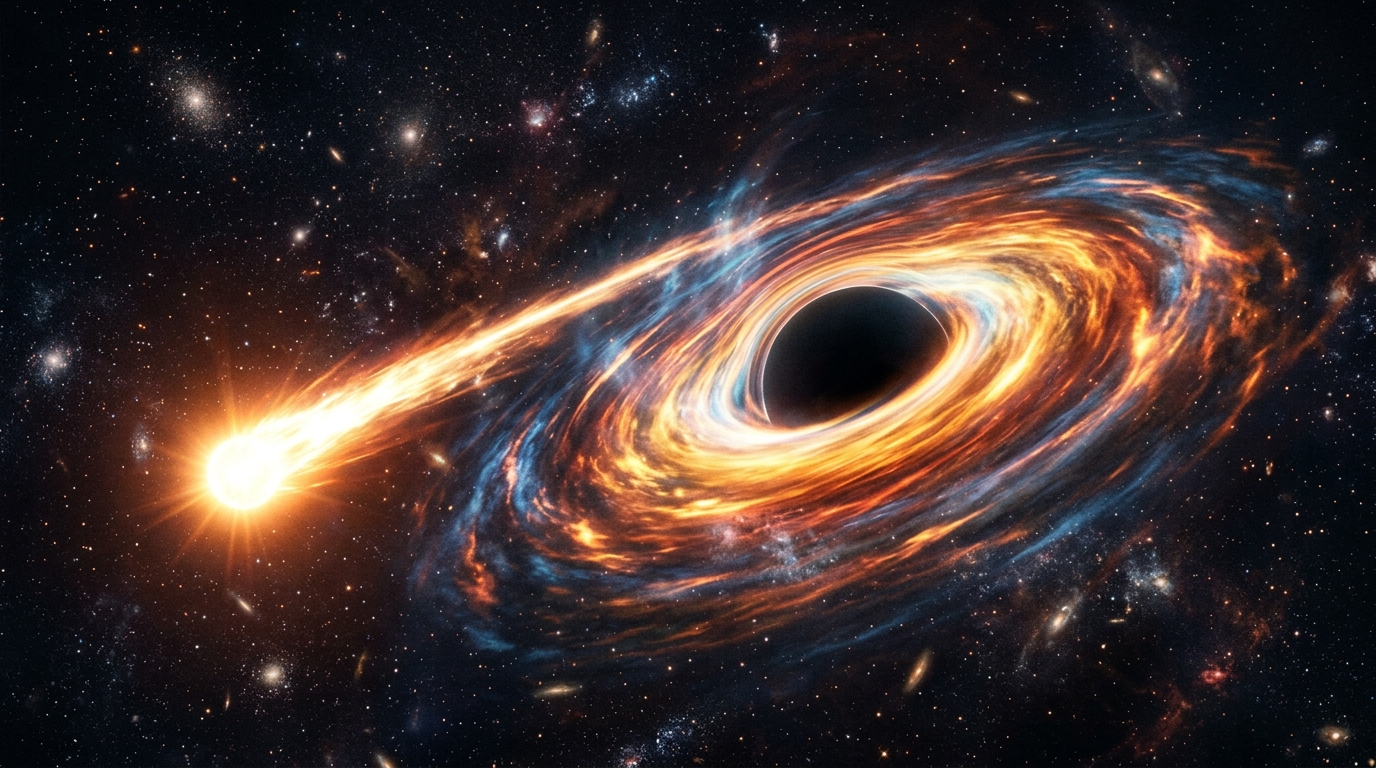
Eight thousand kilometers per second. That is the velocity at which a star newly identified at the very heart of our galaxy hurtles through space, a figure so dizzying that it could span the distance from Paris to New York in a fraction of a second. Named S4716, this tiny cosmic marvel follows an orbit that brings it exceedingly close to the supermassive black hole lurking at the center of the Milky Way, Sagittarius A*, and it is forcing astronomers to rethink the physical limits imposed by such a gravitational giant. First detected in 2022, it continues to captivate scientists as they seek to unlock the secrets of this extreme region of our galaxy.
- S4716 travels at roughly 8,000 km/s and completes a full orbit around Sagittarius A* in just four years, an absolute record.
- Its highly elliptical path brings it within about 15 billion kilometers of the supermassive black hole, yet it remains intact despite the extreme gravitational forces.
- Discovered in 2022 after two decades of observations with five telescopes, it could help measure subtle relativistic effects such as the Lense-Thirring precession.
- A star skimming the edge of the impossible
- Four years for a full orbit: the shortest orbit ever observed
- How to endure such extreme gravitational forces
- What S4716 reveals about unresolved mysteries at the galactic center
A star skimming the edge of the impossible
At the center of the Milky Way, about 26,000 light-years from Earth, lies a supermassive black hole whose mass amounts to millions of times that of the Sun. Around it, a distinctive gathering of stars—known as the S-stars—circulates, noted for their intensely elongated trajectories and for venturing perilously close to the event horizon with each pass. Among them, S4716 stands out. Its orbit carries it to a minimum distance of merely 15 billion kilometers from Sagittarius A*, before it journeys to a peak roughly around 100 billion kilometers. This orbital dance, with an eccentricity of 0.75, showcases a star navigating the very fringes of what physics seems to permit.
What astonishes researchers most is the star’s unprecedented proximity to such a destructive object. At these ranges, tidal forces should be so immense that the star’s material would normally be stretched apart or torn from the system. Yet S4716 persists, year after year tracing a path that appears to defy all odds.
Four years for a full orbit: the shortest orbital period ever observed
S4716’s record isn’t limited to its blistering velocity. The star completes a full orbit around the black hole in just four years, which stands as the shortest orbital period ever measured for an object bound to Sagittarius A*. To put this achievement in perspective, the previous record-holders required many more years to complete the same circuit. S4716 has effectively shattered the limits previously set by the astronomical community.
This breakthrough isn’t a stroke of luck. It results from meticulous observational work spanning nearly two decades, conducted with five different telescopes, four of which were calibrated in concert to sharpen measurement precision. Instruments such as NIRC2, OSIRIS, SINFONI, NACO, and GRAVITY enabled precise tracking of S4716, allowing researchers to reconstruct its intricate orbit with remarkable accuracy. It is this painstaking accumulation of data, gathered by teams at the University of Cologne and Masaryk University of Brno, that made this new cosmological record attainable.
How to survive such extreme gravitational forces
The question that haunts astrophysicists may seem straightforward at first glance, but it is exceedingly complex to answer: how can a star remain intact while venturing so near a supermassive black hole? At these distances, tidal effects would typically stretch and rip apart the stellar material—a phenomenon often nicknamed spaghettification. Yet the orbit of S4716 appears surprisingly stable, a finding that has surprised researchers studying these processes.
That unexpected stability raises many questions about the star’s true nature, its mass, density, and the precise configuration of its orbit that would permit it to dodge the most destructive gravitational pulls. Astronomers also speculate that this extreme proximity could someday enable the measurement of extremely subtle relativistic phenomena, such as the Lense-Thirring precession, a consequence of the black hole’s own rotation that warps the surrounding space-time. If such measurements come to fruition, they would provide a rare opportunity to test the predictions of general relativity under conditions never before probed with this level of precision.
What S4716 reveals about the still-unsolved mysteries of the galactic center
Beyond merely setting a speed record, S4716 functions as a natural probe into the galaxy’s most inaccessible regions. Each new observation of its orbital behavior helps refine theoretical models concerning the exact mass of Sagittarius A*, the structure of its accretion disk, and the mechanisms that govern whether stars near a supermassive black hole survive or are torn apart.
This star also serves as a reminder of how incomplete our understanding of the galactic center remains. For decades, astronomers believed they had mapped the bulk of objects orbiting this black hole. The 2022 discovery of S4716 challenged that view, opening the door to new observations that might reveal other stars as extreme as S4716, still hidden in the shadows of Sagittarius A*.
S4716 perfectly illustrates the universe’s capacity to surprise us, even in regions we thought we already knew well. With its astonishing speed, its record-breaking orbit, and its surprising resilience against the most violent gravitational forces, this star continues to fuel research and could, in the years ahead, help unravel some of the deepest mysteries of fundamental physics. One thing is certain: the center of our galaxy has likely not finished offering up surprises.
