
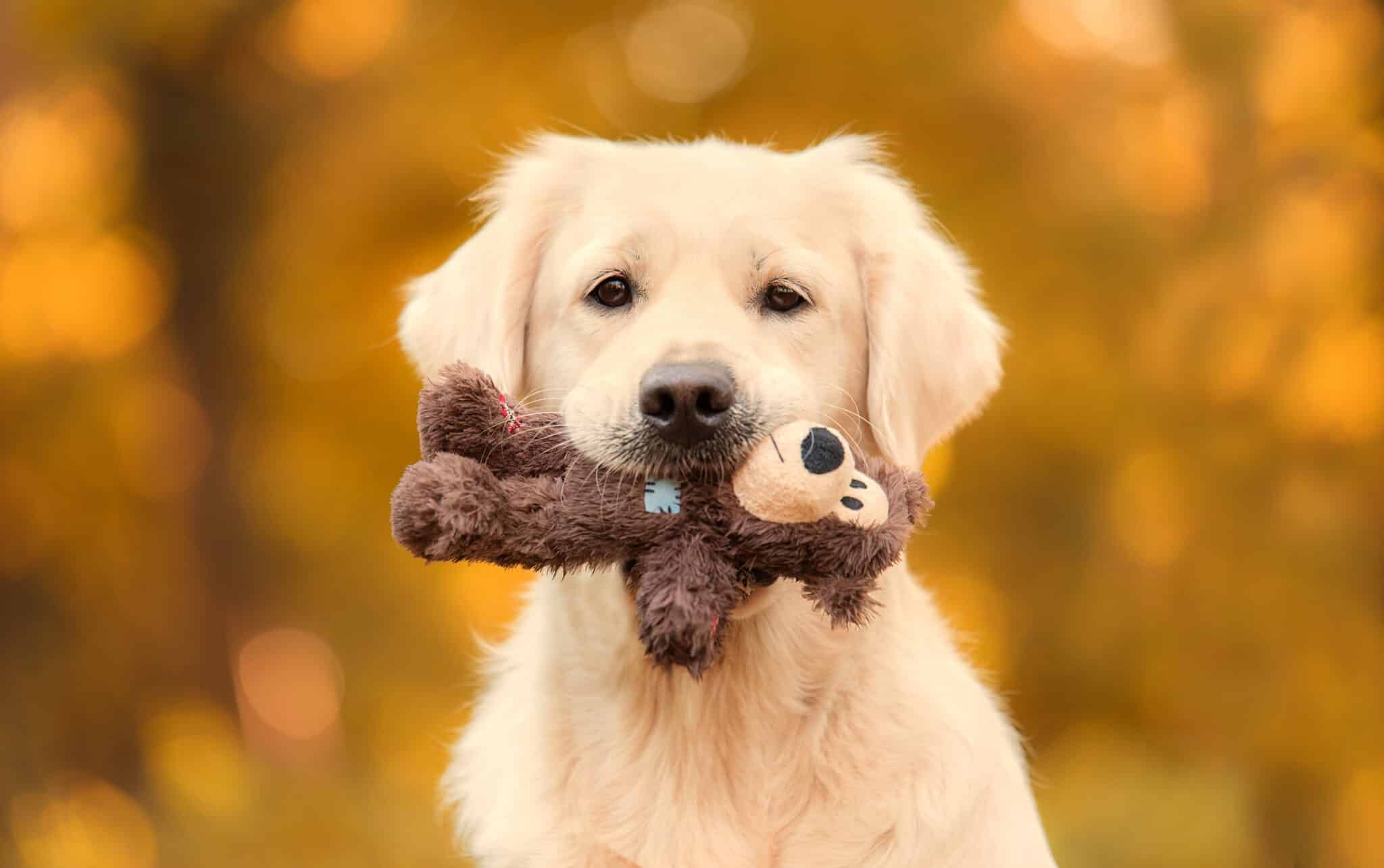
For a long time, dogs have fascinated humans with their intelligence and loyalty. But a new study led by Claudia Fugazza and her team at Eötvös Loránd University in Budapest reveals an unsuspected cognitive capacity: some dogs can not only remember the names of their favorite toys, but also extend these “labels” to entirely new objects based on their function, and this, without any formal training. This discovery challenges our understanding of canine intelligence and opens up new perspectives on how animals perceive the world.
Human-like Capacities
The Hungarian researchers observed that some dogs can conceptualize the function of objects, in the same way that a child understands that a “cup” can denote a mug, a glass, or a stein. The tested dogs were able to classify their toys according to their utility—pull or fetch—even when the objects differed greatly in appearance. This ability, called “label extension,” had previously been observed mainly in animals that had undergone intensive training. Here it appears spontaneously, simply through daily play with their owners.
This capacity goes beyond mere memorization. It reveals a form of abstract reasoning, where dogs do not merely associate an object with a word, but understand the function it serves in a given context. For researchers, this is evidence that canine cognition can, in certain cases, approach that of young children, who are able to categorize objects by their use rather than by appearance.
Vision, Olfaction, and Spatial Bias: The Role of the Senses
The way dogs perceive their environment plays a crucial role in these performances. Fugazza’s team observed that visual acuity is a determining factor: dogs with sharper vision and a shorter face show fewer spatial biases, meaning they focus on the object itself rather than its location. This observation suggests that canine intelligence is not only linked to memory or training, but also to how the brain processes sensory information.
Even though dogs prioritize sight, smell remains an essential tool, especially in low-light conditions. Dogs memorize the appearance and the scent of their toys, thereby creating what researchers call a “multilayer mental image.” This multi-sensory combination allows dogs to recognize objects they’ve never encountered before and to apply learned labels to new situations, demonstrating impressive cognitive flexibility.
Spontaneous Learning Through Play
The most surprising discovery is that this ability requires no formal training. In the 2022 experiment, seven “word-learning dogs” (GWL) were observed playing with new toys for a week, simply by interacting naturally with their owners. The dogs learned to distinguish the toys by their function—pull or fetch—even when these objects were entirely new and the names had not been repeated.
Statistically, the dogs chose the functional toys correctly far more often than chance would allow. This performance shows that learning in dogs can occur naturally and intuitively, through experience and social interaction, without repetitions or formal guidance. These results indicate that dogs do not merely react to commands; they build a sophisticated mental representation of objects and their use, reinforcing the idea that their intelligence goes well beyond what is typically observed in classic memory tests.
A Reassessment of Canine Intelligence
These studies open new perspectives on animal cognition and on how dogs perceive and interact with their environment. The ability to generalize the function of one object to another suggests that dogs possess a form of cognitive abstraction, which could be more developed than previously imagined.
Understanding these mechanisms can not only enhance our knowledge of domestic animals but also inspire practical applications, from canine education to assistance for people or rescue work. More broadly, this study reminds us that intelligence is not limited to humans and that, in some cases, our four-legged companions can surprise us with their subtle understanding of the world.
