
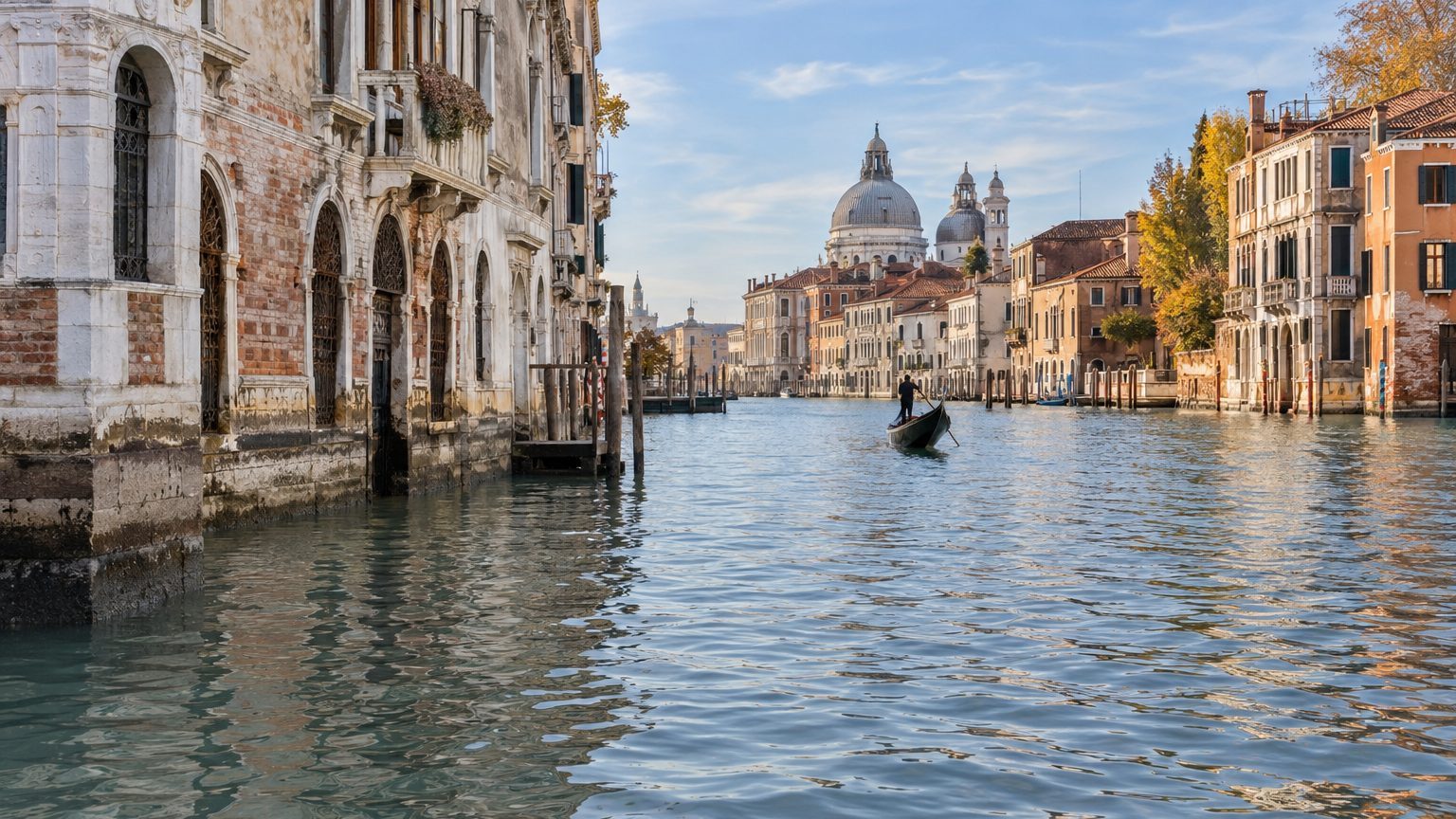
Over roughly a century, Venice has dropped about 23 cm relative to the mean sea level. The sea is asking for only 11 cm. According to a geotechnical study published in 2005 in the Giornale di Geologia Applicata, 9 cm come from human activity and 3 cm from natural subsidence.
None of these three lines bears the weight of the palaces.
- Venice has lost 23 cm of altitude in a century, of which 9 cm were caused by groundwater pumping between 1930 and 1973.
- The Marghera factories pumped up to 500 liters per second, lowering the groundwater tables and compacting clay layers by as much as 17 mm per year in 1969.
- The cessation of pumping from 1973 onward halted the sinking and triggered a rebound of about 2 cm, but 85% of the settlement remains irreversible.
By pumping deep water, the ground has subsided
The first factories settled at Marghera around 1930, on solid ground facing the lagoon. Artesian water extraction began roughly at that time. Six aquifers lie beneath the city, four of which were heavily exploited. Prior to this, subsidence was natural and hovered around 1 mm per year.
The peak occurred between 1950 and 1970. In 1969, Marghera pumped 500 l/s, about 43,000 m³ per day, enough to fill 17 Olympic-sized pools every 24 hours.
When water is drawn, pressure drops in the aquifers and the intercalated clay layers compress. On the surface, the ground sinks. The maximum rate, 17 mm per year, was recorded in 1968-1969 in the industrial zone.
Venice pumped less than Marghera yet subsided by about the same magnitude.
The explanation lies in hydraulics and geology. Marghera’s withdrawals disturb the balance of the aquifers even beneath the historic center, where local pumping does not fully explain the observed decline. The Venetian subsoil contains more clay: the ratio of subsidence to pressure drop here is 1/50, compared with 1/100 at Marghera. Between 1950 and 1970, human-origin subsidence reached 14 cm at Marghera and 10 cm on average in Venice. The factory wells thus lowered the city farther and more than they lowered their own district.
23 cm in total, including 9 cm from pumping
The sea remains the largest contributor to the tally, at 11 cm. But it has accumulated over a century, whereas pumping contributed over roughly forty years, between 1930 and 1973. Of the 23 cm, the human portion (9 cm) weighs almost as much as that from the sea.
This figure of 9 cm is shown in the study’s chart, though it is a matter of debate. The simulations published in 1974 by Gambolati and colleagues estimate about 15 cm of total subsidence for the period 1930-1973, while geodetic measurements document 10 cm from 1952-1969. The most honest approach is therefore to speak of a range, on the order of 10 cm up to 15 cm depending on the method.
9 cm of ground loss equates to 9 cm of water gained.
By stopping the pumps, the city stopped sinking
The remedy was simple in one move: cut the water supply. Local authorities began addressing aquifer overexploitation as early as 1970, and the level of the aquifer rose quickly. Marghera pumped 500 l/s in 1969, versus 170 l/s in 1975, after the partial or full shutdown of many artesian wells. The rate of subsidence slowed down and then halted in 1973. Between 1973 and 1993, subsidence remained near zero almost everywhere.
The 1975 leveling even recorded a slight rebound of about 2 cm. The maximum rebound was observed in the historic city center, as the models had predicted. As early as 1974, simulations indicated that a complete stop to pumping would yield about 2 cm.
It’s the mechanics of the Brière played in reverse, on a more famous stage. By digging and pumping to support an activity, the ground was lowered. By shutting down the pumps, the city stopped sinking. Some of the water that today flows into Venetian squares has thus fallen from its own underground, through factory wells.
The remedy did not restore everything: 2 cm of rebound versus 9 cm lost. Models estimate about 85% of the clay layer settlement to be irreversible, which accounts for the discrepancy. The 9 cm will not return.
Sources: agupubs.onlinelibrary.wiley.com | futura-sciences.com
