
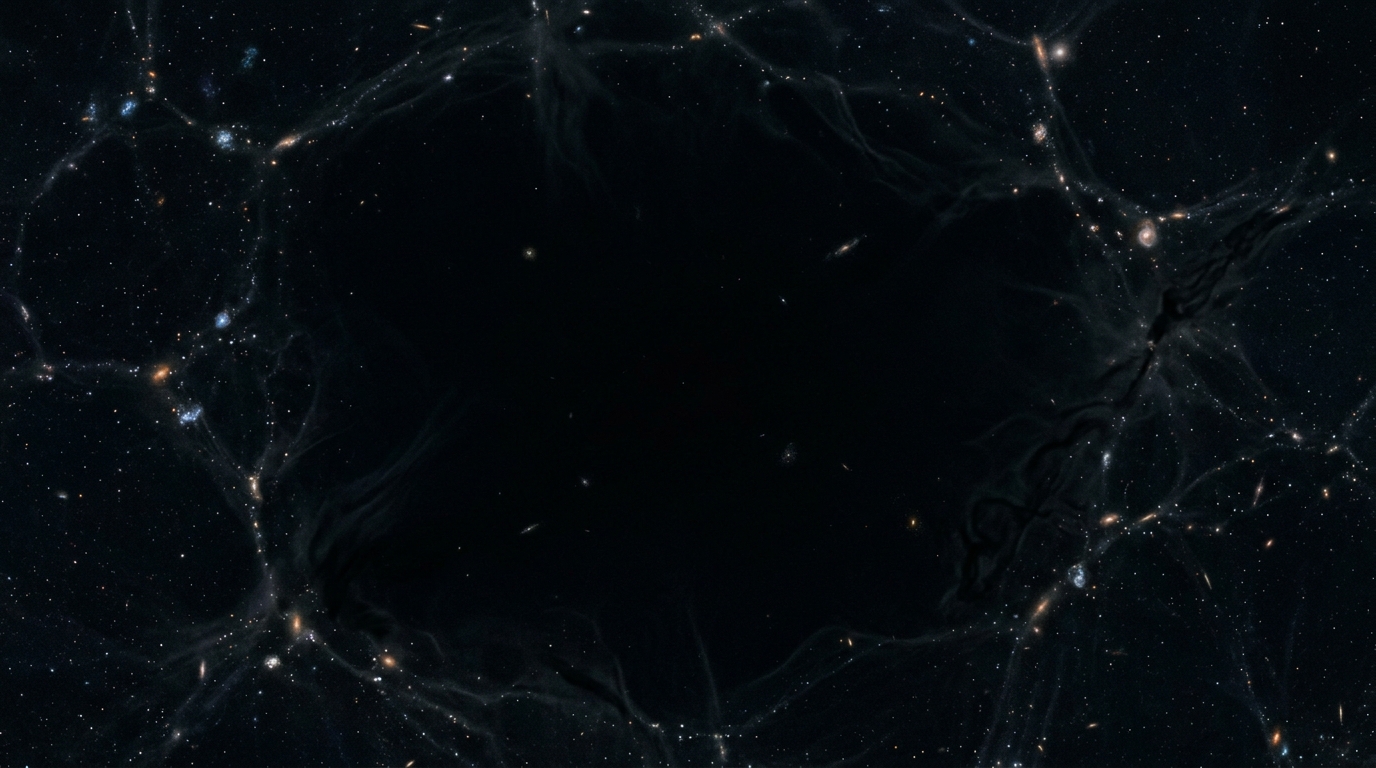
Picture lifting your eyes to the autumn sky on an evening when the air begins to chill, and not having much trouble spotting the Boötes constellation, with its bright Arcturus star serving as a landmark. Nothing, at first glance, distinguishes this patch of the sky from another. And yet it is precisely in this direction that lies one of the most perplexing secrets of the observable Universe: a region so devoid of matter that it defies all cosmological logic. Where one would expect thousands of galaxies, only a handful remain, lost in near-total silence. This paradox, known as the Boötes Void, continues to intrigue astronomers decades after its discovery.
- The Boötes Void, discovered in 1981 by Robert Kirshner and his team through a redshift survey, spans roughly 330 million light-years in diameter.
- Despite several successive surveys, only about sixty galaxies were cataloged in this region by 1997, a paltry figure given its vastness.
- No single cause has been identified to explain this void; the favored hypothesis is the gradual merging of several smaller cavities, in line with the cosmic web model.
- A giant hole in the sky no one expected
- A discovery born from a simple redshift survey
- Sixty galaxies lost in an ocean of void
- What the Boötes Void reveals about the cosmic web
A giant hole in the sky no one expected
When observing the distribution of galaxies on large scales, one expects a certain regularity, a somewhat homogeneous lattice of cosmic structures. That is precisely what makes the Boötes Void so perplexing: it is an immense spherical cavity spanning nearly 330 million light-years in diameter, a distance so dizzying that it ranks as one of the largest voids ever cataloged in the known Universe. It is even described, to emphasize its magnitude, as a supervoid.
To give a rough idea, the Milky Way itself measures about 100,000 light-years across. The Boötes Void could therefore hold several thousands of galaxies of our size, lined up one behind the other, without ever touching its edges. This region lies in the direction of the Boötes constellation, with a local center located approximately at RA 14h 50m and Dec 46°, coordinates that allow astronomers to locate it with precision, despite its apparent invisibility to the naked eye.
A discovery born from a simple redshift survey
The story of this discovery goes back to 1981, when the astronomer Robert Kirshner, aided by colleagues Augustus Oemler Jr, Paul Schechter and Stephen Shectman, carried out a systematic survey of the redshifts of galaxies. This technique, which measures how the light from galaxies stretches toward the red end of the spectrum according to their distance, enables mapping the depth of the Universe with unprecedented precision for the time.
It was while analyzing these data that the team stumbled upon an anomaly: an entire region appeared almost completely devoid of galaxies, contrary to what theoretical models predicted. This finding, at once simple and astonishing, marked the birth of the Boötes Void, sometimes nicknamed the Grand Void. Far from being a mere anecdote, this discovery would reshape, in a lasting way, how astronomers conceive the large-scale structure of the Universe.
Sixty galaxies lost in an ocean of void
Contrary to the notion of absolute emptiness, several teams of astronomers subsequently studied this region to verify whether it truly lacked any galaxy. In 1987, a team including Robert Kirshner reported the discovery of eight additional galaxies in the area. Then, in 1988, Mark Strauss and John Huchra identified three more, followed by Greg Aldering and Ron Marzke cataloguing fifteen others the following year.
These successive discoveries, patiently accumulated through surveys, culminated around 1997 with a total of about sixty galaxies cataloged within the Boötes Void. A figure that seems trivial when compared with the usual galactic density on such a vast scale. This extreme scarcity even inspired a famous remark among specialists in the field: the astronomer Greg Aldering noted the region’s extreme isolation, stating that if the Milky Way stood there, the existence of other galaxies would have remained unsuspected for decades. A striking way to illustrate how much our own view of the Universe depends on our position within this immense cosmic fabric.
What the Boötes Void reveals about the cosmic web
Facing a structure as vast and as sparsely populated, a natural question arises: what could have emptied this region of its matter? Strangely, no massive object capable of ejecting the surrounding galaxies has ever been detected. There is therefore no single culprit, no giant black hole nor isolated cosmic catastrophe that would singly explain this monumental void.
The most widely held hypothesis among astronomers rather points to a gradual process: the Boötes Void would result from the fusion of several smaller cavities, somewhat like soap bubbles that, when they come together, form a single pocket much larger than any of the individual ones taken separately. This dynamics fits within a broader framework, that of the cosmic web, this network of filaments and voids that organizes the distribution of matter on the scale of the observable Universe. Galaxies would thus not be scattered at random, but would follow the contours of gigantic empty bubbles, like the foam of a giant bath where matter concentrates along the walls rather than inside the cavities.
This model offers a compelling clue to understanding the origin of the Boötes supervoid, without definitively closing the debate. The absence of any single identified cause leaves the door open to other explanations, and continues to fuel research on the large-scale formation of our Universe.
This colossal void, tucked behind the familiar stars of Boötes, reminds us how fragmentary our knowledge of the Universe remains, even at such colossal scales. Sixty galaxies for filling a space spanning 330 million light-years in diameter is almost nothing, and yet this very rarity provides a treasure trove of information about how matter has organized itself since the earliest moments of the cosmos. Perhaps other similar voids, still undiscovered, await discovery in the depths of the sky, provided we keep methodically surveying every corner of the Universe around us.
