
Thirty-three and a half billion euros. That is the amount France injects each year into the cohesion of its territories, a figure dizzying enough to make one logically expect results commensurate with it. And yet, that is not what the Court of Auditors’ latest work reveals. A report published in late March 2026 comes to remind us of an obvious truth that we often prefer to sweep under the rug: public money does not suffice to mend territorial fractures when it is distributed without a compass. Neither the lack of resources nor geographic isolation are to blame. The real problem lies elsewhere, and it is markedly more troubling to admit.
- The Court of Auditors denounces a fragmented governance among the state, agencies, and local authorities, with no clear assessment of costs or of the effectiveness of the schemes.
- The same contradictions recur in education, social housing, and security, with resources poorly distributed between saturated areas and underserviced ones.
- GDP per capita ranges from €32,652 in Bourgogne-Franche-Comté to €69,288 in Île-de-France, illustrating the persistence of territorial inequalities.
- 33.5 billion euros spent, yet the gap widens
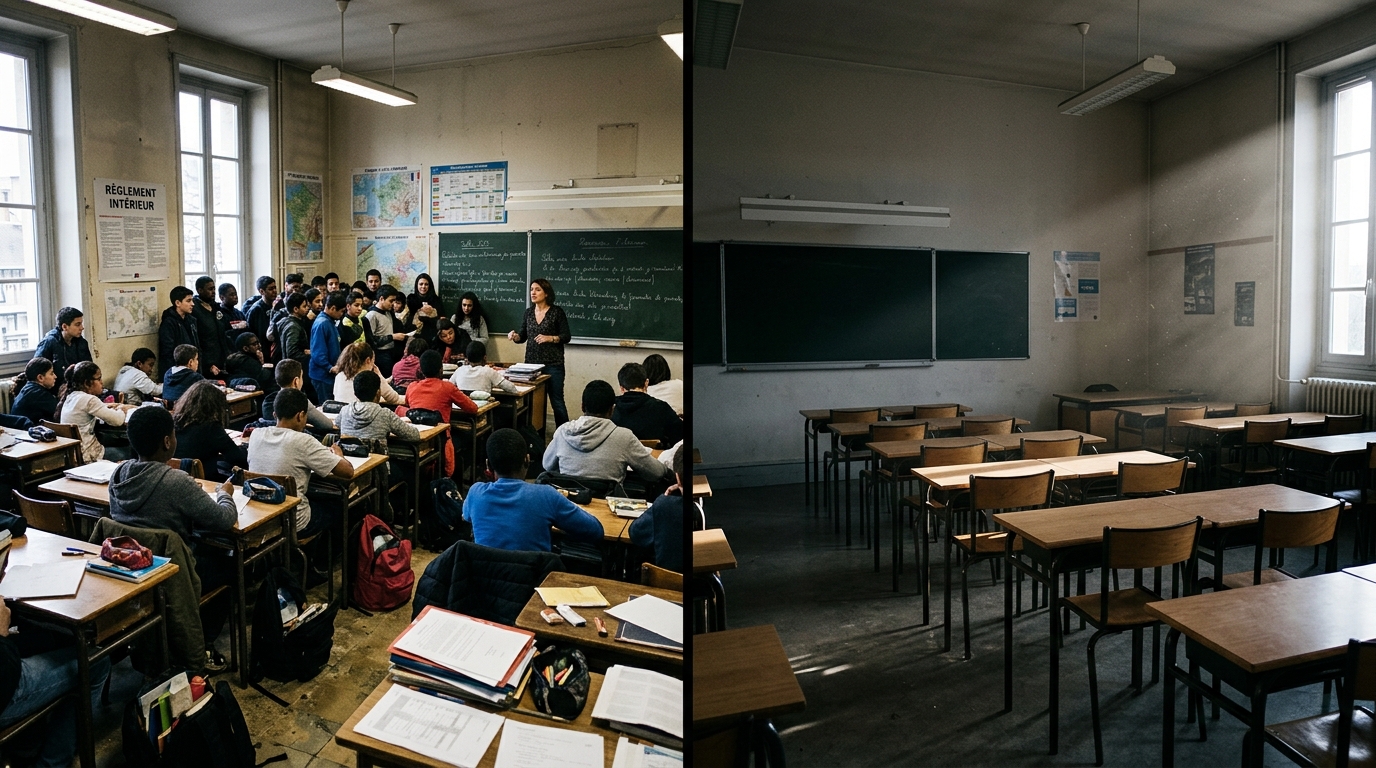
- Middle schools overcrowded on one side, empty on the other
- Vacant social housing, applicants without solutions
- Security, health, transport: the same pattern repeats everywhere
33.5 billion euros spent, yet the gap widens
A colossal budget allocated to territorial cohesion does not yield the expected effects. The Court of Auditors points to an almost dizzying paradox: the more public money flows in, the less the results follow. There are €18.5 billion recorded directly in the state budget, to which €15 billion in tax expenditures take the form of tax cuts. All this with no real coordination among the various actors involved.
The report published at the end of March delivers a harsh assessment. Credits are scattered across the state, a multitude of agencies and local authorities, without any clear evaluation of costs or the effectiveness of the schemes to illuminate the choices made. According to the financial magistrates, France has shifted from an active state to a distributor state, a shift that fundamentally changes the nature of public action.
This shift is not trivial. Multiplied subsidies without an overall vision mechanically create administrative blind spots. Some territories accumulate schemes to saturation, while others remain almost invisible on the radar of public policies, as if forgotten in the blind spots of a system that has become unreadable even to those who operate it.
Des collèges surchargés d’un côté, vides de l’autre
The French school map illustrates this derailment perfectly. In certain urban areas, middle schools run at overheating capacity, welcoming far more pupils than they should, with all the tensions this implies for social mix and teaching conditions. Just a few kilometers away, other establishments display vacant places that remain desperately unoccupied, as if an invisible border separated two educational realities that nothing should nonetheless oppose.
The artificial maintenance of rural establishments whose enrollments keep shrinking year after year also carries a cost. Each pupil enrolled in these schools costs the community more, without serious consideration of closing or merging them. Too often, local political logic takes precedence over budgetary rationality, with each elected official defending the school in their town, regardless of its actual attendance.
The result is a two-speed school map. Neither saturated urban zones nor sparsely populated rural zones benefit from a coherent allocation of educational resources. We spend a lot, but we spend poorly, which is like pouring oil on a fire that we claim to be putting out.
Logements sociaux vacants, demandeurs sans solution
Social housing embodies exactly the same contradictions. In some communes, apartments remain vacant for lack of candidates, while elsewhere families wait for years without ever receiving a response to their application. It’s a bit like having two shelves, one empty and the other overflowing, without ever thinking to reorganize the shelves.
The Court of Auditors recommends checking the real match between the available supply and the beneficiaries’ wishes. The system is deemed heavy, bureaucratic, largely disconnected from the concrete needs on the ground. We build, allocate, manage, but sometimes forget to ask whether the housing offered truly matches what applicants are seeking.
This mismatch does not stem from a national shortage of housing. It mainly reflects a faulty distribution, worsened by the stacking of similar schemes on the same territory, where several actors pursue near-identical goals without ever coordinating effectively.
Sécurité, santé, transports : le même schéma se répète partout
Public security does not escape this observation. There are €24.4 billion mobilized by the state and €2.3 billion additional by local authorities. Yet, the distribution of personnel does not always align with the real needs of the territories; some areas enjoy a comfortable police presence while others feel neglected despite identified needs.
Access to care and to transport also remains highly unequal depending on where one lives. Digitization, often presented as a universal solution able to offset geographic remoteness, fails to erase these persistent territorial fractures. Some citizens remain distant from essential services despite substantial investments, prompting questions about the real effectiveness of these policies.
The report also highlights an especially fragmented leadership, with a multitude of actors interfering on the same topics without real coordination: the central state, the National Agency for Territorial Cohesion (ANCT), ADEME, the National Agency for Urban Renovation (ANRU), or the Interministerial City Committee. So many institutions with sometimes overlapping missions, which contribute to diluting the overall effectiveness of public action.
These gaps are also visible in measures of territorial wealth. The GDP per capita ranges from €32,652 in Bourgogne-Franche-Comté to €69,288 in Île-de-France, a gulf that illustrates how economically unbalanced France’s geography remains, despite decades of policies intended to correct it.
What this report ultimately reveals goes far beyond a budgeting issue. Poorly distributed middle schools, misallocated housing, security staffing disconnected from real needs: the Court of Auditors calls for a coherent strategy, capable of producing measurable results while guaranteeing a baseline of essential public services across the entire territory.
At heart, this diagnosis invites rethinking how territorial solidarity is conceived. It is no longer about how much is spent, but about how and for whom. A simple, almost obvious question, but one that seems to have been lost along the way in a system that has grown too complex to fix itself. It remains to be seen whether this finding will suffice to durably reverse the trend, or whether it will simply enrich the long list of reports that have not spurred significant follow-up.
