
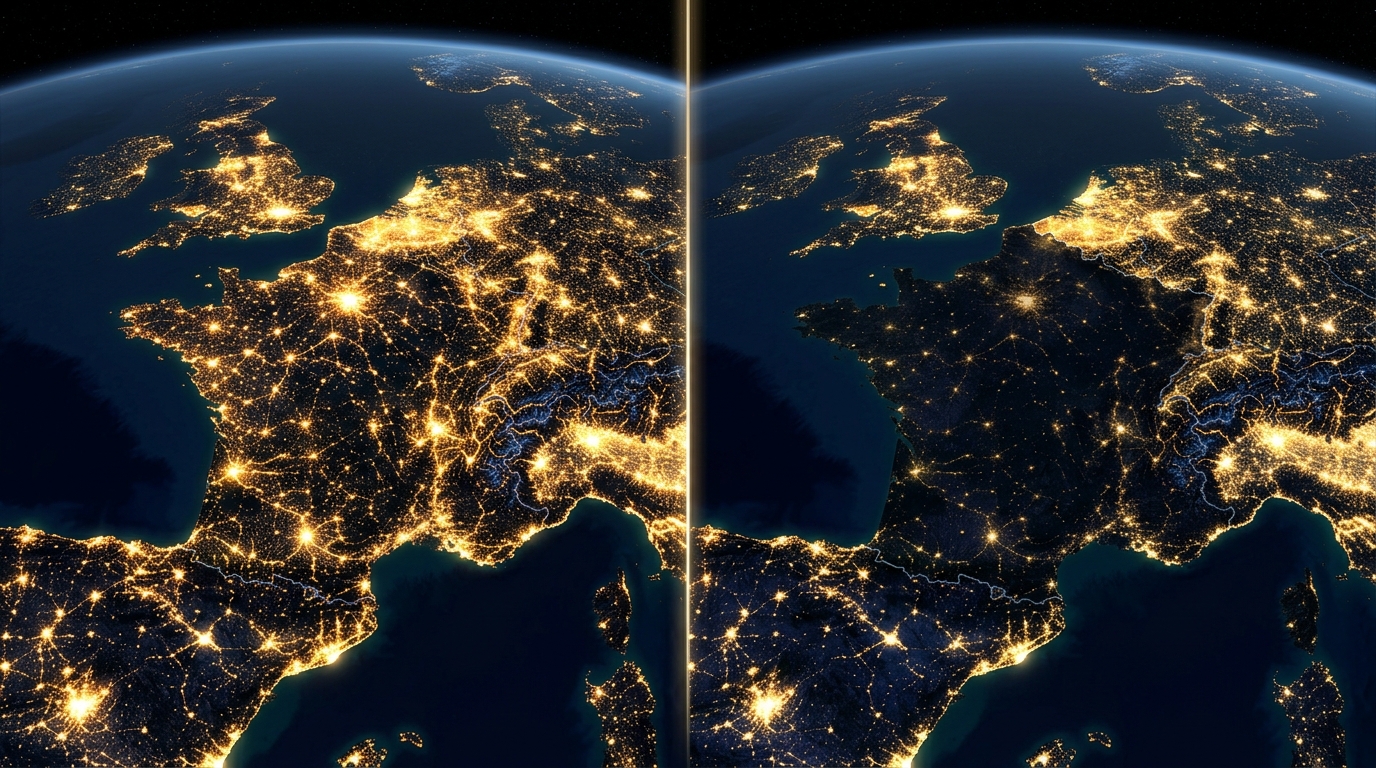
On one side, megacities growing ever brighter, neon signs that never dim, and amber halos visible from space. On the other, a country that, contrary to expectations, is gradually restoring its night sky to reveal its stars once again. While light pollution continues to advance across nearly the entire planet, France seems to be walking a radically different path. This discrepancy piques the interest of astronomers and night-sky enthusiasts, who observe the phenomenon with a mix of astonishment and curiosity. But before shouting victory for nocturnal biodiversity or for the climate, it is important to grasp what truly lies behind this trend. For the explanation, as surprising as it may be, has little to do with a sudden environmental awakening.
- The share of French land exposed to high levels of light pollution dropped from 91% in 2014 to 72% in 2023.
- This decline is mainly explained by the widespread adoption of LEDs and the tightening of nighttime extinguishing of shops and offices.
- These measures were adopted to reduce energy costs for local authorities, not for ecological reasons.
- A paradox that intrigues astronomers around the world
- The number that changes everything: France goes against the global trend
- The real culprit behind this surprising drop in light pollution
A paradox that intrigues astronomers around the world
Across the globe, nights are growing brighter by the year. Major Asian and American cities, and even certain European metropolises, see their urban lighting intensify in step with rampant urbanization and the proliferation of giant digital advertising displays. This phenomenon, extensively documented by specialists in the night sky, alarms ecologists as well as amateur astronomers, who are increasingly forced to travel away from urban centers in hopes of catching a glimpse of the Milky Way. In this rather somber global context, if one may say so, France stands out as an exception. A finding that is bound to surprise, especially in a country where Christmas lights and animated storefronts form part of winter folklore.
The number that changes everything: France goes against the global trend
According to official data from the French Office for Biodiversity and the statistics service of the Ministry for Ecological Transition, the portion of French territory exposed to high levels of light pollution dropped from 91% in 2014 to 72% in 2023. A dramatic decline, almost unheard of when compared to trends observed elsewhere. This retreat deserves emphasis, because it is not merely a stabilization but a genuine reversal of the situation. It fuels the hope of one day seeing the French sky become a privileged playground again for stargazers, without needing to retreat to the most remote corners of the Hexagon.
The real culprit behind this surprising drop in light pollution
Here’s the twist that few people anticipated: this decrease isn’t the fruit of a bold environmental policy or a collective ecological awakening. It is primarily explained by economic and regulatory considerations. The widespread adoption of LEDs in public lighting, driven mainly by energy savings and thus budgets for local authorities, has mechanically reduced the diffusion of stray light into the night sky. Add to that stricter regulations on the nighttime extinction of shops and offices, introduced amid a push to control energy costs, especially since electricity price tensions intensified. In other words, municipalities first sought to trim their bills, not to save the stars. The positive effect on light pollution is therefore only an indirect consequence, almost a fortunate accident, of decisions made for purely financial reasons.
In short, this unexpected evolution of the French night sky is explained less by ecological awareness than by precise economic and regulatory choices, revealing a paradox as surprising as it is instructive about the real levers of change. And the question remains: might future environmental advances also arise from motivations that, at first glance, have nothing ecological about them?
