
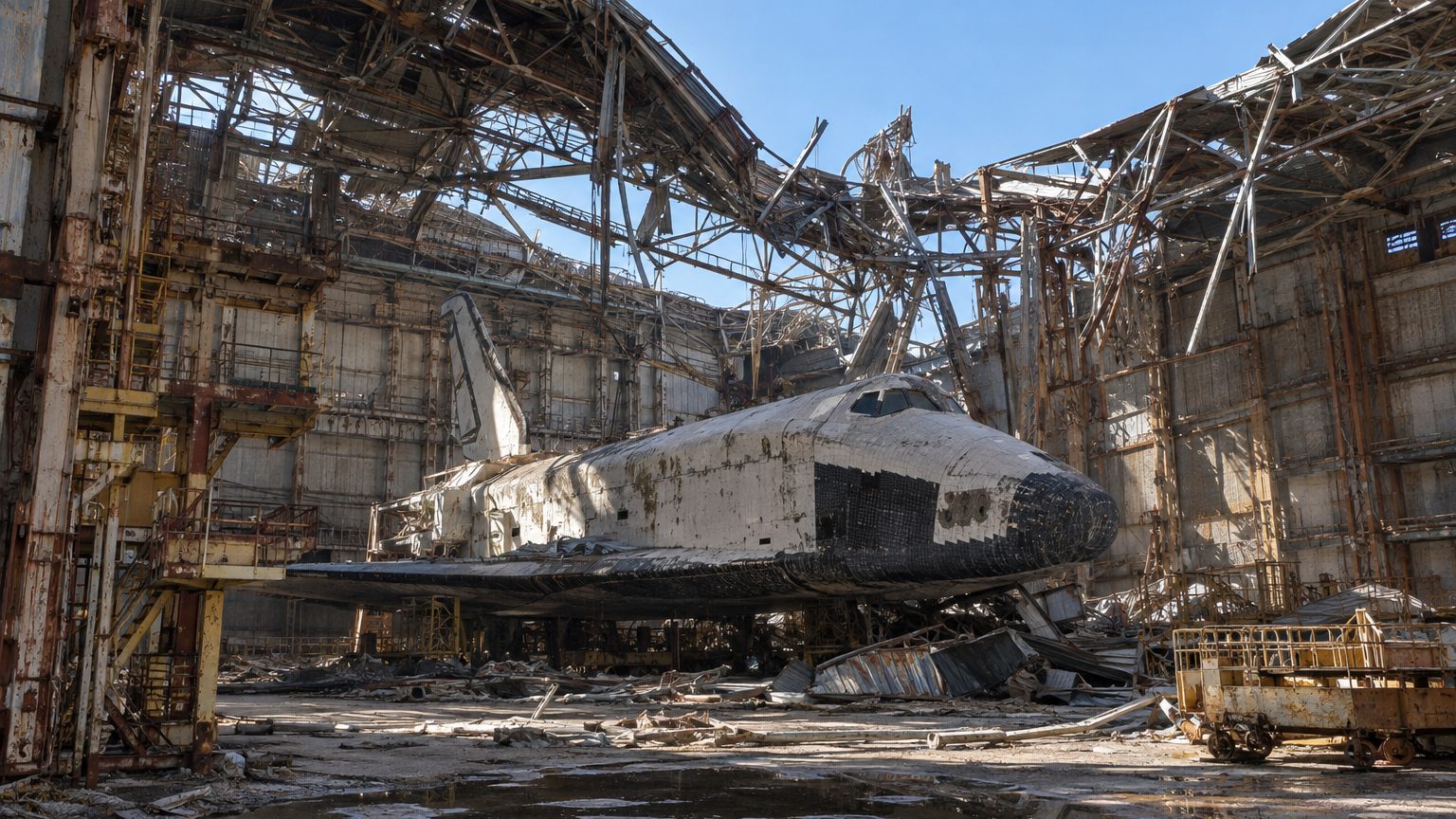
May 12, 2002 was a rainy Sunday in Baikonur. On that day, the roof of Building 112 collapsed onto Bourane, the only Soviet shuttle to have left the atmosphere. Eight workers, who were on the roof to repair it, died beneath the rubble (some sources count seven).
It had flown only once, on November 15, 1988.
- Bourane completed its sole flight on 15 November 1988 with fully automatic piloting, with no crew on board.
- The shuttle had been in slumber for 14 years in Baikonur’s Building 112, an ill-maintained structure whose roof was rotting from moisture.
- On May 12, 2002, the roof collapsed under the weight of rain, killing eight workers and destroying the historic shuttle forever.
Three and a half hours in space, with no one aboard
Powered by the colossal Energia launcher, Bourane completed two orbits around the Earth in 206 minutes, roughly the duration of a Paris-to-Athens flight. The flyby was entirely automatic, including the landing. Despite a crosswind of about 61 km/h, it touched down 3 meters from the runway axis and 10 meters from the target point. No crew could have performed better, and no crew was there.
The takeoff had not been broadcast live, which fed rumors of a staged display.
The launch video has since been released, and it clearly shows the shuttle lifting off into foul weather. The program had mobilized more than 150,000 people and over 1,000 companies across the USSR. Yet it was frozen in 1990, then officially shelved in 1993 under Boris Yeltsin, due to a lack of money in a Russia in crisis.
Fourteen years under a roof that no one maintained
After its flight, Orbiter 1.01 (105 tons, 35.4 meters long, nearly two articulated buses end to end) was stored in a Baikonur building. It rested on a scale-model of Energia, inside a structure built to assemble the Energia and Bourane rockets, and once used for the lunar N-1 program. Kazakhstan, having become the owner of the facilities after the dissolution of the USSR, had neither use nor means to maintain it.
Several sources attribute the roof’s fragility to its insulating foam, designed to withstand the temperature swings of a scorching steppe in summer and a freezing winter. This foam allegedly soaked up water like a sponge, in a region where rainfall occurs only a few days a year.
That Sunday, eight men were on the roof.
They were attempting to reinforce the structure weighed down by the rain. It still gave way, carrying the shuttle and the Energia model with it. The exact toll remains disputed: Aviation Week, reporting on May 20, 2002, spoke of “up to eight” victims, and many subsequent publications retain this figure.
What the disaster left behind
For Russia, the loss did not have any direct effect on the space program, according to Aviation Week. The concerns came instead from Starsem, the Franco-Russian Soyuz launch joint venture that used site facilities, and whose preparations for the European Mars Express probe, planned for 2003, became uncertain.
The other completed specimens fared better. Ptichka, the orbiter finished at about 95–97%, which never flew, was moved to a neighboring building after the accident, alongside a full-scale orbiter model. An atmospheric test aircraft, the OK-GLI, is on display at the Speyer Museum in Germany. As for Hangar 112, it still stands half-collapsed, visible in the background during Baikonur launch broadcasts.
The two remaining shuttles on site now attract urban explorers. Russian filmmaker Alexander Kaunas thus walked roughly forty kilometers (24 miles) across the desert to gain access, then spent three nights among the wreckage.
Sources: keops-ingenierie.fr | shango.media
