
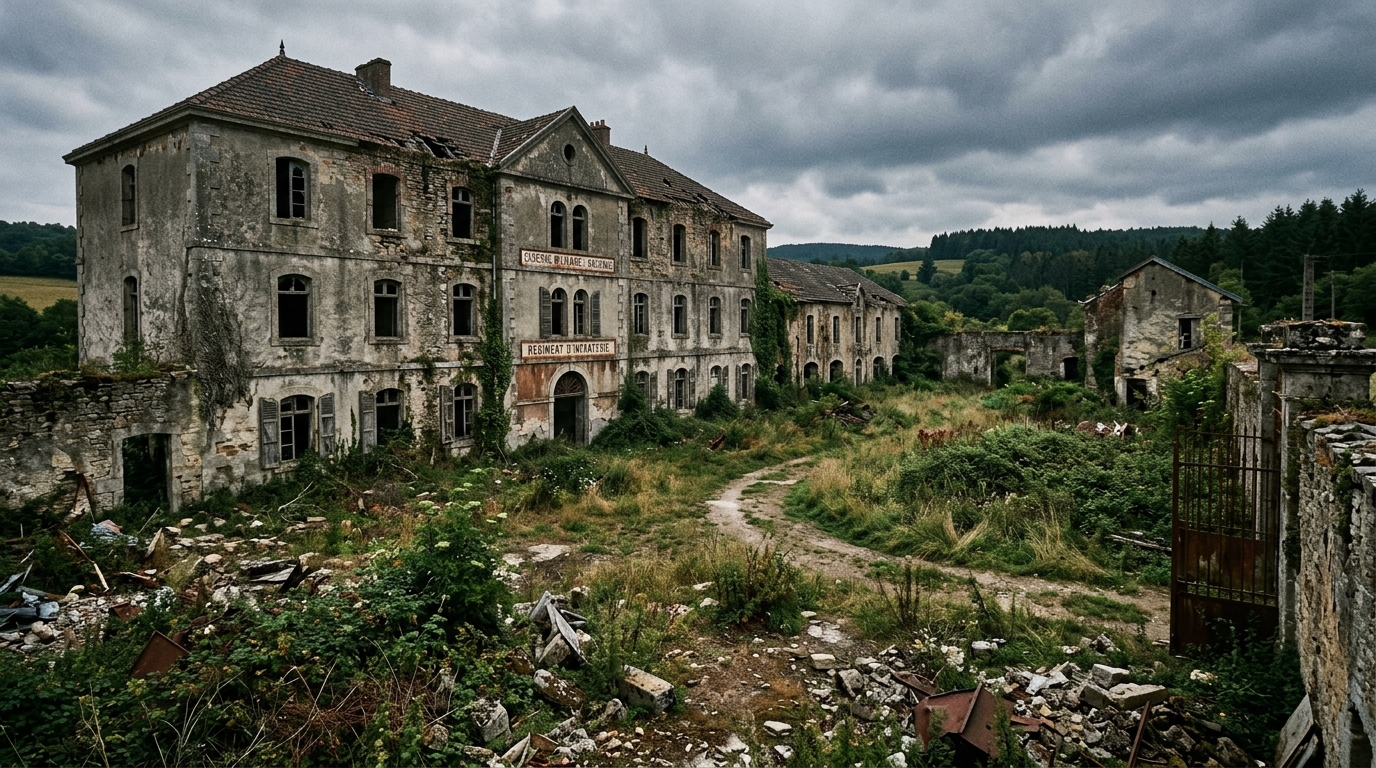
Rusted fences, broken windows, weeds growing between the cobblestones of old barracks’ courtyards: this is the face that dozens of French military sites still show today, abandoned for nearly two decades. How can such inertia be explained?
- The 2008 military reform closed 83 sites despite a promised aid package of 320 million euros to be paid by 2015.
- Pollution cleanup (hydrocarbons or pyrotechnics) blocks many projects, with delays of up to three years.
- These abandoned brownfields generate guarding costs and tax revenue losses, such as Dieuze losing 400,000 euros in annual revenue.
- Eighteen years later, the scene hasn’t moved: the state of play that prompts reflection
- Why no one has taken back control of these abandoned properties
- The true cost of silence: what these military brownfields cost taxpayers each year
- Solutions exist, but remain dead letters: what this dossier reveals about public asset management
Eighteen years later, the scene hasn’t moved: the state of play that demands attention
Back in time. In 2008, a broad restructuring of the French armed forces led to the loss of 54,000 jobs and the closure of 83 military sites across the country. To cushion the blow, the State promised affected territories aid of 320 million euros, to be paid by 2015. On paper, the promise was clear. In practice, a very different story has unfolded, one of buildings that wait, sometimes for more than ten years, for a second life that never arrives.
Take the case of the Dieuze barracks in Moselle. Two years after its closure, the town mayor is still fighting to reclaim the deserted buildings and house businesses there. But an administrative dispute blocks the process, and in the meantime, the town pays the price: 400,000 euros of tax revenue vanish each year due to the lack of activity on the site. A bit further away, on the heights of Metz, the army has been trying for twenty years to part ways with a giant fort. Neighboring municipalities dream of turning it into a tourist site, but the project runs up against a major obstacle: a pollution cleanup operation as lengthy as it is costly.
Why hasn’t anyone taken back control of these abandoned properties
Behind this stagnation, several locks have accumulated. As part of the General Review of Public Policy, some barracks were indeed returned to local authorities, sometimes for the symbolic euro. But owning a building is not enough to give it a use. Four gendarmerie academies closed in 2008 thus remained without any conversion after four years of complete inactivity, generating guarding costs far from trivial for structures supposed to cost nothing anymore.
The professionalisation of the armed forces, which accompanied this wave of closures, also left behind sites with very specific issues, such as ETAMAT in Thouars, whose redevelopment runs into both budgetary and technical constraints. And this is where the problem most often bites: pollution. In Dijon, 4,000 tons of hydrocarbon-polluted soil had to be excavated before the slightest project could be envisioned. When the pollution is pyrotechnic, i.e., linked to old ammunition stocks, the delay before work can begin can rise to three years. Suffice it to say that is an eternity for local leaders hoping for a quick redevelopment.
The true cost of silence: what these military brownfields cost taxpayers each year
This status quo is not free. Each dormant site generates invisible but real costs: guarding, minimal maintenance, securing against intrusions, not to mention the tax revenue shortfall for the municipalities involved. In Brittany, sixty-four military sites that have become useless are currently under sale negotiations. But among them, seven simply risk never finding a buyer, victims of pyrotechnic or hydrocarbon pollution deemed too heavy to treat.
Another detail, almost anecdotal in appearance, reveals the scale of the administrative problem: those military sites whose market value does not exceed 13,000 euros do not even receive centralized monitoring. They simply escape from official conversion tables. In other words, part of the abandoned military heritage is not counted anywhere, which makes any overall assessment of the phenomenon particularly challenging.
Solutions exist, but remain dead letters: what this dossier reveals about public asset management
It would be unfair to paint an entirely bleak picture. Some redevelopments have worked perfectly, proving that the scenario of mismanagement is not an inevitability. In Brest, the former naval workshops became the Capucins district, a lively living space. In Metz, former barracks now host housing and university facilities. These examples show that a military brownfield can become a driver for a city, provided time, resources, and genuine local political will are dedicated.
But these successes remain minority compared to the bulk of sites still abandoned. The verdict is blunt: the military sites closed between 2008 and 2015 remain, for many of them, unoccupied and not redeveloped today. Between legal disputes, endless pollutions, and lack of monitoring for small parcels, the dossier illustrates a broader challenge: turning a public policy promise into concrete results on the ground.
One question that deserves a direct answer: how much longer will these buildings remain frozen in time, while towns keep paying, literally, the price of waiting?
