
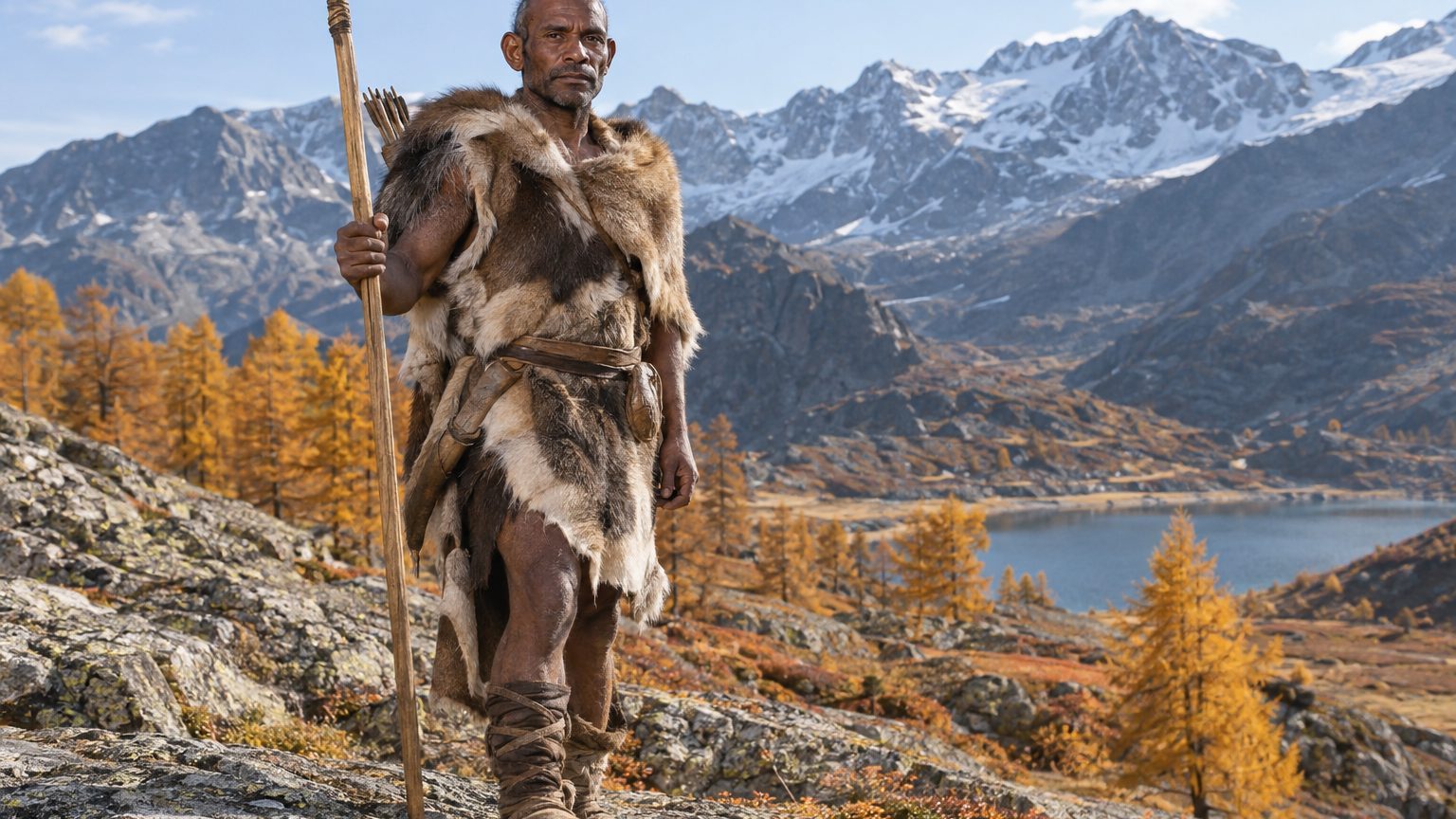
The initial analysis of Ötzi’s genome suggested traces of steppe shepherds, but more refined results no longer confirm this. The original sample was contaminated by modern DNA. The 2012 sequencing also led to the impression of thick, long hair and a lighter skin tone. The re-reading at 15.3× coverage, published in Cell Genomics on August 16, 2023, reverses all three points.
Neither steppe ancestry, nor abundant hair, nor pale skin.
- Ötzi’s 2012 genome contained modern-DNA contamination that biased the results
- Ötzi was bald or nearly bald, not as hairy as museum depictions suggest
- His skin was genetically darker than that of contemporary Southern Europeans
- Ötzi descends directly from Anatolian farmers, with no genetic input from steppe shepherds
A contamination at the origin of the misunderstanding
The Similaun mummy, dated to 3350–3120 BCE, holds a special status. Its genome was the first to be sequenced from a mummy. A team from the Max Planck Institute for Evolutionary Anthropology and Eurac Research managed to reconstruct its genome with greater precision thanks to advances in sequencing methods. They produced a genome with a coverage of 15.33× from two ilium bone samples, as in 2012, but with virtually no contamination this time. Each portion of the genome was read about fifteen times on average, enough to rule out the errors introduced by modern-DNA noise.
The case of steppe herders is the clearest example. These populations from Eastern Europe profoundly reshaped the genetic landscape of Europeans after Ötzi’s time, and the initial analysis appeared to find his signature there. Researchers found no trace of it in his genome.
Farmers from Anatolia, no detour
Among the hundreds of Europeans who lived at Ötzi’s time and whose genomes are available, he shares the most ancestry with the earliest farmers of Anatolia. This result surprised the authors themselves. It suggests an Alpine population that remained isolated, untouched by the genetic mingling that affected other parts of Europe.
This interpretation remains a hypothesis. To verify it, one would need to study more individuals from the same region and period.
Dark skin, bald head
In terms of appearance, the verdict is also clear. His skin was genetically much darker than previously thought, darker than that of today’s Southern Europeans. The mummy itself, with very pigmented skin, already pointed in this direction.
His head showed no hair.
The genome provides an explanation. It carries alleles associated with male pattern baldness, but also with type 2 diabetes and obesity. These metabolic risks presumably had little impact given his healthy lifestyle. Ötzi was likely bald, or nearly so, at the time of his death.
What this changes for Ötzi’s portrait
According to Eurac Research, these data challenge his iconic image: a long, thick mane now seems almost excluded. The depictions circulating for years, in museums and textbooks, need to be revised.
The 2012 genome was not without significance.
More than 5,000 years after his death, the emerging portrait rests on a clean reading of his DNA: a man with dark skin, probably bald, heir to farmers from Anatolia.
Sources: eurac.edu | eva.mpg.de | genomeweb.com
