
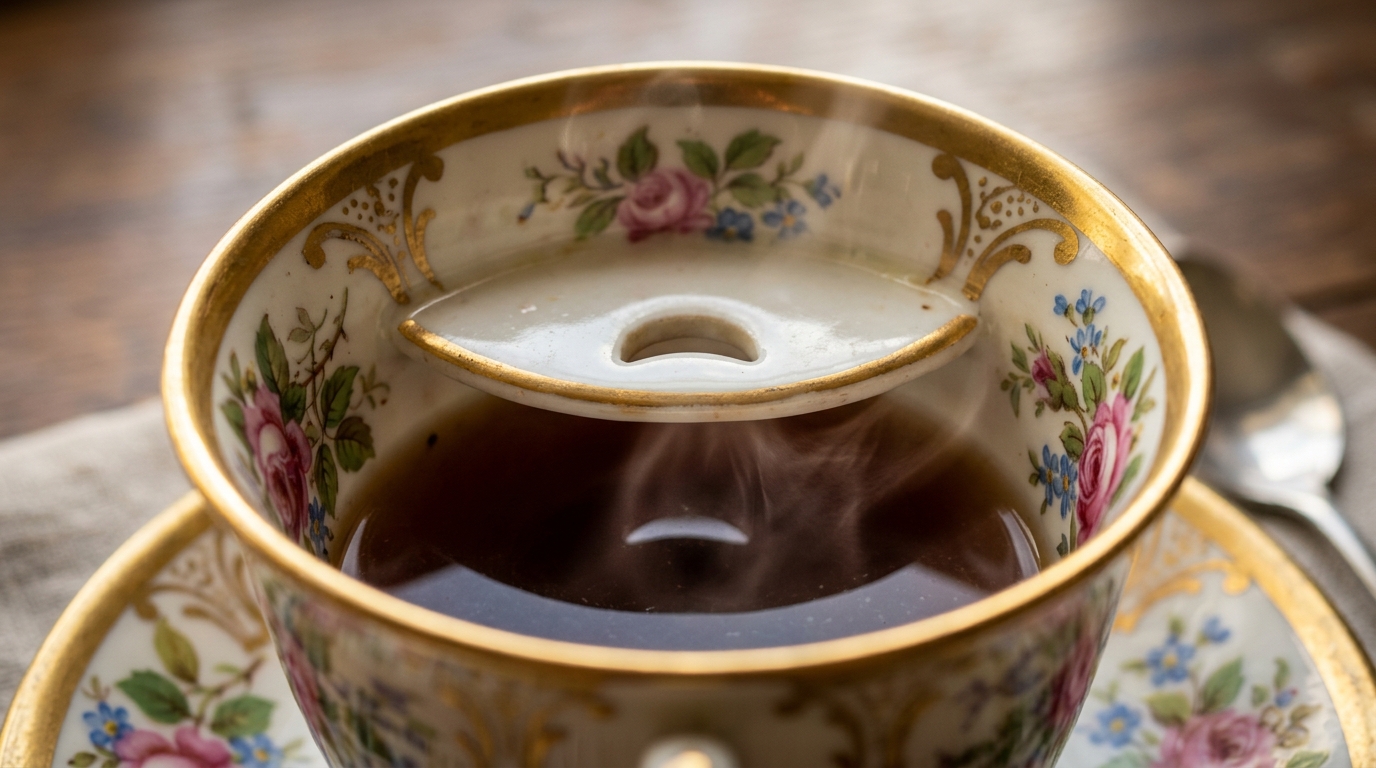
Imagine the scene: you are a nineteenth-century English gentleman, proud of your neatly waxed and curled moustache at the ends, and you lift your steaming teacup to your lips. Within moments, the heat of the liquid melts the wax that kept your facial hair in place, and it begins to drip into your drink, making it undrinkable and your moustache look ridiculous. This little daily mishap, as humorous as it may seem today, was a genuine trouble for thousands of men in Victorian England. Fortunately, an inventive potter would soon discover the remedy.
- The moustache cup, invented by potter Harvey Adams in the 1860s, features a semicircular rim with a perforated opening to shield the waxed moustache from contact with hot tea.
- This accessory addressed a common Victorian-era problem: the wax used to sculpt moustaches melted when exposed to hot beverages, ruining both the tea and the appearance of the facial hair.
- The item achieved international commercial success into the early 20th century, produced by renowned manufacturers such as Meissen or Limoges, before waning with the decline of moustache fashion after World War I.
- The most unusual Victorian-era object really existed, and it fit inside a teacup
- When the wax melted into the tea, it was a real social disaster
- The semicircular rim, a simple idea that changes everything
- Harvey Adams, the potter who understood the problem before anyone else
- Why this object still fascinates collectors and the curious today
The most unusual Victorian-era object really existed, and it fit inside a teacup
Among the countless curious inventions born during the Victorian era, one deserves particular attention: the moustache cup. Seen from the outside, it appears no different from a regular teacup. But its secret lies inside, concealed beneath the hot liquid it contains. This object, born in England in the 1860s, would become one of the era’s best-selling accessories, before nearly vanishing from cupboards in the following century.
What makes this invention fascinating is that it addressed a very concrete, almost intimate problem that men of the Victorian era confronted every morning at breakfast. A concern that today’s grooming habits have likely made hard to imagine.
When the wax melted into the tea, it was a real social disaster
To understand the origin of this peculiar cup, we must return to the aesthetic codes of the nineteenth century. At that time, the moustache was not merely a facial feature: it was a social marker, a symbol of virility and respectability that men tended with almost religious seriousness. To give it a perfect, sharp, and rigid form, they applied a generous amount of wax, much as one might fix a hairstyle today with hairspray.
The problem, however, was that this wax could not withstand heat. As soon as a man held a steaming cup to his lips, the steam and direct contact with the liquid caused the preparation to melt, and it would then drip straight into the drink. Result: a ruined tea, a moustache softened and deformed, and an embarrassing situation repeated at every meal. This nuisance, documented by several museum institutions specializing in Victorian everyday objects, was not merely anecdotal: it affected a large portion of the male population of the era, for whom sporting a moustache was nearly a sartorial obligation.
The semicircular rim, a simple idea that changes everything
The solution devised to solve this puzzle is disarmingly simple, and that is precisely what makes it genius. Inside the cup, a semicircular rim was added—a small porcelain ledge following the cup’s contour, pierced by a single opening to allow the liquid to pass through. This device, called a moustache guard in English, acted as a physical barrier between the moustache and the tea.
In practice, the user tilted the cup so that the liquid went through the small slit, while the remainder of the rim kept the moustache dry and out of reach of heat and moisture. A remarkably effective mechanical trick that required no special action from the drinker: one simply had to drink as usual, and the guard did its job.
Harvey Adams, the potter who understood the problem before anyone else
The invention of this cup is generally attributed to Harvey Adams, a British potter from Stoke-on-Trent, a region historically famous for its ceramic industries. Depending on sources, the creation dates to the 1860s, though some accounts point to the following decade, or an even earlier origin according to the Rosenberg Library Museum in Galveston, Texas, which places the appearance of the object as early as 1830. This divergence among sources perfectly illustrates how the history of everyday objects is often transmitted with varying degrees of precision.
Be that as it may, commercial success was immediate and resounding. The moustache cup first spread across the United Kingdom, then conquered continental Europe, followed by the United States, where it was sold in major department stores such as Sears or Marshall Field’s. Prestigious porcelain manufactories, among them Meissen, Royal Crown Derby, and Limoges, began producing their own versions of the object between 1850 and 1900, evidence that demand was real and enduring.
Why this object still fascinates collectors and the curious today
If the fashion for a waxed moustache eventually declined after World War I, leading to the gradual disappearance of the dedicated cup, the object never fully vanished from the collective imagination. Even today, in this autumn season conducive to flea markets and antique fairs, it is not uncommon to encounter these antique cups among collectors, who prize both their mechanical ingenuity and their quaint charm.
Fun fact: the success of this invention even inspired a variant aimed at another Victorian dining dilemma, that of soup. In 1868, the American Solon Ferrer patented the moustache spoon, available in right- and left-handed versions, proof that Victorian ingenuity knew no bounds when it came to preserving the honor of well-groomed facial hair.
From this somewhat wild anecdote, the universal lesson remains: sometimes all it takes is a small, nearly invisible modification to solve a problem that seemed insoluble. So the next time you sip your tea without fearing for your moustache, spare a thought for Harvey Adams and his clever little porcelain ledge.
