
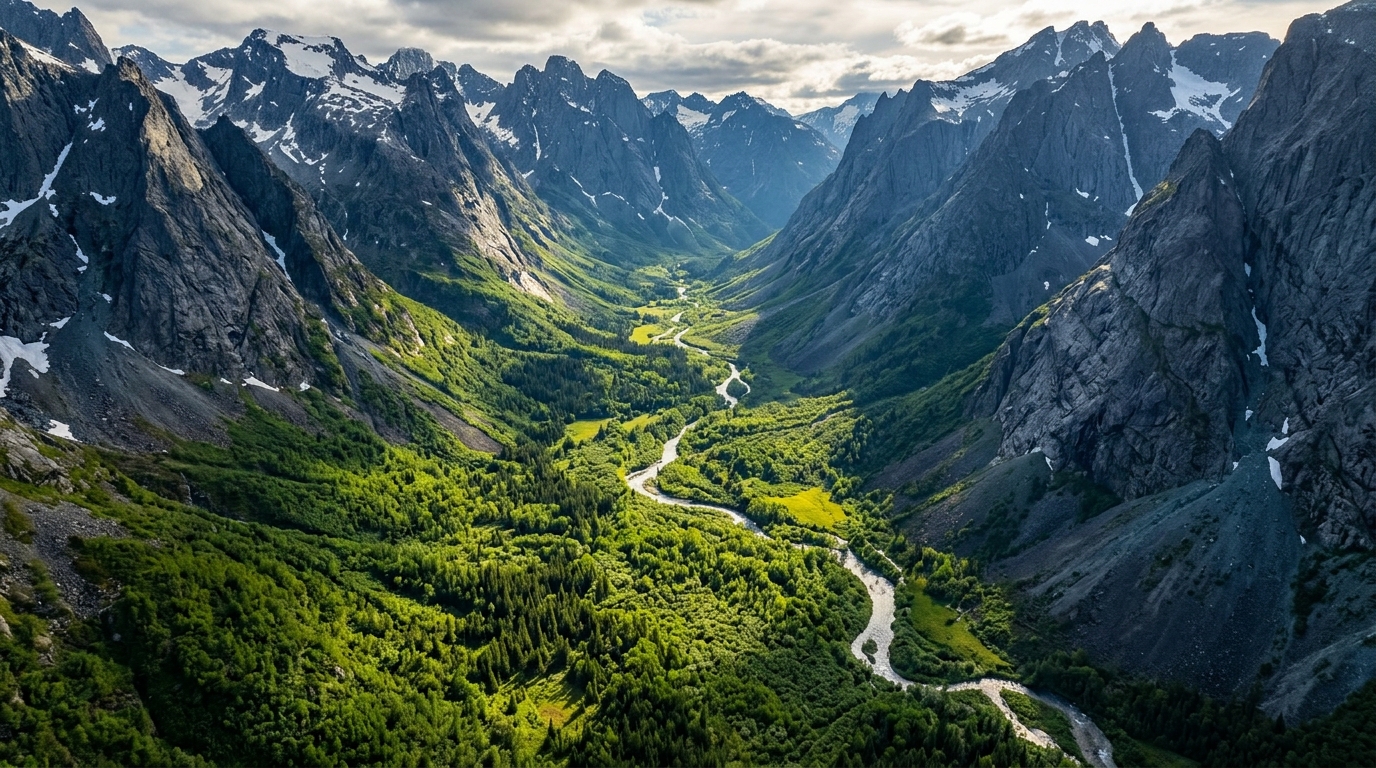
An ice desert should not shelter a forest. Yet this is the paradox concealed in the south of Greenland, where trees several metres tall grow against all odds, just a stone’s throw from a frozen fjord. The reason for this anomaly lies neither in an especially mild summer nor in recent human intervention, but in a geological configuration dating back thousands of years. A story that blends glaciology, Viking sagas, and the fragility of polar ecosystems, and one that deserves a moment’s reflection.
- The Qinngua valley, ringed by mountains rising to 1,500 metres and shielded from cold winds, forms a unique climatic bubble allowing trees to reach heights of 6 to 7.5 metres.
- The Vikings led by Erik the Red settled there as early as the 10th century, exploiting this forest to the point of deforestation, erosion and the collapse of their colony in the 15th century.
- Today Greenland has only 500 plant species and 700 insect species, making this forest of over 300 species a total botanical anomaly on the island.
- A heat trap drawn by the mountains
- Erik the Red and the lie that drew settlers
- When the Vikings cut the branch they were living on
- A pocket of green life in a desert of ice
Under a two-kilometre-thick layer of ice, scientists have recovered plant DNA dating to around 500,000 years ago, accompanied by remains of insects, spiders and butterflies. Tangible proof that Greenland experienced, in the distant past, a climate far milder than today. But about fifteen kilometres away, there is no need to dig into the ice cap to find vegetation: an entire valley hides a real forest, with trees reaching 7 metres in height. And contrary to what one might expect, neither the current warming nor human hands explain this botanical miracle.
A heat trap drawn by the mountains
Mountains peaking at 1,500 metres encircle the Qinngua valley like an unpassable natural wall. They block icy winds coming from inland, creating a genuine climatic bubble isolated from the rest of the island. This relief acts as a shield, preventing cold air from rushing in and freezing any form of plant life, as happens almost everywhere else in Greenland.
The sea, for its part, lies about 50 kilometres away, a distance enough not to chill the air but close enough to ease temperatures. This almost miraculous geographic cocktail allows dwarf birch and gray-leaved willows to climb to 6–7.5 metres in height, a feat for species that typically stay stunted at these latitudes. More than 300 plant species have been recorded in this valley, a number modest on a global scale but absolutely remarkable for Greenland. This biodiversity owes nothing to global climate trends: it results solely from the unique terrain configuration.
Erik the Red and the lie that drew settlers
As early as the 10th century, Norse Vikings landed on this surprisingly hospitable coast. Erik the Red founded Brattahlíð, whose ruins would still stand today near the current coastline. A vestige of a time when the region’s microclimate made possible what seemed impossible at such icy latitudes.
The very name Greenland, meaning “green land,” was not the result of a climatic accident but a deliberate piece of messaging. Erik the Red is said to have chosen it to entice future colonists, long before marketing became a discipline in its own right. The strategy worked, as the colony thrived for 500 years thanks to this providential microclimate, an achievement few Arctic lands can claim.
When the Vikings cut the branch they were living on
To build houses and ships, the Norse settlers felled the valley’s trees relentlessly. A scarce resource they exploited without regard for its fragility, given the lack of alternatives in an environment where timber is precious. The massive deforestation quickly led to overgrazing of exposed lands, followed by soil erosion that accelerated across generations.
The fragile balance of the microclimate then began to crack, like a house of cards carefully dismantled by its own builders. In the 15th century, a global climate cooling delivered the final blow to this human venture. The colony collapsed and disappeared, leaving behind a depleted landscape that nature would take centuries to heal, only partially.
A pocket of green life in a desert of ice
Today Greenland hosts only 700 insect species, compared with nearly a million elsewhere in the world. No native reptiles or amphibians survive there, and plant biodiversity is limited to about 500 species. A striking contrast to the wealth of marine life that surrounds the island on every side.
The terrestrial fauna, meanwhile, consists of only a few hardy species able to brave this extreme climate: the polar bear, reindeer, musk ox, Arctic fox, Arctic hare, Arctic wolf, collared lemming, ermine and wolverine. In this biological desert, Qinngua Valley stands as a total anomaly. Its survival does not rest on current warming nor on any human intervention, but on a geographical accident dating back thousands of years, a fragile heritage that the Vikings themselves nearly destroyed through their own exploitation.
At a time when the greening of polar lands is almost automatically linked to climate warming, the story of Qinngua reminds us that a geographical accident can be enough to create a lasting exception. This improbable forest, wedged between mountains and a fjord, also testifies to the fragility of natural balances when humans meddle without fully understanding the consequences. A lesson from the depths of time, which oddly resonates with today’s debates on preserving the last untouched ecosystems.
