
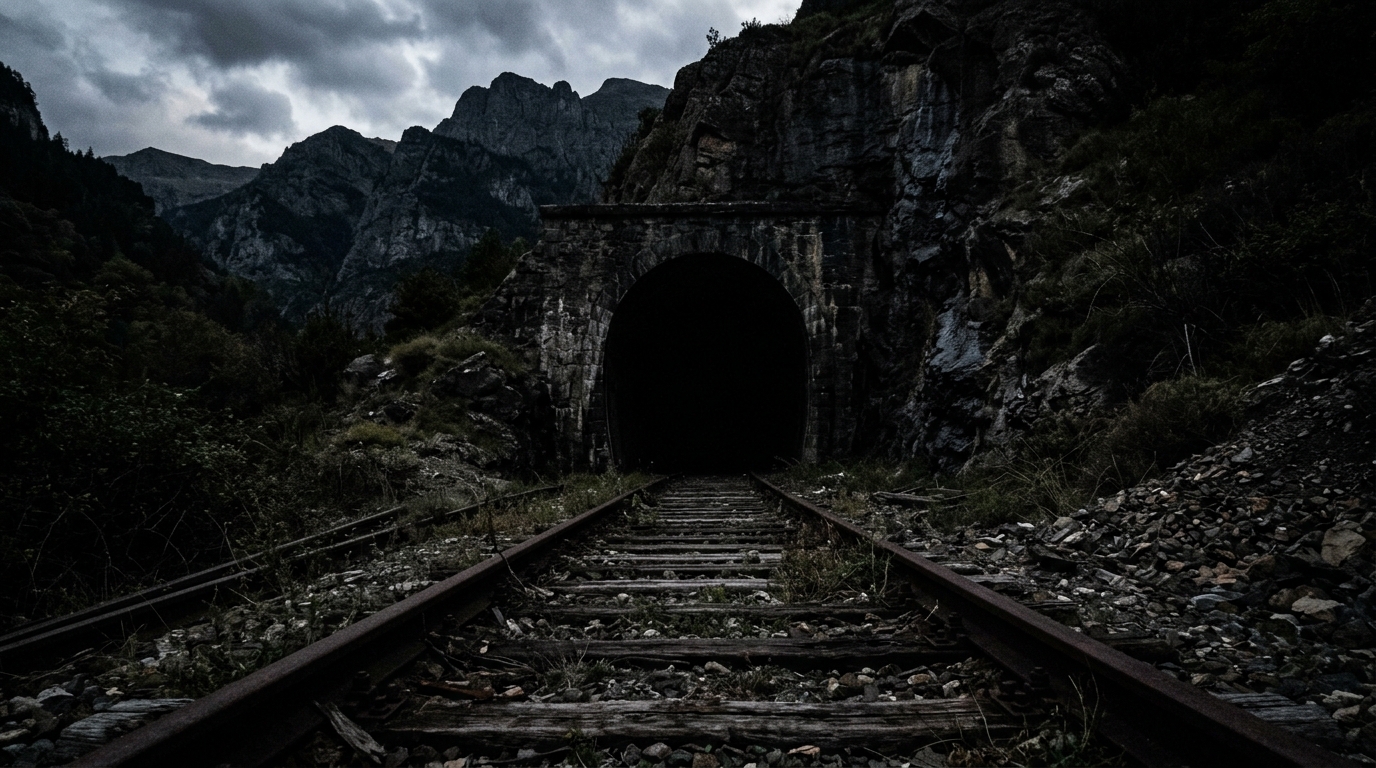
Imagine a brand-new highway carved through the mountains with billions spent, yet no car has traveled on it for years. This is somewhat the story of the Perpignan-Figueras high-speed line, an 8.3-kilometer tunnel drilled beneath the Pyrenees to connect France to Spain at full speed. A colossal project, designed as a showcase of European cooperation, which over the years has become an awkward symbol of financial waste. Even today, the infrastructure remains largely abandoned, while its history deserves to be told in detail to understand how such a project could derail.
- The Perpignan-Figueras TGV line, built for 1.1 billion euros, saw its concessionaire TP Ferro go bankrupt in 2016 due to insufficient traffic.
- The service collapsed after the dissolution of the SNCF-Renfe cooperation in December 2022, leaving only a Paris-Barcelona daily TGV.
- The failure can be explained by the absence of the New Montpellier-Perpignan Line, the lack of Franco-Spanish interoperability, and competition from low-cost air and road transport.
- A Billion Euros’ Worth of Rails Lie Dormant Beneath the Pyrenees
- The Night the Concessionaire Went Bankrupt
- Brand-new Tracks, Zero Passengers for Three Years
- Who Pays the Bill for This Rail Fiasco?
- Phantom TGV: The Symbol of a Public-Private Partnership That Derailed
A Billion Euros’ Worth of Rails Lie Dormant Beneath the Pyrenees
Everything began in February 2004, when the TP Ferro consortium, a joint venture between the French company Eiffage and the Spanish ACS, was chosen to build and operate this rail link for several decades. The aim was clear: pierce the natural barrier of the Pyrenees to provide a smooth rail continuity between France and Spain. The project resulted in a route of about 45 kilometers, including an impressive 8.3-kilometer tunnel, for a total cost of 1.1 billion euros. The line entered commercial service on December 19, 2010, with two daily TGVs capable of linking Paris to Figueras in just 5 hours and 27 minutes. On paper, everything seemed in place to make this infrastructure a sparkling success of European high-speed rail.
The Night the Concessionaire Went Bankrupt
But reality soon caught up with the optimistic forecasts. Studies projected 2.9 million travelers and as much freight at opening. Actual traffic proved far below these expectations, and by January 2013, TP Ferro plunged into serious financial difficulties. The company’s debt rose to 557.2 million euros, of which 391.5 million were owed directly to creditors. A final refinancing attempt was presented to the commercial court in June 2016, but it failed due to insufficient quorum at the creditors’ meeting held in September of the same year. The stake then fell: TP Ferro announced a restructuring plan that opened the way to its judicial liquidation and the termination of its concession contract. Anticipating this catastrophe scenario, France and Spain had prudently concluded, as early as May 2016, an international agreement designed to organize the takeover of operations in the event of concessionaire failure.
Brand-new Tracks, Zero Passengers for Three Years
Following the bankruptcy, a new bilateral entity bringing together SNCF Réseau and its Spanish counterpart ADIF takes over the line’s management. The French state then assures that cross-border traffic between the two countries will not be affected by this handover. Yet the offering continues to shrink over the years. In 2022, only three or four daily services remain between Perpignan and Figueras. Then, in December of that year, the dissolution of the historic Renfe-SNCF cooperation delivers the coup de grâce: several international links disappear outright, leaving only a single daily TGV between Paris and Barcelona. Since then, the kilometers of tracks laid beneath the mountain have hosted several trains each day, with traffic still below forecasts.
Who Pays the Bill for This Rail Fiasco?
The burning question is, of course, the bill. Behind this failure lies a familiar mechanism of public-private partnerships: when the private company collapses, the public sector ends up taking the baton, with its accompanying load of accumulated debts. Several structural factors explain this commercial failure. North of Perpignan, trains must still join the conventional network due to the unfinished New Montpellier-Perpignan Line, a project still in the public consultation stage and pushed to the 2034-2040 horizon. Intended from the start to be mixed-use—carrying both passengers and freight to relieve the A9 highway overwhelmed by heavy trucks—the line also suffers from a glaring lack of interoperability between the French and Spanish signalling systems. Not to mention the formidable competition from low-cost aviation and road transport, considerably more competitive in linking the Iberian Peninsula with the rest of Europe.
Phantom TGV: The Symbol of a Public-Private Partnership That Derailed
Fifteen years after its completion, this one‑billion‑euro tunnel hosts only a handful of TGVs and a few freight trains each day, with SNCF and Renfe now running their services separately. This fiasco tells, in subtext, the story of an industrial gamble that was too optimistic, where overestimated traffic forecasts clashed with underestimated technical constraints between two national rail systems that were never truly harmonized. The tunnel remains, vast and silent beneath the mountain, as a monument to the excesses of grand infrastructure projects when they fail to find their audience.
The question remains that goes beyond the Pyrenean scope: how many other infrastructures, built with billions and promises of European cooperation, will also sleep, having failed to anticipate the realities on the ground? The Perpignan-Figueras example invites broader reflection on how we plan and finance the major railway projects of tomorrow.
