
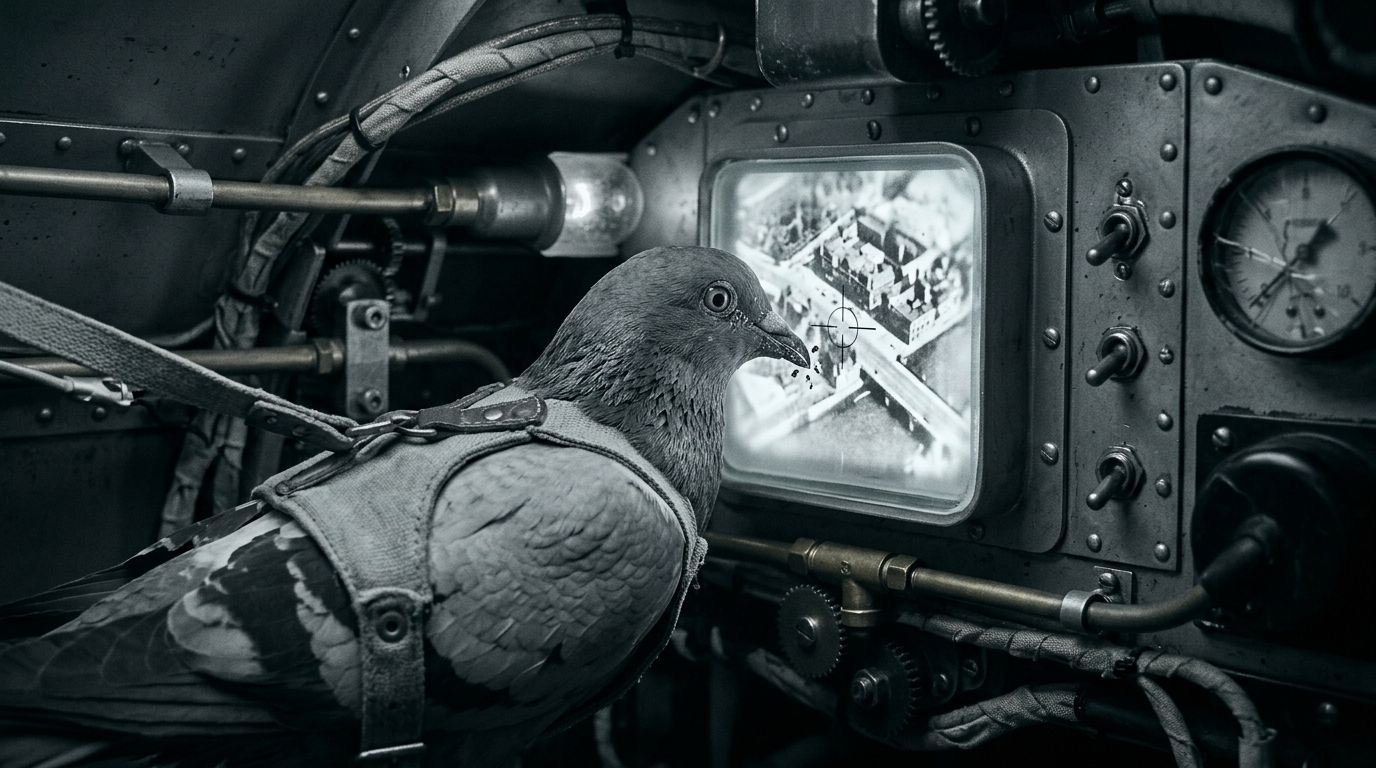
Imagine the scene for a moment: in the nose of an American missile hovering above the Atlantic, three pigeons frantically peck at a screen, each peck theoretically capable of deciding the fate of an enemy factory. It isn’t a far-fetched fable nor the plot of a B-movie, but a real military project funded by the U.S. Army during World War II. Its name: Project Pigeon. And its creator was none other than a psychologist destined for a legendary career, far from the battlefields. The story of this program, as improbable as it is scientifically rigorous, carries a twist few people anticipate: it wasn’t a technical failure or a budget issue that toppled these feathered bombers.
- The psychologist B.F. Skinner designed a system where three pigeons, trained by conditioning, guide a glide bomb by pecking at a target on a screen according to a majority vote.
- Tests proved technically conclusive, with the pigeons remaining effective despite noise, temperature, and altitude.
- On October 8, 1944, the project was canceled not for failure or cost, but due to concerns that it would delay other weapons deemed more priority for immediate use.
- When a psychologist promised to train pigeons for war
- In the nose of the bomb, three tiny brains piloted the precision
- The tests worked: so why this sudden rejection
- What the fate of Project Pigeon reveals about war and technology
When a psychologist promised to train pigeons for war
In the early 1940s, as the United States desperately sought ways to improve the accuracy of its bombing over Nazi Germany, a behaviorist psychologist, B.F. Skinner, proposed an idea that would today make any aeronautical engineer smile. A specialist in operant conditioning—the reward-based learning technique he himself had extensively theorized—Skinner was convinced it was possible to train pigeons to guide a glide bomb with unnerving reliability.
The National Defense Research Committee, the body responsible for overseeing American military innovations, was at best skeptical. The idea seemed eccentric, almost laughable in a context where work already advanced on cutting-edge technologies like radar. Yet, lacking a better immediate alternative and out of scientific curiosity, the committee agreed to allocate a modest $25,000 to fund Skinner’s research. A sum small by today’s standards, but enough to give this rather wild wager a real chance.
In the nose of the bomb, three tiny brains piloted the precision
The technical principle behind Project Pigeon was ingeniously aligned with the era. At the front of a glide bomb nicknamed Pelican, three lenses projected the image of the intended target onto a small transparent screen, mounted before three pigeons confined in a compartment. Trained beforehand by conditioning, the birds learned to peck precisely at the center of that image whenever they spotted the target.
But the clever trick lay somewhere else. Rather than centering the entire guidance system on a single animal, potentially fallible, Skinner established a genuine avian democracy. If two pigeons out of three, or even all three at once, pecked in the same direction, the majority signal won and adjusted the missile’s trajectory accordingly. This majority-vote system smooths out individual errors and markedly increases the reliability of the guidance, much like a jury that rules by multiple voices instead of letting a lone judge decide the verdict.
The tests worked: so why this sudden rejection
Here’s the twist that nobody truly expects: the tests conducted by Skinner and his team turned out exceptionally conclusive. Contrary to what one might assume, the pigeons were not disturbed by deafening noise, temperature variations, or even altitude. Their ability to identify a target and follow it with steady consistency impressed the observers. On a purely technical level, Skinner’s bet was won.
And yet, on October 8, 1944, the program was officially canceled. The military note justifying the decision did not cite a failure of the tests or a cost problem, but a more pragmatic argument: the fear that continuing this project would delay the development of other weapons deemed more promising for immediate battlefield use. In other words, it wasn’t that the pigeons didn’t work; it was that the armed forces had other urgent priorities to address during the global conflict.
Behind this official justification lay a subtler, almost psychological reality. The military leaders of the time simply struggled to take seriously a guidance system based on living birds. On the cusp of the atomic era, as the race of technology leaned toward electronic solutions like radar or radio, betting on pigeons to pilot bombs seemed almost incongruous, even though those nascent technologies were, at the time, less precise than Skinner’s envisioned approach.
What the fate of Project Pigeon reveals about war and technology
The story does not end there, however. In 1948, the United States Navy briefly revived the idea under a new name, Project Orcon, a contraction of Organic Control. This burst of interest did not last: by 1953, electronic guidance systems had progressed enough to demonstrate superior reliability, sealing the ultimate fate of pigeons in military use.
No pigeon would ever truly take part in a combat mission. But reducing this experiment to a mere historical curiosity would miss the point. Project Pigeon demonstrated, well before its time, that a human–animal–machine interface could operate with surprising precision. By teaching birds to visually recognize a target and respond accordingly, Skinner unknowingly foreshadowed the fundamental principles of what would, decades later, become computer vision and image-recognition systems.
Thus, this project stands as a striking example of how an idea, brilliant in its scientific scope, can collide with considerations unrelated to its actual effectiveness. Between military pragmatism and public perception, the fate of Project Pigeon shows how innovation does not always follow a purely rational logic. So how many other ideas deemed too eccentric for their era still lie dormant in the archives, waiting for a fresh perspective to restore their relevance?
