
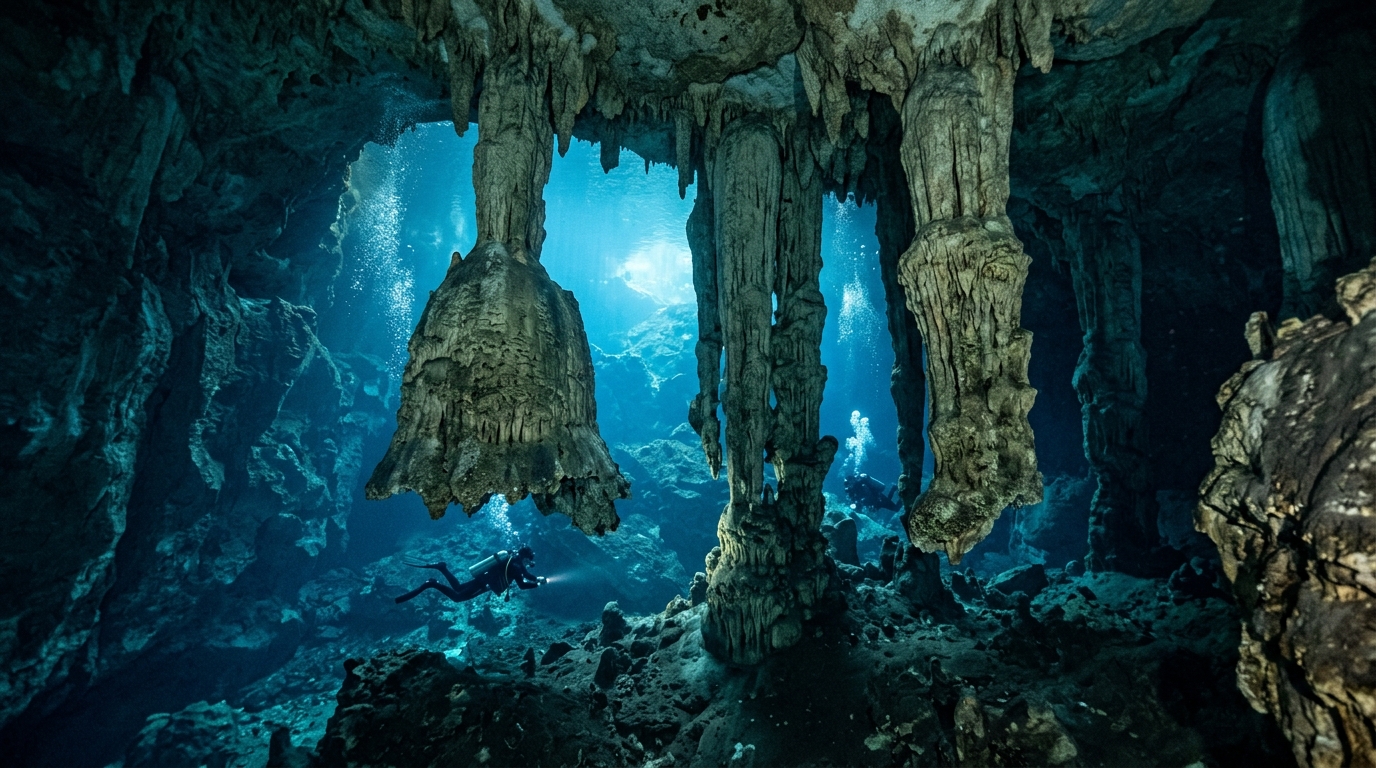
There are places on Earth where time does not flow as it does elsewhere, where matter shapes itself slowly, sheltered from any light and any gaze. Beneath 50 meters of water, at the bottom of the El Zapote cenote, calcite formations have been growing for 5,000 years without ever touching the open air. Unlike classic stalactites, they are neither elongated nor pointed: they resemble open bells, some exceeding 2 meters long. Divers gave them a striking name, echoing a famous AC/DC track: Hells Bells.
Stone bells born underwater, never in the air
The El Zapote cenote lies in the state of Quintana Roo, on the Yucatán Peninsula in Mexico. It is a water-filled sinkhole, 50 meters deep, whose cavity takes an unusually hourglass-shaped form. In classical limestone caves, water seeping from the surface drips away to shape stalactites: long, fine spires that descend from the ceiling, formed by contact with air. Here, none of that. The formations found at El Zapote grew entirely while submerged, in a cavity that has remained permanently underwater at the depth where they formed. Free air has thus never properly touched them.
- In the El Zapote cenote, calcite formations called Hells Bells have grown beneath 50 meters of water for 5,000 years, never having been exposed to open air.
- These open-bell-shaped structures, sometimes over 2 meters long, develop only at the boundary between fresh water and the halocline, a low-oxygen mixing zone where calcite can precipitate without dissolving.
- Their ring is never complete: an opening remains systematically oriented toward the cave walls, a sign of a precise growth mechanism tied to the chemical conditions of the environment.
- Stone bells born underwater, never in the air
- The ring that never fully closes
- An invisible boundary that carves the limestone
- Five thousand years of growth in absolute darkness
These structures cluster at mid-height of the cavity, in a narrow belt of about 6 meters, where they cover nearly the entire surface available. Their dimensions are impressive: some exceed 2 meters in length, with a width that can reach up to 1 meter, and walls as thick as 3 centimeters. They are far from a mere discreet deposit; they are genuine natural sculptures, as massive as they are enigmatic.
The ring that never fully closes
Their shape is what first catches the eye. Generally circular or elliptical, these calcite bells never form a complete circle: an opening corresponding to a quarter, or even a third of the ring, remains systematically present. And this detail is far from trivial: this gap always faces the cave walls, never toward the center of the cavity. A pattern like this, repeated across a very large number of formations, suggests a growth mechanism governed by the physico-chemical conditions of the environment rather than by chance.
Visually, the ensemble evokes lampshades hanging in the darkness, or a row of inverted bells waiting to be rung. Hence the nickname given by the divers who explored them, struck by this atmosphere that is at once mineral and almost eerie.
An invisible boundary that carves the limestone
To understand why these bells form precisely there and nowhere else, one must look at the structure of the water itself. The El Zapote cenote contains two distinct layers: salted water at depth and fresh water at the surface. Between them lies a mixing zone called the halocline, an invisible liquid boundary where the chemical properties change radically from one side to the other.
Now, it is precisely at the boundary between this halocline and the freshwater layer that the Hells Bells develop. In the saline layer, calcite dissolves rather than precipitating, which prevents any bell formation. The halocline is moreover characterized by being almost devoid of oxygen, unlike the overlying fresh water. This combination of chemical factors creates an extremely narrow deposition zone, a kind of corridor favorable for carbonate to accumulate year after year, millennium after millennium, without being dissolved or dispersed.
Five thousand years of growth in absolute darkness
Analyses conducted on these formations, notably radiometric dating, indicate that their growth began about 5,000 years ago. This figure is dizzying: for all that time, in total silence and darkness, beneath tens of meters of water, the carbonate has been deposited layer after layer, millimeter after millimeter, never disturbed by contact with air. Researchers favor an origin that is both biological and physico-chemical for these deposits, formed underwater and never exposed to the atmosphere.
What makes these bells fascinating, beyond their spectacular appearance, is that they tell a story of geological patience almost inconceivable at human scales. While entire civilizations rose and fell above ground, these structures continued, unfazed, their slow growth in the dark, guided by an invisible chemical boundary deep within the cenote.
The El Zapote cenote thus reminds us that some of the planet’s strangest landscapes are not found in the open sky, but tucked beneath layers of water that few human eyes have had the chance to explore. How many other such singular formations still await discovery, somewhere beneath the surface?
