
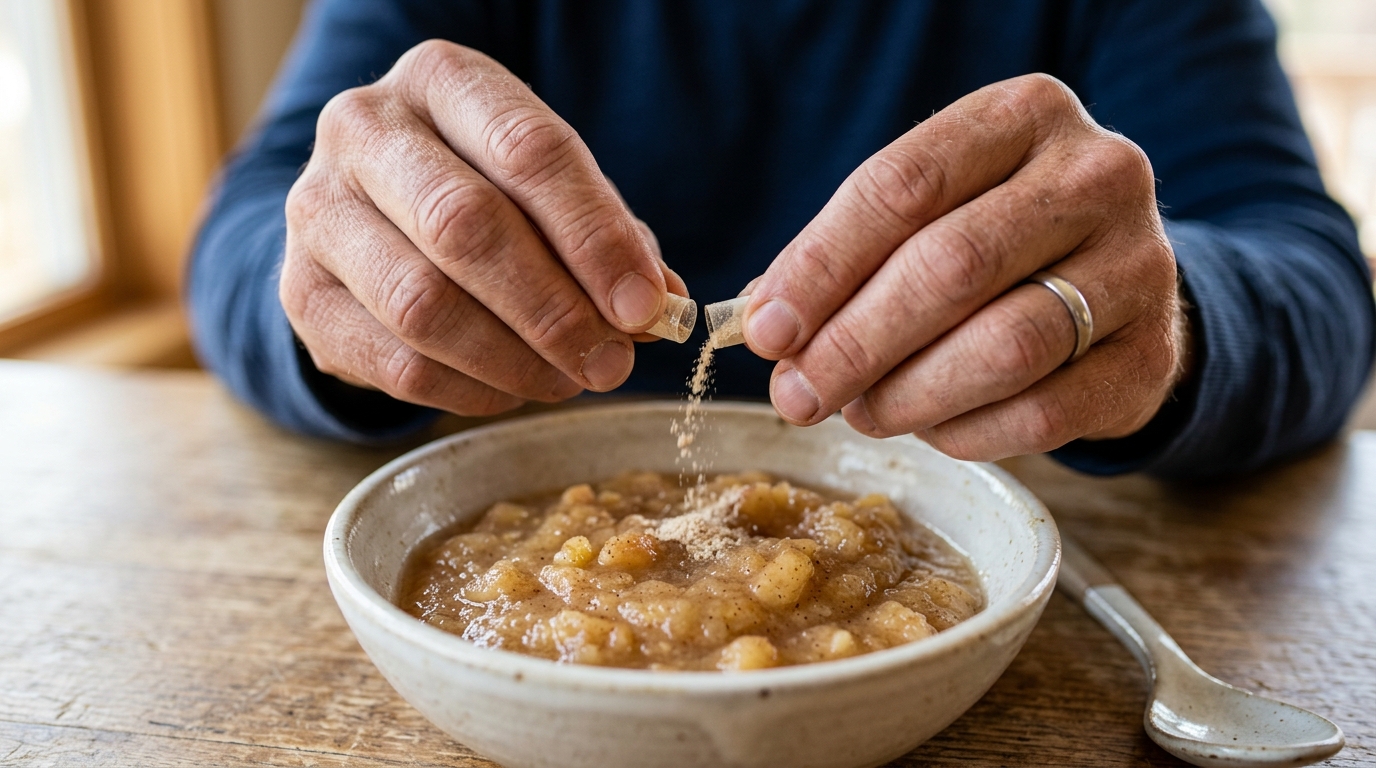
Every morning, the same routine settles in the kitchen: an opened capsule, its contents poured gently over an apple sauce, then the spoon extended with patience. This gesture, thousands of caregivers repeat daily, convinced they are helping. After all, swallowing a tablet when one is elderly and has swallowing difficulties can sometimes feel like a battle. Yet, behind this seemingly harmless habit lies a reality few families suspect: mixing a medicine with food can literally change how the body absorbs it, for better or for worse.
- More than 40% of elderly people suffer from swallowing disorders, which often pushes caregivers to crush tablets or open capsules without medical advice
- A study from Rouen University Hospital (CHU) reveals that 42% of crushed medicines should never have been crushed, as their formulation does not permit it
- Before any manipulation, always consult the pharmacist to verify compatibility with the chosen food and consider an alternative pharmaceutical form
- When good intentions become an invisible trap
- Why some capsules cannot tolerate any opening
- Apple sauce is not always an ally: what safe alternatives reveal
When good intentions become an invisible trap
The finding is striking: more than 40% of elderly people suffer from swallowing disorders, which naturally pushes caregivers to seek practical solutions. Crushing a tablet or opening a capsule may then seem straightforward. But this manipulation actually alters the dosage form of the medicine, that is, its design to act at a precise moment and at a precise location in the body. A study conducted at Rouen University Hospital has indeed revealed that 42% of crushed medicines should never have been crushed, their formulation simply does not permit it. A figure that is dizzying when you know how widespread this practice is, often without prior medical validation.
Why some capsules cannot tolerate any opening
Some medicines are designed as true chemical safes. Gastro-resistant tablets, like Depakine, are coated to protect the active ingredient from the acidic juices of the stomach, in a manner similar to omeprazole. Breaking them destroys this protection, exposing the medicine to premature degradation or, on the contrary, to too rapid release. The same logic applies to extended-release tablets like Topalgic, whose effect is specifically designed to unfold over time. Opening or crushing these forms risks a brutal overdose or a total loss of efficacy. And this risk does not concern only a few molecules: all pharmacological classes can be affected, which makes vigilance essential, whatever the treatment in question.
Apple sauce is not always an ally: what safe alternatives reveal
Faced with this reality, a question arises: how can we help a loved one swallow their medicine without putting their health at risk? The answer never lies in improvised methods, but in systematically consulting the pharmacist before any manipulation. This professional is best placed to understand the specifics of each dosage form and to indicate whether a tablet can be crushed or a capsule opened, including its compatibility with the chosen food. Because aging is usually accompanied by changes in the functioning of the organs responsible for the absorption and elimination of medicines, which may require adjusting the dosage rather than tinkering with the treatment’s form. Here are the essential reflexes to adopt before any modification:
- Always seek the pharmacist’s advice before crushing or opening a medication
- Check the compatibility between the medication and the food used for mixing
- Explore the existence of a more suitable dosage form, such as a syrup or a drinkable solution
- Never modify a treatment without prior medical validation
In some cases, the medicine simply does not exist in a form that is easier to swallow, which complicates things for patients with impaired consciousness or psychiatric disorders. It is precisely in these delicate situations that dialogue with the care team takes on its full meaning, to find a tailored solution rather than a kitchen trick improvised on the fly.
What this story reveals is that vigilance does not stop at taking the medication: it begins with its preparation. Before crushing a tablet or opening a capsule to facilitate a loved one’s intake, it is best to systematically consult the pharmacist, verify compatibility with the chosen food, and explore available alternative dosage forms. A simple question, asked in time, can prevent a serious accident.
