
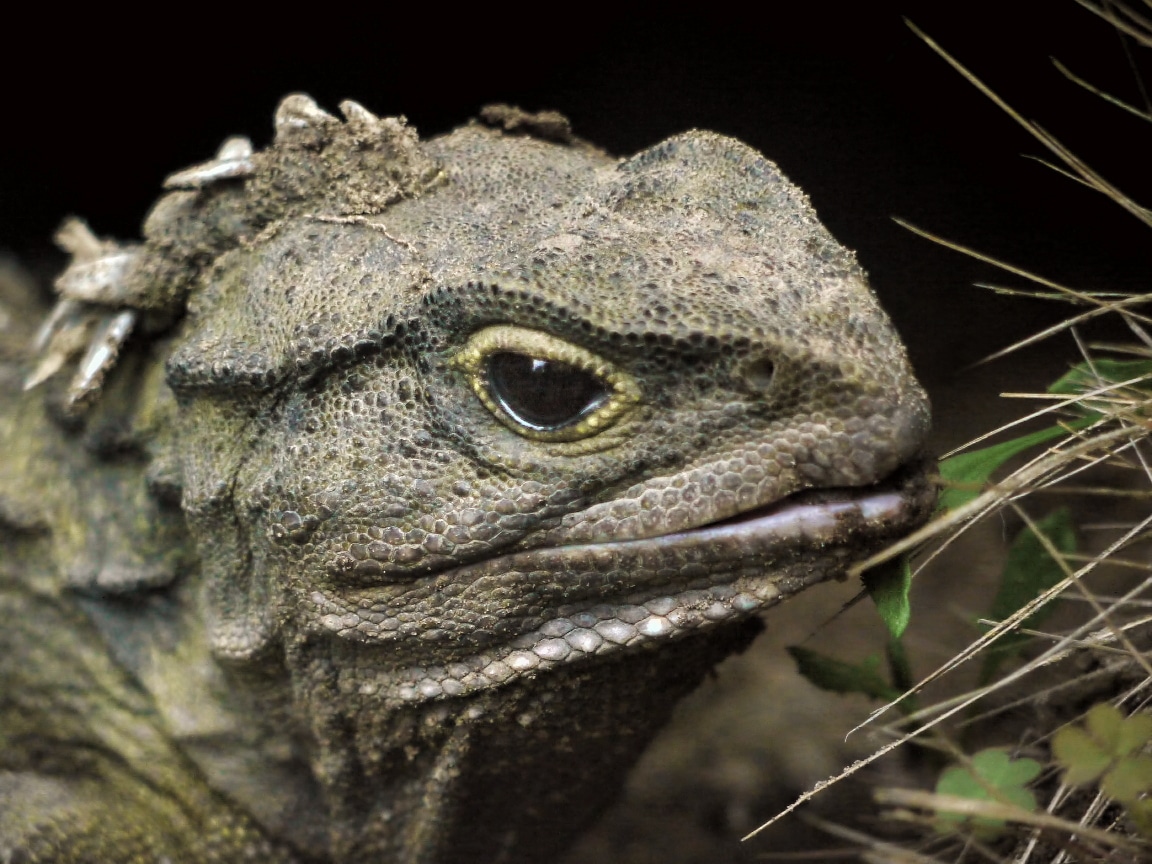
In 2009, a 111-year-old tuatara became a father for the first time — after a tumor that suppressed his libido was removed. Henry’s story is sensational, but it is above all the animal itself that is extraordinary: an evolutionary survivor 250 million years old, lacking a penis, with a third eye, and potentially still capable of beating a record.
What you will learn
- Why tuataras are not lizards — and how far apart they are evolutionarily
- What makes their reproduction unique among reptiles
- How Henry, this “old grump,” became a father at 111 after a life-saving operation
Henry, the oldest father in recent animal history
Henry had been living in isolation at the Te Unua Museum in Southland, New Zealand since 1970, famed for his aggressive temperament. When staff introduced a female named Mildred to him, he twice ripped off part of her tail. Not exactly the ideal romantic start.
Everything changed when veterinarians discovered a malignant tumor near his reproductive organs. Its removal miraculously restored his libido. The mating with Mildred — who was over 70 at the time — produced 12 eggs, 11 of which hatched successfully in 2009. Henry was 111 years old at the time.
The story traveled the world, drawing international attention and earning him a meeting with Prince Harry in 2015, as well as a role in the award-winning documentary “Love in Cold Blood.” Henry now lives peacefully at the Queens Park Wildlife Reserve in Invercargill, alongside Mildred and another companion, Lucy, aged about 70.
Not a lizard — and that’s very important
Tuatara resemble lizards, but they are not. They are the only survivors of an ancient reptile order called Rhynchocephalia, which split from the ancestors of lizards and snakes about 250 million years ago. To give a sense of this evolutionary gulf: humans are genetically closer to kangaroos than tuataras are to lizards.
They can live up to 137 years, making them one of the longest-lived reptiles in the world. They evolved in isolation in New Zealand after the disappearance of their kin elsewhere on the planet — an island known for its distinctive manifestations of natural selection.
A biology decidedly out of the ordinary
Male tuataras lack a penis — one of the rarest cases among reptiles. During mating, the two partners simply rub their cloacal openings and exchange their sperm via a cloacal kiss, similar to how most birds mate.
To compensate for the imprecision of this method, the male’s sperm are the fastest of all studied reptiles and three times longer than human sperm.
They also possess a “third eye” on the skull — the parietal eye — equipped with a rudimentary lens, a retina, and neural connections. It only perceives light variations, without forming full images, but its exact function remains debated.
