
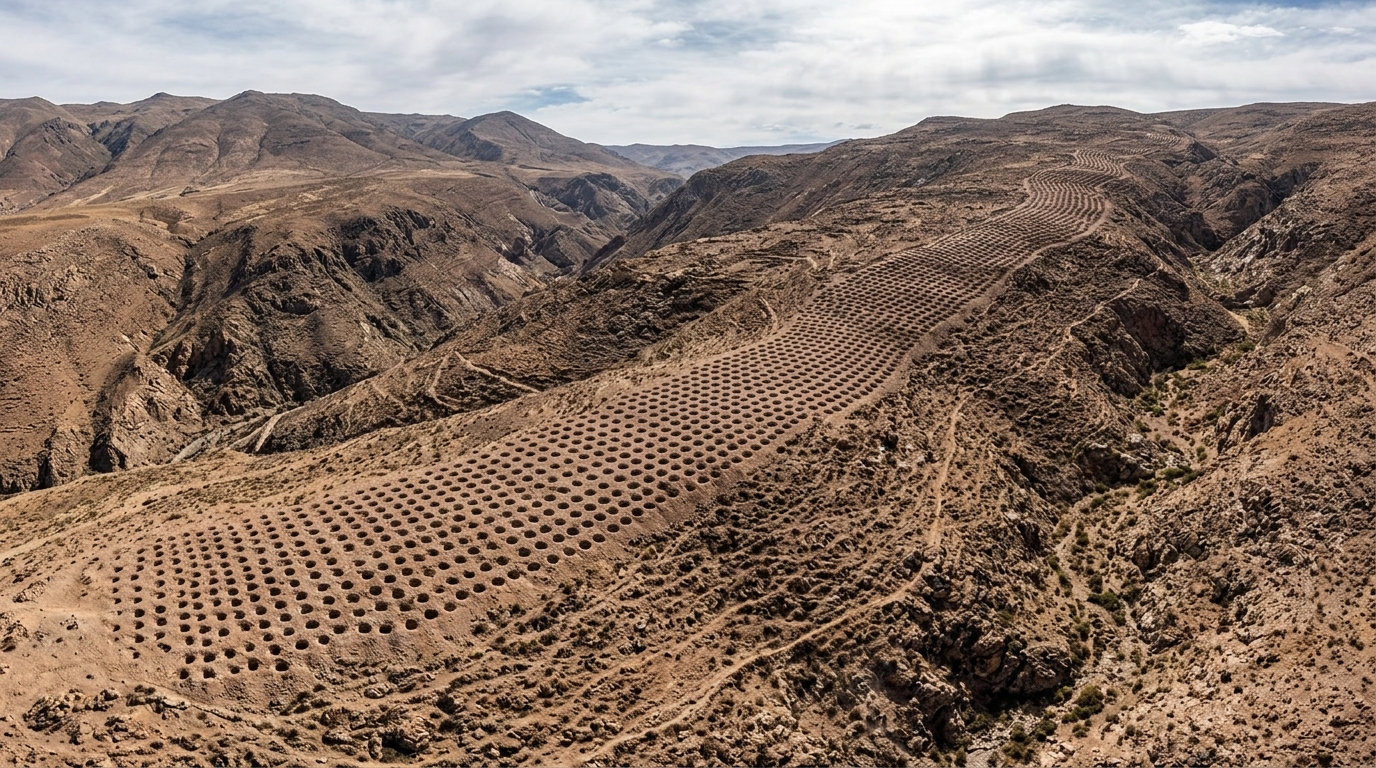
Imagine a windswept desert hill in Peru, where someone once decided to dig nearly six thousand holes side by side, with an almost obsessive precision. Not a handful of isolated pits, not a construction site abandoned along the way, but a methodical row stretching for more than a kilometer. This place indeed exists, in the Pisco valley, and it bears a name that is both simple and enigmatic: the Band of Holes. For nearly a century, this site has fascinated as much as it has baffled specialists, because no one has ever managed to explain with certainty what its purpose could have been.
- The Band of Holes extends roughly 1,500 meters and comprises between 5,000 and 6,000 depressions arranged in distinct blocks.
- No excavations have yielded bones, so the funerary hypothesis has been set aside in favor of an Inca dating, around the 15th century, linked to the proximity of Tambo Colorado.
- Researchers favor the hypothesis of an administrative use, such as grain storage or counting tributes by ayllu, though there is no definitive consensus among experts.
- Five thousand holes carved into the hillside, and no one to explain why
- Empty tombs that never yielded a single bone
- An Inca tax counted hole by hole rather than in coins
- A disagreement among experts that leaves the mystery intact
Five thousand holes dug into the hillside, and no one to explain why
Credit: © DR
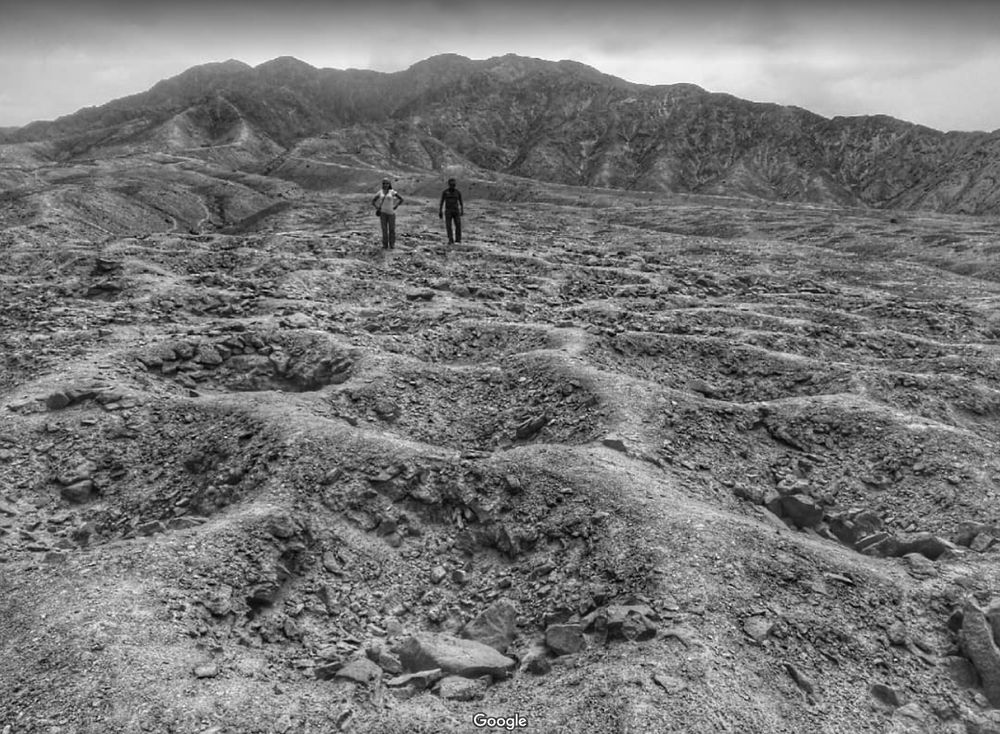
Known locally as Monte Sierpe or Cerro Viruela, this archaeological site presents itself as a narrow strip about 14 to 20 meters wide that climbs a hillside for nearly 1,500 meters. Along its length lie shallow pits, each roughly one meter in diameter and a depth ranging from 50 to 100 centimeters. Some were dug directly into piles of earth, while others were formed from rock outcrops that protrude at the surface.
What is most striking is the site’s organization. It isn’t a chaotic collection of cavities but a structure split into several distinct groups, which researchers refer to as blocs. Each bloc exhibits a hole pattern unique to it, as if different teams, or different communities, had each affixed their own signature to the landscape. It is this unsettling regularity, almost architectural, that initially captivated observers who viewed it from above.
Empty tombs that never yielded a single bone
The modern history of the site begins in the 1930s, when aviator Robert Shippee published an aerial photograph in National Geographic. Seen from the ground, the band of holes is nearly invisible in the vast Peruvian expanse; seen from above, it becomes a striking, almost hypnotic motif that immediately draws the attention of scientists and the public.
In 1953, explorer Victor Wolfgang von Hagen examined the mystery and estimated that about 5,000 depressions make up the alignment. Struck by their regular shape, he called them “tombs,” imagining an immense open-air cemetery. Yet the funerary hypothesis quickly hit a major obstacle: no excavations at the site have ever uncovered any bones or typical grave goods. One thing seems clear: these holes, however numerous and methodical, were never used to bury anyone.
It wasn’t until 2015 that technology refined our understanding of the scale of the site. A team from the University of California mapped the area with a drone and revised the estimate upward, placing the total at between 5,000 and 6,000 depressions. A figure that inspires awe when you imagine the human labor required to dig that many cavities, one by one, on such a long slope.
An Inca tax counted hole by hole rather than in coins
If the holes do not contain the dead, what could they have held, or represented? Several contextual elements help illuminate this question. The immediate proximity of an ancient Inca road, of colcas (the granaries typical of Inca administration), and pottery dating from the same era strongly point to a dating around the 15th century, i.e., after the Chincha region was conquered by the Incas.
The site sits merely four miles from Tambo Colorado, a major Inca administrative center of that period. This proximity is meaningful: it places the Band of Holes at the heart of the imperial empire’s management and oversight system in the region. In 1984, archaeologist John Hyslop had already suggested that these circular structures could have served as storage, as observed at other sites like Quebrada de la Vaca and Tambo Colorado.
Another theory championed by Andean-civilizations expert Charles Stanish goes even further. According to this view, the holes were used to measure agricultural tributes owed to Inca rulers: each pit could be filled with a precise quantity of grain or goods, allowing a visual tally of what each family group, or ayllu, owed to imperial administration. In this scenario, each block of holes would correspond to a different ayllu, which would explain why patterns vary from one group to another. A kind of open-air ledger, where the tax was counted not in coins but in filled holes.
A disagreement among experts that leaves the mystery intact
Charismatic on paper, the agricultural-tribute hypothesis does not win universal acceptance. Jean-Pierre Protzen, a renowned expert in Inca architecture, expresses disagreement with this theory. While he does not detail his precise objections here, that simple disagreement among specialists underscores a fundamental truth: despite decades of observation, flyovers, and measurements, the Band of Holes still has not yielded all of its secrets.
Perhaps this is precisely what makes the site so captivating. It is not a myth-encrusted riddle, but a genuine archaeological puzzle grounded in verifiable facts: a patch of earth, thousands of holes, a dating that points to the Inca Empire, and yet no definitive certainty about their exact function.
Between the open-air granary hypothesis, the grand-scale tax registry idea, and the doubts voiced by certain experts, the Band of Holes remains one of the most intriguing relics of the Pisco valley. A colossal, hand-dug undertaking from centuries past, whose true purpose continues to elude researchers. And perhaps, ultimately, the beauty of this site lies precisely in that element of mystery that resists every explanation?
