
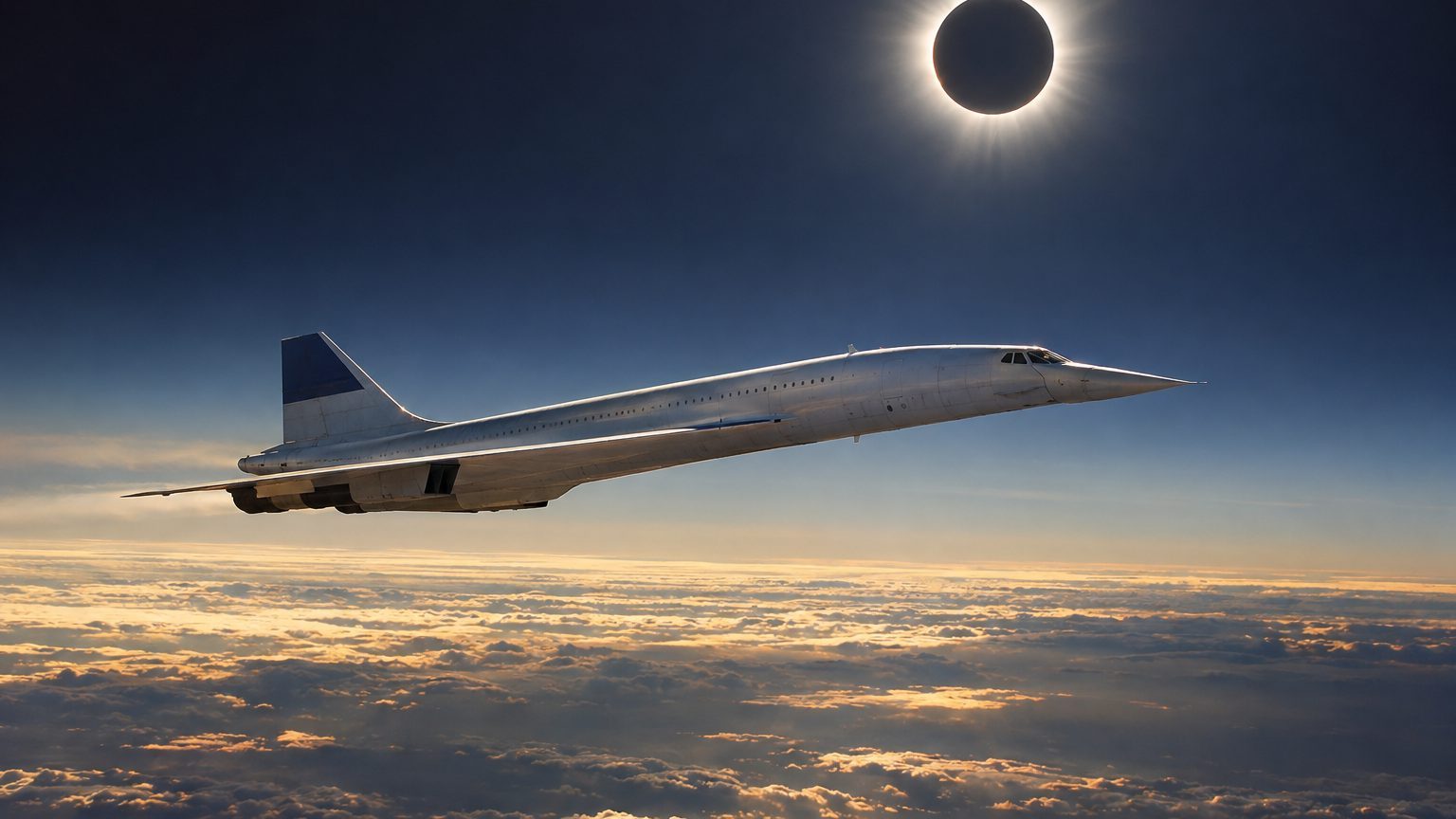
While streaking at Mach 2 on June 30, 1973, Concorde 001 literally stretched a total solar eclipse far beyond the seven minutes that ground observers could offer at best. The numerous astronomers deployed on the ground watched it for six minutes, long enough to boil a soft-boiled egg. Aboard the prototype, totality lasted 74 minutes.
That is nearly ten times longer than what a stationary observer can obtain.
Everything rests on a matching of speeds. The Moon’s shadow moved at more than 2,000 km/h, i.e., more than 550 meters every second. Concorde 001 took off from Las Palmas, in the Canary Islands, and caught up with it over Mauritania, at Mach 2.08 according to the text by Pierre Léna associated with the Musée de l’Air et de l’Espace. From an altitude of 17,000 m, the crew only had to stay inside the shadow cone as Africa streamed beneath.
- Concorde 001 observed a total solar eclipse for 74 minutes, ten times longer than from the ground.
- The aircraft flew at Mach 2.08 to stay in the Moon’s shadow moving at over 2,000 km/h.
- Fourteen people boarded, including six crew members and eight researchers from France, Britain and the United States.
A Lunch in Toulouse, a Prototype outfitted with Skylights
The story begins in May 1972, over a lunch in a restaurant at Toulouse airport. Pierre Léna, an astronomer at the Paris Observatory, proposed to the test pilot André Turcat that the 1973 eclipse be observed from an aircraft.
The green light was not immediate. In the autumn of 1972, Léna learned that his team and Turcat’s could begin work, though no firm decision would be taken before February 1973. The British astrophysicist John Beckman had, for his part, been turned down for using the 002 prototype for the same purpose. On February 2, the announcement came: the flight would take place.
Concorde 001 was then modified, with skylights in the roof and observation instruments. A final test flight was conducted in Toulouse on June 27, three days before the eclipse. The initial footage preserved by the INA shows a prototype prepared as a flying laboratory.
Fourteen People, Eight Researchers, Five Experiments
Fourteen people boarded that day.
Six formed the crew: André Turcat, chief pilot; Jean Dabos, co-pilot; Henri Perrier, chief engineer; Jean Conche, engineer; Hubert Guyonnet, radionavigator; and Michel Rétif, test technician. The other eight were researchers. From France, Britain and the United States, invited by the CNRS, they ran five experiments and studied the solar corona at different wavelengths. Their laboratories ranged from Los Alamos to the Paris Observatory, via Kitt Peak, Queen Mary in London and Aberdeen.
What These 74 Minutes Yielded
Thanks to this duration, the scientific programs were deemed successful by Léna, and the aircraft landed in Fort-Lamy, today N’Djamena, in Chad. A tally that the astronomer, a key participant in the project, naturally defended.
The footage recorded aboard was broadcast on the 8 p.m. news.
Historians’ retrospective is more measured. According to Wikipedia, the five experiments had limited scientific impact. The achievement, however, remains indisputable: 74 minutes of totality, the longest total eclipse observation ever conducted.
Concorde 001 is today on display at the Musée de l’Air et de l’Espace, wearing the eclipse mission livery. Commercial flights by Air France and British Airways did not begin until January 21, 1976, two and a half years after this test flight.
Sources: ina.fr | blogs.futura-sciences.com
