
A child who constantly complains of stomach pains, who runs to the bathroom between two activities, or who refuses to finish their plate: in many families affected by ADHD, the reflex is almost automatic. People blame the treatment, suspect a poorly tolerated food, adjust meals. Yet an analysis covering nearly two million medical records from over twenty studies conducted worldwide challenges these assumptions. It suggests that these digestive troubles are not merely side effects or dietary whims, but indeed a distinct component of the neurodevelopmental disorder itself.
- A meta-analysis spanning nearly 2 million records shows that ADHD is associated with a 48% increase in gastrointestinal symptoms, with peaks for constipation (+97%), diarrhea (+118%), and especially encopresis (+332%).
- These digestive issues would be an intrinsic component of ADHD rather than a simple side effect of medications or diet, implicating notably the vagus nerve and the gut microbiome.
- Care providers are urged to systematically inquire about digestive symptoms in ADHD patients, though the question of causality between the two conditions remains to be clarified.
- ADHD Does Not Stop at the Head; It Reaches the Gut
- Constipation, Diarrhea, Pain: The Body Speaks Louder Than the Diagnosis
- Why the Gut and the Brain Share the Same Nervous System
- What These Figures Change for Families and Caregivers
ADHD Does Not Stop at the Head; It Reaches the Gut
Attention-deficit/hyperactivity disorder, better known by its acronym ADHD, would affect around 5% of children and up to 4% of adults worldwide. Difficulties with focus, impulsivity, motor restlessness: the most obvious symptoms have traditionally been studied in relation to the brain and behavior. Yet for four decades, diagnostic rates have risen, and with them, researchers’ curiosity about how this condition might impact other parts of the body in less obvious ways.
Against this backdrop, a large data synthesis explored a terrain still relatively uncovered: the links between ADHD and gastrointestinal symptoms. By pooling samples ranging from fifty individuals to nearly seven hundred fifty thousand participants, the study revealed a clear and hard-to-ignore trend: the gut in people affected appears to bear the marks of the condition as well.
Constipation, Diarrhea, Pain: The Body Speaks Louder Than the Diagnosis
The figures are staggering. Overall, ADHD is associated with a 48% increased likelihood of experiencing gastrointestinal symptoms compared with the neurotypical population. The specifics are equally telling: dyspepsia, the familiar indigestion, rises by 52%, while irritable bowel syndrome climbs by 58%.
Some findings are even more striking. Abdominal pain increases by 88%, constipation nearly doubles with a 97% rise, and diarrhea surpasses that threshold with a 118% increase. The most pronounced disorder remains encopresis, the loss of bowel control, whose prevalence jumps by 332%—more than four times higher than in neurotypical individuals. For unclassified digestive troubles, often labeled as mysterious due to a lack of precise diagnosis, the rate climbs by 82%. In other words, almost no intestinal symptom studied escapes this ADHD association.
Why the Gut and the Brain Share the Same Nervous System
How can there be such a strong echo between head and gut? Several explanations emerge, none of them alone sufficient. First, certain ADHD traits, such as heightened stress reactivity, could render the digestive system more sensitive. Then, impulsive eating behaviors and irregular mealtimes—common among those affected—are independently linked to dyspepsia, bloating, and constipation.
Another hypothesis concerns the gut microbiome. Impulsivity could drive imbalanced dietary choices, high in sugary drinks and low in fiber, while fiber nourishes beneficial gut bacteria. Food sensory differences can also reduce the variety of accepted foods, disturbing transit and promoting constipation. Added to this are the possible effects of certain medications and sleep disorders, which can influence gut motility and immune responses.
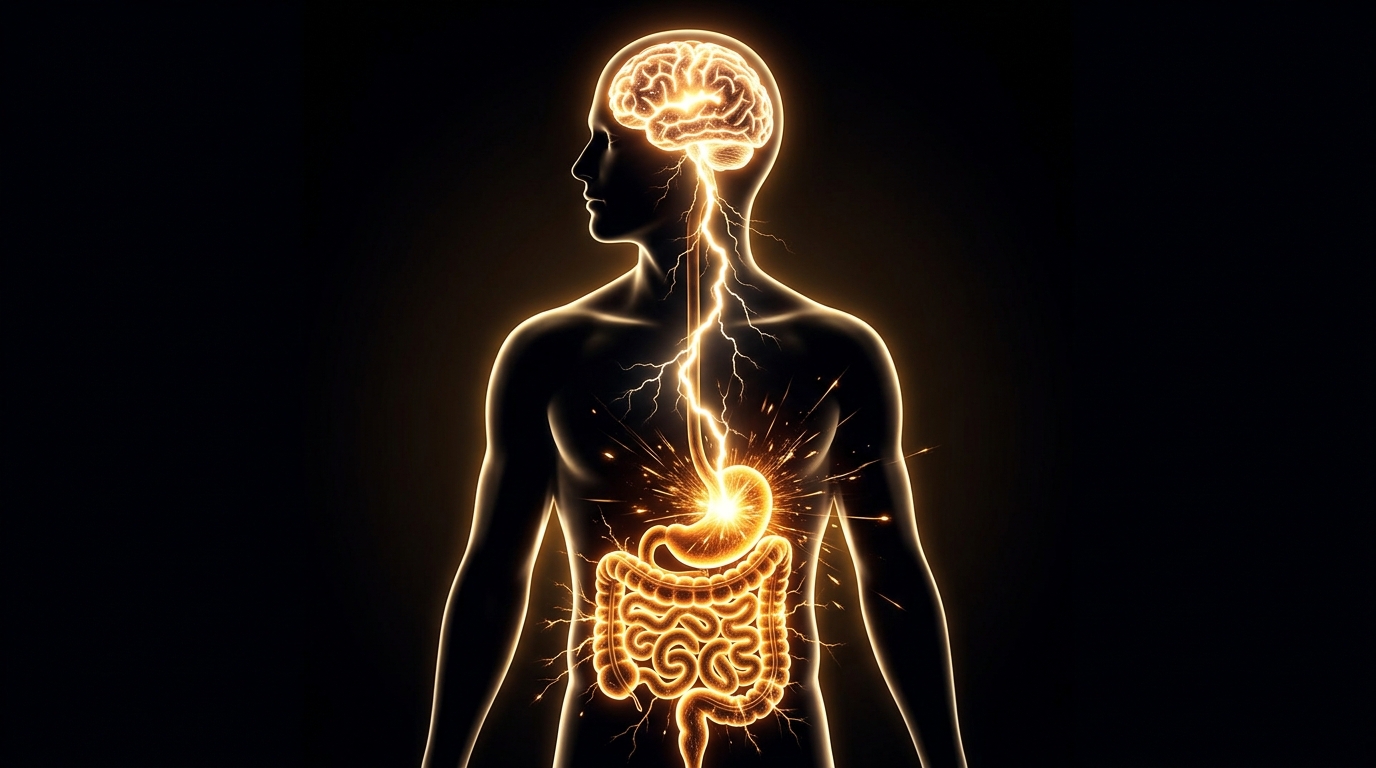
At the heart of this dialogue between brain and gut lies the vagus nerve, the longest cranial nerve in the human body, often described as a highway of electrical communication linking the two organs in both directions. Its activity is directly influenced by chemicals produced by gut bacteria, and in turn it modulates intestinal inflammation. A dysbiosis, i.e., an imbalance of the gut flora, could sustain chronic inflammation and feed the gastrointestinal symptoms observed in ADHD. Other neurodevelopmental disorders seem to follow a similar pattern, reinforcing the idea that the gut–brain axis, still largely enigmatic, plays a central role in these mechanisms.
What These Figures Change for Families and Caregivers
For families living daily with an affected child, these results provide valuable insight. Rather than automatically seeking an external culprit, a poorly tolerated medication, or a suspect food, it becomes reasonable to consider digestive problems as a potential component of ADHD itself. That does not mean diet or treatments have no influence, but that the overall picture is more complex than a simple isolated side effect.
For clinicians, the challenge is clear: systematically ask ADHD patients about any intestinal symptoms so that these problems, sometimes subtle but truly impactful on quality of life, do not go unnoticed behind the primary diagnosis. One question remains unsettled: what is the direction of causality? Do gastrointestinal issues precede ADHD, accompany it from its onset, or arise in response to its development and management? A chicken-and-egg mystery that future work will need to untangle, particularly by more finely examining variations in the gut microbiome.
In sum, these two million medical records tell a story of ADHD that invites a different perspective: not merely a brain-bound disorder, but a condition that traverses the body, reaching even the most discreet organs. Could the next step be to integrate digestive health systematically into the management of this condition, alongside attention and behavior?
