
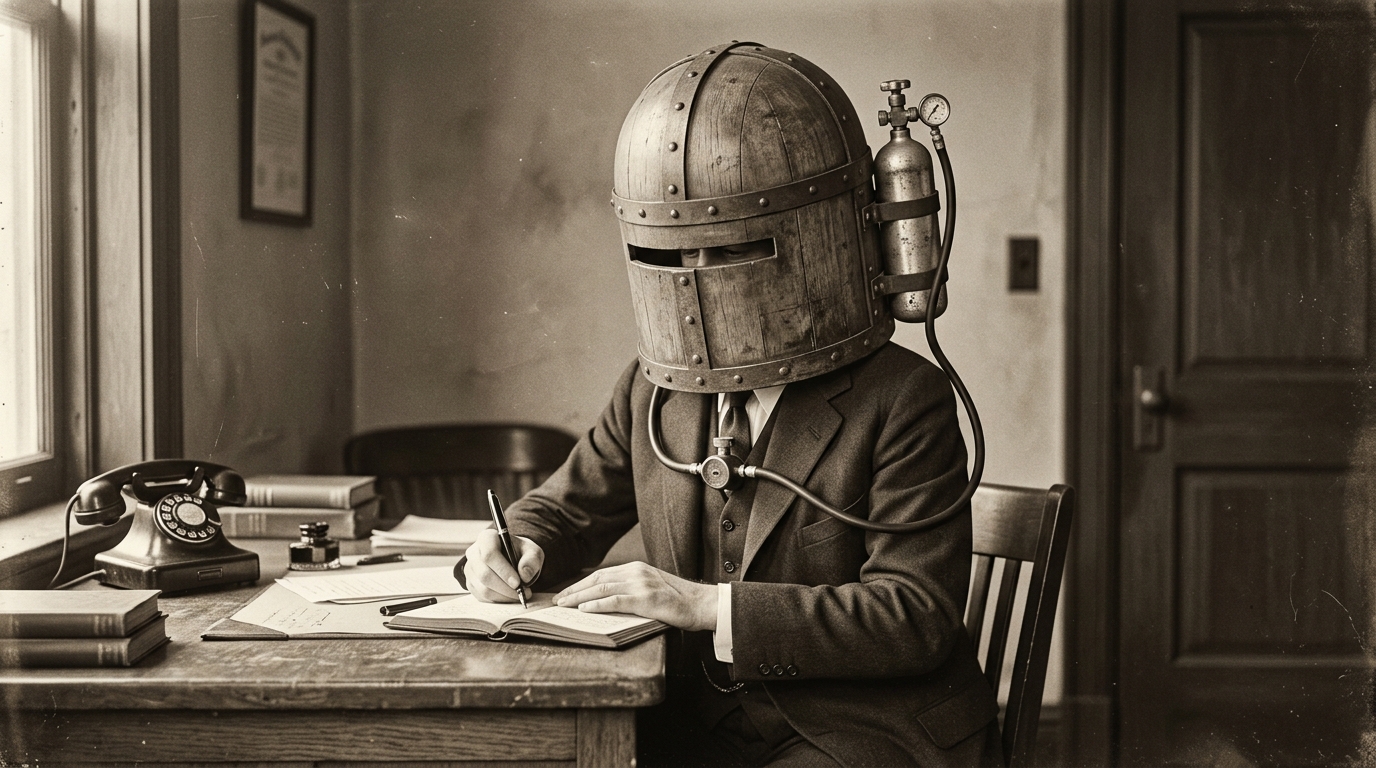
A crucial clarification before diving into this story: no, the anti-noise helmet wasn’t invented to rescue workers from the din of open-plan offices. This widely held belief deserves correction, because the true origin of portable silence goes back long before the era of landscaped sets and shared desks. In this autumn when old forgotten inventions are gladly rediscovered, it is time to dive again into a tale as strange as it is fascinating: a New York inventor who, in 1925, conceived a solution so radical that it would make any modern designer crack a smile.
- In 1925, Hugo Gernsback invents the Isolator, a wooden, cork and felt helmet designed to block 95% of external sounds and to sever the wearer from the outside world.
- The device narrowed the wearer’s vision to a fine horizontal slit and incorporated a breathing system, but its actual effectiveness was only 75% according to Gernsback himself.
- Some users fell asleep from the lack of oxygen, prompting the addition of an oxygen reservoir to the apparatus.
- We thought noise-cancelling headsets were invented for the open-office generation: the story tells a different tale
- The lingering decades-old error about the origin of silence at work
- New York, 1925: an overlooked inventor imagines a solution more radical than any modern headset
- How this device actually worked, the thing no one expected for its time
- From this little-known invention to today’s headsets: what history preserved and what it lost
We Thought Noise-Canceling Headphones Were Invented for the Open-Office Era: The Story Tells a Different Tale
It’s hard not to associate the anti-noise headset with contemporary open offices, those vast floors where conversations, phone calls, and the clatter of keyboards mingle into a perpetual cacophony. One naturally imagines that this accessory arose from the modern need to isolate oneself in a professional world that is increasingly loud. Yet, this version of events conceals a much older and far more surprising reality.
Long before companies knocked down partitions to foster collaboration, a man had already tackled the problem of concentration with methods that today read like they came straight from a science-fiction novel. And that is precisely where the intrigue of this little-known story lies.
The Misconception That Has Lingered for Decades About the Origin of Silence at Work
The received idea that the need for quiet at the desk is a recent phenomenon deserves nuance. In truth, the pursuit of a distraction-free work environment is nearly as old as intellectual labor itself. From the early 20th century onward, certain inventors were already seeking ways to cut off external stimuli to foster concentration.
This historical shortcut, which ties anti-noise to the rise of open-plan offices in the 2000s, completely overlooks a well-documented invention that appeared on the cover of a popular magazine of the era. This often-forgotten detail reshapes the entire perspective on the history of portable silence.
New York, 1925: An Overlooked Inventor Conceives a Solution More Radical than Any Modern Headset
It is in New York, in 1925, that the tale begins to unfold. The inventor Hugo Gernsback, editor of the magazine Science and Invention, showcases on the July cover a creation he dubs the Isolator. His stated aim is simple on paper, yet radical in practice: to eliminate all external distractions to enable the utmost concentration.
Gernsback is not an anonymous inventor. Sometimes referred to as the father of science fiction, he is also a writer, editor and publisher of magazines, including the first one devoted exclusively to the genre. His legacy endures today: the annual awards given at the World Science Fiction Convention, the famed Hugos, remain a cornerstone in contemporary geek culture.
But back to the Isolator. Far from a simple foam headset resting on the ears, the object more closely resembles a deskbound spacesuit. Gernsback’s ambition was grand: this wasn’t merely about muffling noise, but about severing the user from the outside world in its entirety.
How This Device Actually Worked, the Thing No One Expected for Its Time
The Isolator’s mechanism reads almost like a domestic science experiment. The headset was initially crafted from wood and felt, before evolving into a structure of solid wood, lined with cork and covered in felt—three materials chosen for their insulating properties. According to Gernsback, the device could block up to 95% of exterior sounds, an impressive figure that has echoed through decades in numerous narratives about this invention.
Three small glass panes were integrated at eye level, but they were painted black, save for a fine line where the paint had been scraped away. The result: the user could perceive only a narrow horizontal slit, just enough to read a sheet of paper placed in front of them. The field of vision was thus reduced to its strict minimum, a radical method to eliminate any temptation to look elsewhere. A breathing apparatus was also built into the mouth area to allow air passage while further dampening ambient noise.
Yet the story takes a nearly comic turn when the rest is revealed. Gernsback himself acknowledged that his invention was effective only at 75%, because solid wood could not block all external sounds. Worse still, some users ended up falling asleep inside the helmet, enveloped in darkness, silence, and a gradually CO2-rich atmosphere. To address this unintended problem, the inventor added an oxygen reservoir directly integrated into the device.
From This Little-Known Invention to Today’s Headsets: What History Kept and What It Lost
There is something unsettling about comparing the Isolator to the noise-cancelling headsets available in any electronics shop today. Whereas modern devices favor discreet, lightweight, connected technologies, Gernsback’s invention leaned toward near-total sensory deprivation, even if it meant sacrificing comfort, sight, and, ironically, the user’s own breathing at times.
What history preserved from this adventure is primarily the original intention: to create a protective bubble against the distractions of everyday life, an idea that remains relevant nearly a century later. What history lost, on the other hand, is the memory of this exact object, relegated to a curious anecdote rather than recognized as a legitimate ancestor of contemporary anti-noise devices.
Ultimately, the Isolator reminds us of a simple truth: the pursuit of silence is not new; only the methods have changed. Between the wooden headset of 1925 and today’s active-noise-cancelling models worn on commutes or at the desk, the same need persists: to reclaim a protected mental space from a world that only grows noisier. So, the next time you don your headset to escape the surrounding clamor, perhaps you’ll recall Hugo Gernsback and his oxygen canister: modern comfort sometimes has surprisingly strange ancestors.
