
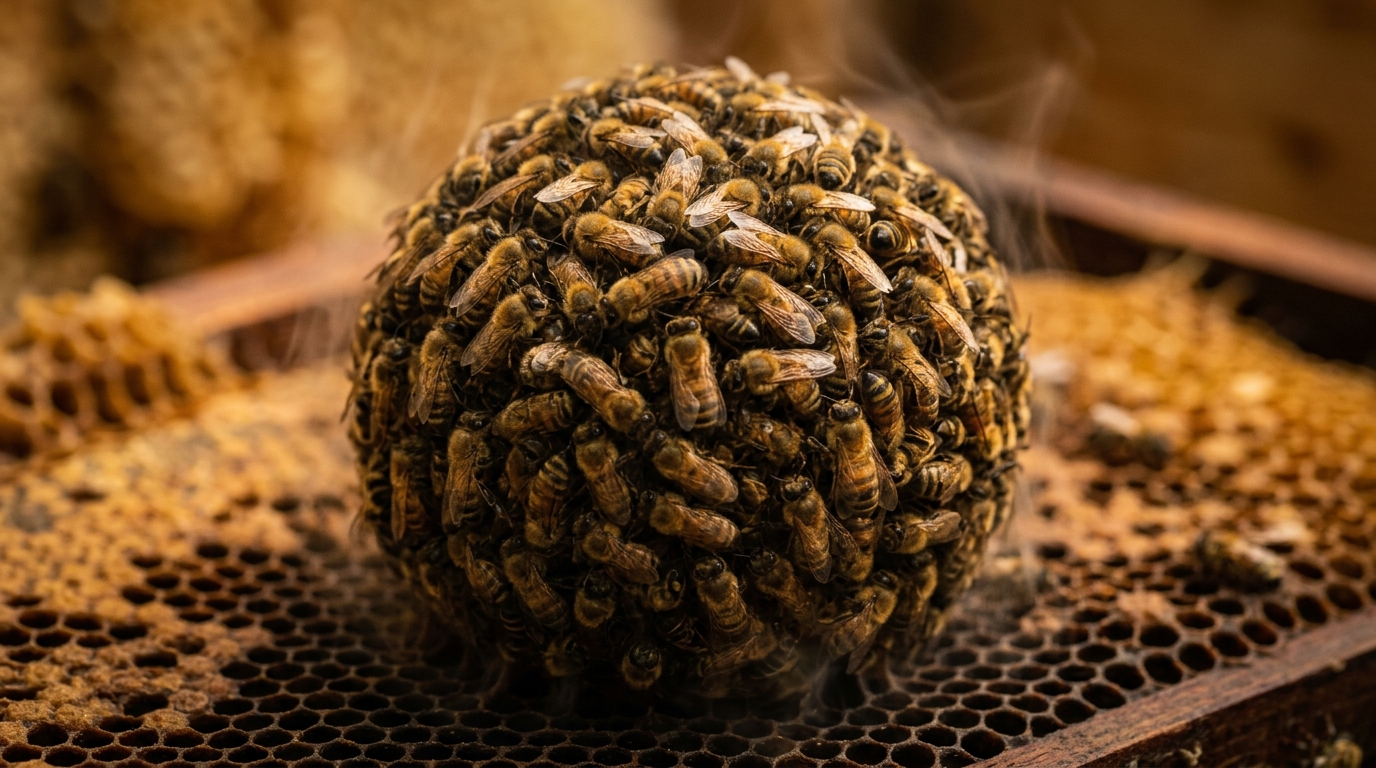
Facing a predator capable of felling up to forty bees per minute, logic would dictate that the hive is doomed to a desperate defense, sting against mandibles. That is the image we tend to keep in mind: an isolated worker, sacrificed, stinging once in the skin of a mammal before dying. Yet, when a hornet ventures inside a colony that has learned to recognize it, the scenario is markedly different. No pitched battle, no frontal clash. Instead, a collective trap forms in a few seconds, silent and relentlessly effective. It isn’t a matter of brute strength, but of thermodynamics applied at the scale of an insect, and the result is as fascinating as it is methodical.
- Around 500 Asian bees surround the hornet in a compact ball.
- The workers raise the temperature at the core of the ball to about 45–47°C, lethal to the hornet but tolerable for them.
- This defensive reflex, absent in the European honey bee Apis mellifera, inspires researchers to design non-chemical solutions against the Asian hornet.
- A ball of 500 bees closes in on the intruder
- 47°C: the temperature that turns the hive into a deadly trap
- Why the hornet can do nothing once encircled
- A collective strategy that speaks volumes about the intelligence of the hive
A ball of 500 bees closes in on the intruder
It all starts as soon as the hornet breaches the hive entrance. In moments, alarm signals spread among the workers, who converge on the intruder with no apparent hesitation. It isn’t a handful of bees that intervene, but around 500 workers who gather around the predator to form a compact, almost organic mass, literally a living ball enveloping the hornet from every direction. This technique has a name, heat balling, literally the “heat ball,” and it has been shaped over thousands of years of coevolution between the Asian honey bee Apis cerana and the hornet Vespa velutina in East Asia.
What is striking is the speed with which this maneuver is carried out. The bees act mostly as a collective, some of them attempting to sting the hornet directly, whose armor resists stings quite well. The aim is not to pierce, but to enclose. Once the ball closes, the hornet becomes completely immobilized, squeezed at the center of a swarm of workers who, each in their own way, contribute to a phenomenon far larger than themselves.
47°C: the temperature that turns the hive into a deadly trap
Here the strategy reveals all its ingenuity. Once the hornet is trapped in the ball, the bees begin to vibrate their flight muscles vigorously, without actually flapping their wings. This muscular activity generates heat, which accumulates at the heart of the cluster until it reaches a temperature between 45 and 47°C. A number that may seem minor, but that precisely matches the hornet’s tolerance threshold, whose lethal limit lies around 44–46°C.
The bees, for their part, enjoy a much wider safety margin: their bodies can withstand up to 50°C, or even a little more according to some observations. This difference of just a few degrees makes all the difference between life and death. The hornet, literally cooked alive at the center of the ball, has no thermal escape, while the surrounding workers remain in a relatively comfortable zone. The operation can last about ten minutes or stretch into several hours, as long as the heat irreversibly does its work.
Why the hornet can do nothing once encircled
Once trapped, the hornet finds itself in a situation where all its weapons become useless. Its mandibles, formidable in flight or in a frontal attack, are useless against a mass of bees closing in from all sides. Some observations even indicate that workers in direct contact with its body apply pressure on its abdomen, thereby hindering its breathing and worsening its physiological distress. The hornet thus faces a double constraint: the heat rising inexorably, and a compression that limits its gas exchange.
This mechanism explains why this method works so well: it does not rely on a single fragile factor, but on a combination of simultaneous constraints that leave the intruder with virtually no chance of survival. It should be noted, however, that this defense is specific to the Asian bee. The European bee, Apis mellifera, widespread in our countryside, has not developed this reflex, simply because its evolutionary history with the Asian hornet is much more recent. The latter only arrived in France before 2004, probably hidden in a container of pottery imported from China and landed in Lot-et-Garonne or Bordeaux. Since then, it has advanced across the country at about 78 kilometers per year, and a single colony can decimate up to 200,000 bees, roughly the equivalent of about three entire hives. In this autumn period, when hornet colonies reach their peak activity before winter, pressure on French apiaries is especially high.
A collective strategy that speaks volumes about the intelligence of the hive
What makes this defense so remarkable is not only its physiological efficiency, but what it reveals about how a bee colony operates. No worker decides alone to act this way: it is the entire group, through a collective signal, that triggers a coordinated response on a scale no individual could achieve alone. The Muséum national d’Histoire naturelle confirms that this thermal behavior indeed exists among Asian bees, but remains absent in European colonies, underscoring how adaptation to a predator can take radically different forms depending on the continent.
This mode of operation now inspires researchers and engineers who are working on non-chemical methods to combat the Asian hornet in France. Building on the principle of heat-balling, some projects are exploring devices capable of artificially reproducing this targeted thermal shock, without recourse to pesticides or threatening other pollinators. It remains experimental, but it clearly demonstrates how careful observation of living systems can feed concrete technological solutions, through biomimicry that owes everything to this collective intelligence born in the hive.
Behind this silent execution lies therefore a lesson in organization that goes far beyond the simple duel between two species. The hive, acting as a single organism capable of producing heat on demand, reminds us that survival does not always depend on individual strength, but sometimes on choreographic coordination. It remains to be seen whether this strategy, shaped by millennia of coevolution in Asia, will one day be faithfully imitated to protect, in turn, European apiaries still defenseless against this invader from elsewhere.
