
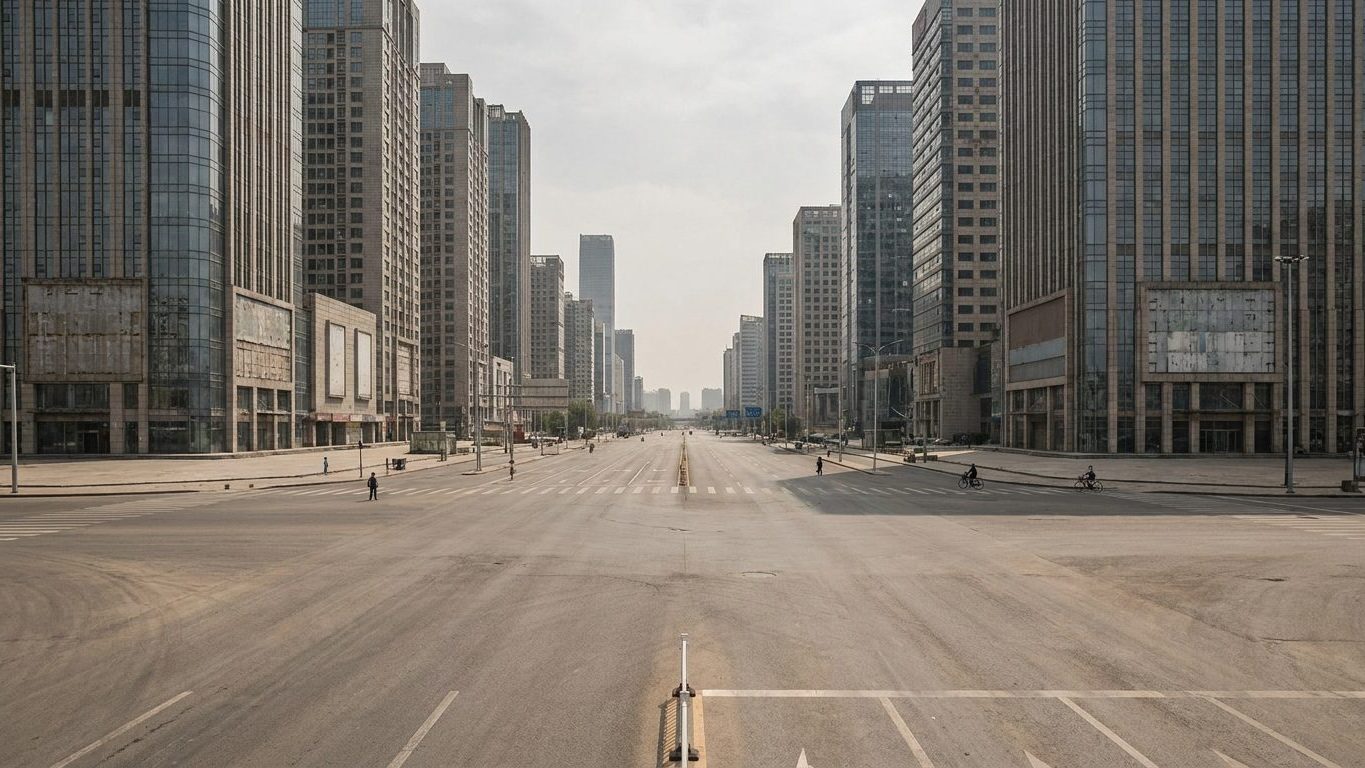
Kangbashi. The name means little to most readers, but the image does not: eight-lane avenues left empty, gleaming new office towers with their lights off, and museums of dramatic architecture for an audience that never arrives. Ordos, in Inner Mongolia, has since the mid-2000s housed a district named Kangbashi, designed to accommodate one million people. Twenty years on, it is neither coal nor factories that ended up drawing residents there.
It’s a story of schools, universities, and administrative offices relocated en masse.
- Kangbashi was designed in 2004 to host one million residents, financed through land sales to developers
- The district embodied the Chinese “ghost city” for fifteen years, with only about 30,000 inhabitants instead of the planned million
- The establishment of reputable schools and administrative offices from 2016 onward gradually drew families, lifting the population to around 120,000–130,000 residents
A City Drawn for a Million Inhabitants, Paid for with Land
The project targeted a goal of one million inhabitants, with the construction of Kangbashi’s new district approved by the municipal government in May 2004. Work unfolded in several phases, from 2004 to 2007 for infrastructure, from 2007 to 2011 for the above-ground structures, then from 2011 to 2015 for the finishing touches. The visual result is striking enough to surprise any visitor: eight-lane avenues laid bare, spectacular museums, and a nearly surreal sense of calm. The funding, however, relied on a classic Chinese arrangement: the local government sold land to developers to raise the funds needed for construction, a mechanism that eventually ground to a halt when demand for real estate collapsed.
A report dating from 2012 laid this out plainly: the efforts to repay the debt were complicated by the fall in demand for undeveloped land, which the Ordos government auctioned to developers, and land-sale revenues had fallen by 80% in the first half of the year compared to 2011. With no buyers, no revenues. Without revenues, no more construction.
Fifteen Years Embodying the Chinese Ghost City
The nickname has clung to the district for more than a decade. A million residents were expected in Kangbashi; they were only 30,000 at the start of the 2010s. Western journalists, then the Chinese press itself, took up the subject: empty streets, luxury apartments abandoned, and a troubling hush became the hallmark of Ordos, earning it the moniker of China’s “ghost city.”
The Olympic stadium built for the ethnic-minority sports Games sums up this planned fiasco in a single emblem: a 60,000-seat venue completed in 2015, almost never used since. Even the most creative initiatives could not reverse the trend. In 2008, artist Ai Weiwei coordinated a project bringing together around a hundred international architects to design as many luxury villas in a district dedicated to them. The residences rose from the ground, but the wealthy buyers never truly came to live there.
Schools, Universities and Offices: The Real Engine of Repopulation
The turning point did not come from a new mine or a factory, but from an administrative relocation. Since the mid-2010s, the arrival of schools, universities, and administrative offices has pushed the district’s population into the hundreds of thousands. A local guide cited by a traveler visiting the region in 2025 described how real estate prices and the desire to live in Kangbashi really took off after a renowned school moved there in 2016.
That is modest.
A prestigious middle school relocating, and entire families following to enroll their children in the best institution in the region. The relocation of administrations, the creation of public facilities, and falling prices gradually drew families, so the district now counts roughly 100,000 to 150,000 permanent residents and serves as the administrative, cultural, and residential hub for Ordos. The latest local censuses confirm this progression without ever validating the original ambitions.
A Balance Sheet That Still Falls Short of the Promised Million
Two decades later, the official population tops out around 120,000 to 130,000 residents according to the most recent censuses, barely more than a tenth of the initial target of a million. The district formally changed its administrative status in 2016, marking the official end of a project that had stretched over more than a decade.
Compared with the intermediate target of 300,000 inhabitants set at the turn of the 2010s, the current population still reaches almost half of that more modest objective. Ordos no longer relies solely on this district to project its future: the prefecture is now investing in industrial projects oriented toward renewable energy, far from the coal-only gamble that funded the original grandeur. Kangbashi, for its part, continues to attract residents in small numbers, buoyed by real estate prices that remain far more affordable than in China’s major coastal metropolises.
Sources: keops-ingenierie.fr | voyage-chine.com
