
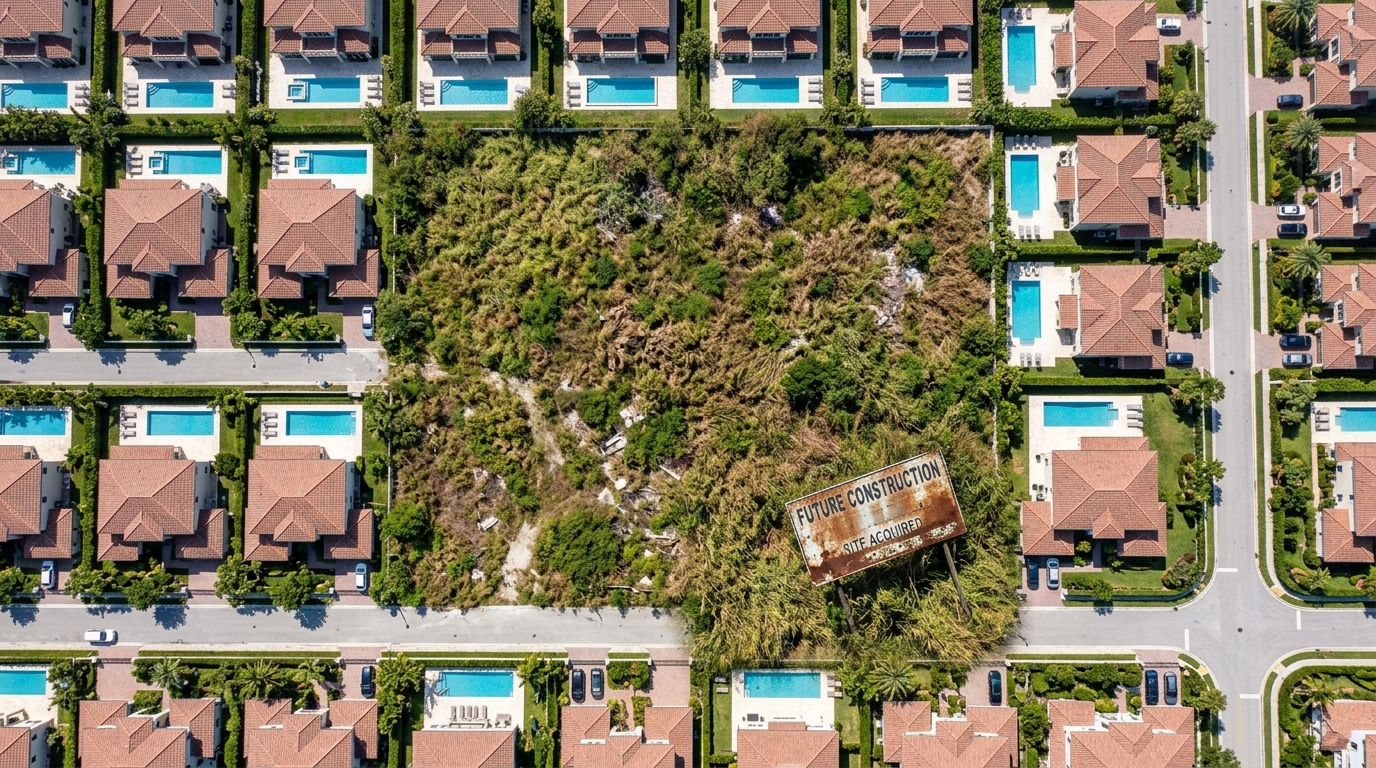
Each autumn, in hundreds of French town halls, a discreet levy shifts quietly toward the actors of social housing. Not to fund a school, nor to repair a road: this sum penalizes the absence of social housing on the commune. For twenty-five years, the law has imposed a precise quota to meet, under penalty of financial sanction. But what happens when the sanction becomes easier to bear than the rule itself? That is the paradox revealed by the latest figures from the Ministry of Housing: far from pushing to build, the SRU fine has, for many elected officials, become a budget line almost as ordinary as any other expense.
- In 2024, 1,276 of the 2,196 communes subject to the SRU law were in deficit, i.e., 58% of them, generating a net levy of 141 million euros.
- The SRU law of December 13, 2000 requires a quota of 20 to 25% social housing, but towns like Pujaut achieved only 4.75% of their objective in 2024.
- For deficient communes deemed recalcitrant, the fine can be increased by up to 400%, as illustrated by the 68 million euros of surcharges recorded in 2024, without stopping some mayors from persisting in inaction.
- Paying rather than building: the choice of more than 1,100 French municipalities
- The SRU law and its 20 percent quota: a rule 25 years old still circumvented
- Why mayors prefer the fine to social housing
- SRU deficiency: a system that has failed to house the poorest
Paying rather than building: the choice of more than 1,100 French municipalities
According to the Ministry of Housing, more than 1,100 communes remain SRU-deficient and opt for a fine rather than constructing social housing each year. This figure alone captures the scale of a phenomenon that extends well beyond local anecdotes. In 2024, among the 2,196 communes covered by the law, 1,276 were in deficit, i.e., 58% of them, unable to reach the social housing rate imposed on them.
The annual levy applied to these deficient towns reached €240 million in 2024. After deducting the actual expenditures incurred in support of social housing, the bill drops to €141 million, but remains substantial. More importantly, it continues to be paid, year after year, by municipalities that have seemingly integrated this expense as a routine operating cost, almost on the level of an electricity bill.
The SRU law and its 20 percent quota: a rule twenty-five years old still circumvented
Everything traces back to the Solidarity and Urban Renewal Law, enacted on December 13, 2000. Its Article 55, now well known among urban planners and local officials, requires the communes concerned to maintain a minimum share of social housing in their residential stock, typically 20 or 25 percent, with an initial target set for 2025. The idea at the time was straightforward: to prevent certain towns from becoming bastions inaccessible to low-income households, by obliging every territory to contribute to social mixing.
A quarter of a century later, the verdict is bitter. The financial sanction mechanism, meant to deter noncompliance, has become a simple adjustment tool for many jurisdictions. Some communes display strikingly weak results: in Gard, Pujaut delivered only 22 social housing units out of 464 required in 2024, or barely 4.75 percent of the targets set. This figure illustrates how the gap between the legislative aspiration and on-the-ground reality can widen so dramatically, without the law ever successfully curbing it.
Why mayors prefer the fine to social housing
How can one explain such persistence in inaction? The answer largely rests on a cold budgeting calculation. Building social housing requires seizing land, dealing with sometimes reluctant neighbours, negotiating with social landlords, and waiting several years before any new building appears. Paying a fine, by comparison, demands none of these steps: it is a purely accounting operation, absorbed into the municipal budget without upsetting the local political balance.
This calculation becomes even more tempting when the sanction, though ostensibly punitive, remains financially bearable within a city’s budgetary framework. True, the state reserves a heavier instrument: the status of a deficient municipality, reserved for the most recalcitrant communities. In such a case, the levy can be multiplied by up to five, i.e., a 400% increase. This surcharge alone accounted for €32.6 million in the Provence-Alpes-C Côte d’Azur region over 2020–2022. Yet even this threat does not always persuade certain mayors to alter course, as the local political cost of a social housing project can weigh more than the financial sanction when voters feel affected by a new development.
SRU deficiency: a system that has failed to house the poorest
The three-year balance sheet for 2020–2022 confirms the scale of the phenomenon nationwide. Of the 1,022 communes subjected to catch-up targets, 711 did not meet their goals, a failure rate that questions the real effectiveness of the scheme. In total, 341 communes were formally deficient under this assessment, compared with 311 in a prior count after harmonizing the calculation methods. Even more striking, the Fondation pour le logement identified 12 multirecidivist communes, consistently found to be deficient across the first six triennial periods, never successfully bending their trajectory in a lasting way.
Today, as autumn 2026 sets in, the three-year review 2023–2025 is under examination. An government directive dated April 30, 2026, has given prefects a precise timetable for deficiency procedures, with final orders expected in December 2026. Of the €141 million net levy recorded in 2024, €68 million stemmed from deficiency surcharges applied to the most recalcitrant communes for that same period. All this suggests that the coming autumn could unveil new names on the list of underperformers, without guaranteeing that the missing housing will finally be built.
Twenty-five years after its adoption, the SRU law stands at a crossroads. The mechanism has undoubtedly enabled progress in certain areas, yet it has also revealed its limits in the face of elected officials willing to shoulder the financial cost of inaction rather than the political cost of construction. A fundamental question remains, one that the next deficiency orders will likely address only partially: how long can a state tolerate that its own rules ultimately finance their circumvention?
