
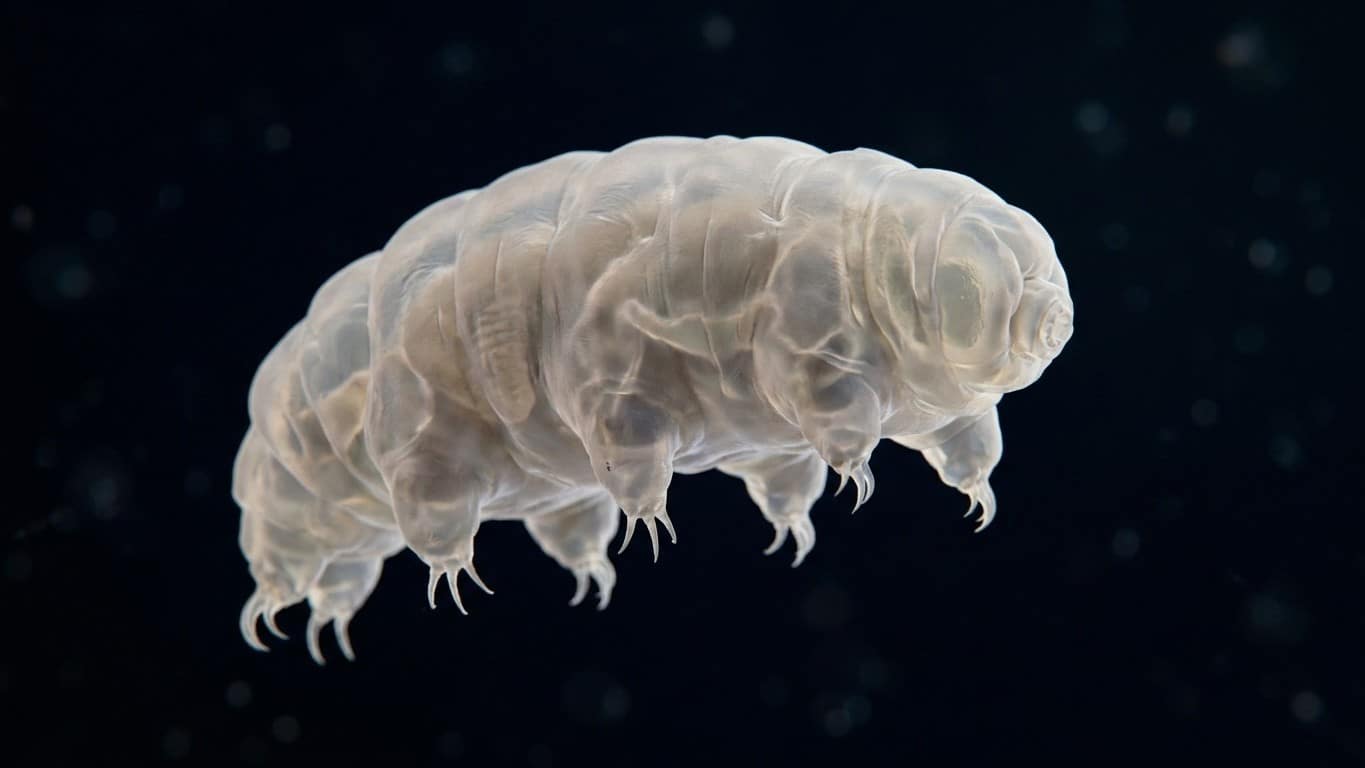
On September 14, 2007, a Soyuz-U rocket lifted off from Baikonur carrying 43 scientific experiments on board. One of them, understated, fit into a few boxes the size of sewing thimbles. Its objective: to determine whether a small group of animals, directly exposed to the vacuum of space, could survive. The result? Even the biologists involved were dumbfounded.
Key takeaways
- Invisible creatures, unseen by the naked eye, defied the unimaginable in 2007
- No living being had ever survived this extreme test before
- Their offspring reveal a resilience secret that science aims to exploit
The challenge nobody believed could be done
It was already known that bacteria could endure such conditions, but it seemed impossible that multicellular animals could withstand the two major hazards of space: the vacuum, which boils internal water, and ultraviolet radiation, which shatters chromosomes. Multicellular animals, with their organs, membranes, and organized DNA, are vastly more fragile than mere bacterial spores. Space is the ultimate void at -270 °C, UV at lethal doses, cosmic radiation unshielded by atmosphere. An environment designed to kill anything that breathes.
The Swedish biologist Ingemar Jönsson, from Kristianstad University, conceived the TARDIS experiment (Tardigrades in Space), which took place on a platform named Biopan-6, built by the ESA and mounted outside the Foton-M3 capsule, orbiting at about 270 kilometers altitude. Tardigrades from four different species, in anhydrobiosis, were arranged in four series of boxes left to space for ten days. One group was shielded from all radiation, two others received either UV-A or UV-B, and the last had no protection.
The capsule landed safely in the Kazakh steppes on September 26. Then the analysis began. And the astonishment followed.
What scientists found when opening the boxes
More than two-thirds (68%) of the samples survived the extreme orbital voyage. Returning from their drought-induced dormancy, the survivors quickly restored their DNA and cellular structures. The tardigrades withstood the vacuum of space. Moreover, at ultraviolet doses a thousand times higher than on Earth’s surface, lethal to most living organisms, they endured.
Even more astonishing: reproduction. Once back on Earth and rehydrated, they reproduced and produced viable offspring. This experiment, published in Current Biology in September 2008, marked the first time an animal had been subjected to simultaneous exposure to space vacuum, cosmic radiation, and direct solar ultraviolet rays. A historic first in biology.
The follow-up confirmed that the damage was not transmitted to subsequent generations. A 2016 study by the same team, tracking the descendants of the survivors over several generations, found no performance deficits compared with unexposed lineages. The authors suggested that the tardigrades that survive do so by fully repairing their damage, rather than letting it accumulate.
The secret: dying to live better
Before entering space, tardigrades were already in a near-dead state. That is their genius. Anhydrobiosis, triggered by the lack of water, is their most formidable survival mode: the tardigrade loses up to 95–99% of its body water and contracts into a desiccated form called a “tun.” A microscopic, inert capsule, metabolically silent. In this form, their vital activity drops to about 0.01% of normal levels.
It’s not merely dehydration. To shield themselves from radiation capable of destroying DNA, tardigrades deploy a specific protein, Dsup (Damage suppression protein), which binds to chromatin and protects DNA from hydroxyl radicals produced by X-rays. An embedded molecular shield, invisible, astonishingly effective. Laboratory studies have shown that these proteins can also increase stress resistance in human cells, opening concrete avenues in medicine.
To grasp the scale: a tardigrade measures between 0.1 and 1.5 mm. Thousands can be found in a square centimeter of damp moss. Their natural habitat, mosses and lichens, often undergo prolonged droughts, which has driven these animals to develop the ability to dry out and revive after several years. Space, in a sense, is just a drought a bit more severe than usual.
What this changes for our view of life
The TARDIS experiment opened a breach across several fields at once. Tardigrade biology continues to captivate medicine: the survival mechanisms of these creatures could pave the way for new technologies to protect astronauts on future missions. Storing medicines without refrigeration, shielding human tissues from radiation, improving lyophilization techniques—the potential applications are plentiful.
Theoretically, panspermia (the idea that life could travel between planets carried by meteorites or debris) ceases to be mere fantasy. Tardigrades are regarded as model organisms for space and astrobiology research. Researchers at the University of Kent even calculated that tardigrades can survive impacts up to 0.9 km/s, with direct implications for panspermia models.
In 2011, the Endeavour mission launched the TARDIKISS project, expanding knowledge about DNA repair mechanisms under the constraints of spaceflight. Tardigrades are no longer just biological curiosities: they have become bona fide scientific tools. And somewhere down a laboratory corridor, direct descendants of the Foton-M3 survivors still live, a living proof that a ten-day journey into the vacuum does not necessarily leave behind obvious traces.
Sources: journaldugeek.com | spacedaily.com
