
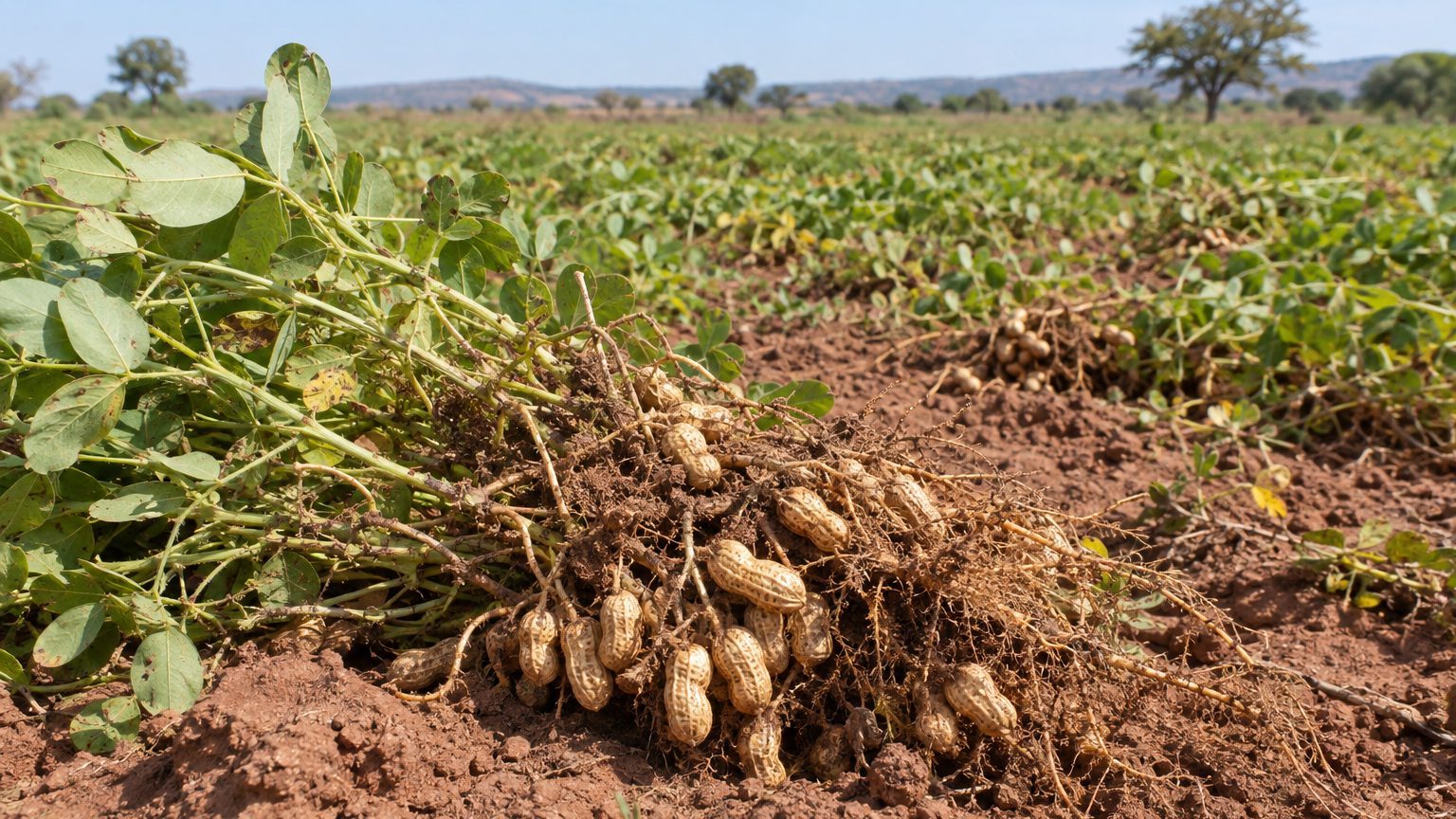
Right after the war, the British Labour government aimed to clear 3,210,000 acres of bush in Tanganyika, about 1.3 million hectares, to plant peanuts. The first harvest, that of 1947-1948, yielded 1,600 tonnes. According to historians John Hogendorn and Kenneth Scott, it was barely enough to supply seed for the following year.
The target for that same harvest: 56,920 tonnes.
- Britain launched in 1947 a peanut program covering 1.3 million hectares in Tanganyika without prior study or pilot project.
- The 1947-1948 harvest reached only 1,600 tonnes versus 56,920 expected, i.e., 2.8% of the target.
- The project was abandoned in 1951 after a loss of £36 million, the worst fiasco in recent British colonial history.
Margarines for a rationed country
The Ministry of Food, led by John Strachey, carried the project forward in 1946-1947. Britain, under rationing, faced a shortage of fats, and peanut oil was to populate its margarines. The Cabinet endorsed the recommendations in January 1947, and the equipment departed for Tanganyika, today Tanzania. According to the Museum of English Rural Life (University of Reading), the preliminary study lasted only seven weeks, and no pilot project preceded the launch.
The plan covered 3,210,000 acres, one and a half times the area of Corsica, to be cleared by 1952 between Kongwa, Urambo, and then the Southern Province. Production targets were set at 56,920 tonnes of nuts for 1948 and 277,676 tonnes for 1949.
1,600 tonnes, barely enough to reseed
At Kongwa, the programme’s headquarters near Dodoma, rain was scarce and the machinery wore down on abrasive soils, notes researcher Matteo Rizzo in a 2006 study. The 1947-1948 harvest topped at 1,600 tonnes, or 2.8% of the 56,920 tonnes aimed for. In African Economic History (1981), Hogendorn and Scott summarize the situation: this production covered only the seed for the next campaign.
On 11 July 1949, before the House of Commons, John Strachey presented the figures. The yield stood at 245 pounds of peanuts per acre, against 750 in the original estimate, i.e., about 111 kilograms instead of 340. He attributed it to drought. As for the harvest, he said, it would amount to “only a few thousand tons.”
The actual yield was a third of what had been planned.
From 277,676 tonnes expected to 2,150 harvested
The 1949 campaign ended with 2,150 tonnes of peanuts, less than 1% of the 277,676 tonnes anticipated. Only 49,620 acres had been planted, about 1.5% of the total target area. In its issue of November 14, 1949, TIME magazine ran a piece titled “peanuts on the rocks” and recalled the project’s estimate of £23,975,000.
January 1951: the programme was abandoned.
In written replies to the Commons, on 29 January 1951, the government formalized the end of the project and the transfer at a loss of £36 million. That is roughly one and a half times the original estimate for the entire project.
The end did not occur in a single day. As early as the debate of 27 July 1949, a speaker noted that Kongwa was no longer being developed at full scale, that Urambo was becoming an experimental station, and that part of the equipment would migrate to the Southern Province. In 1953, a commentator described the affair as the “worst fiasco in recent British colonial history.”
Sources: academia.edu | merl.reading.ac.uk | researchgate.net
