
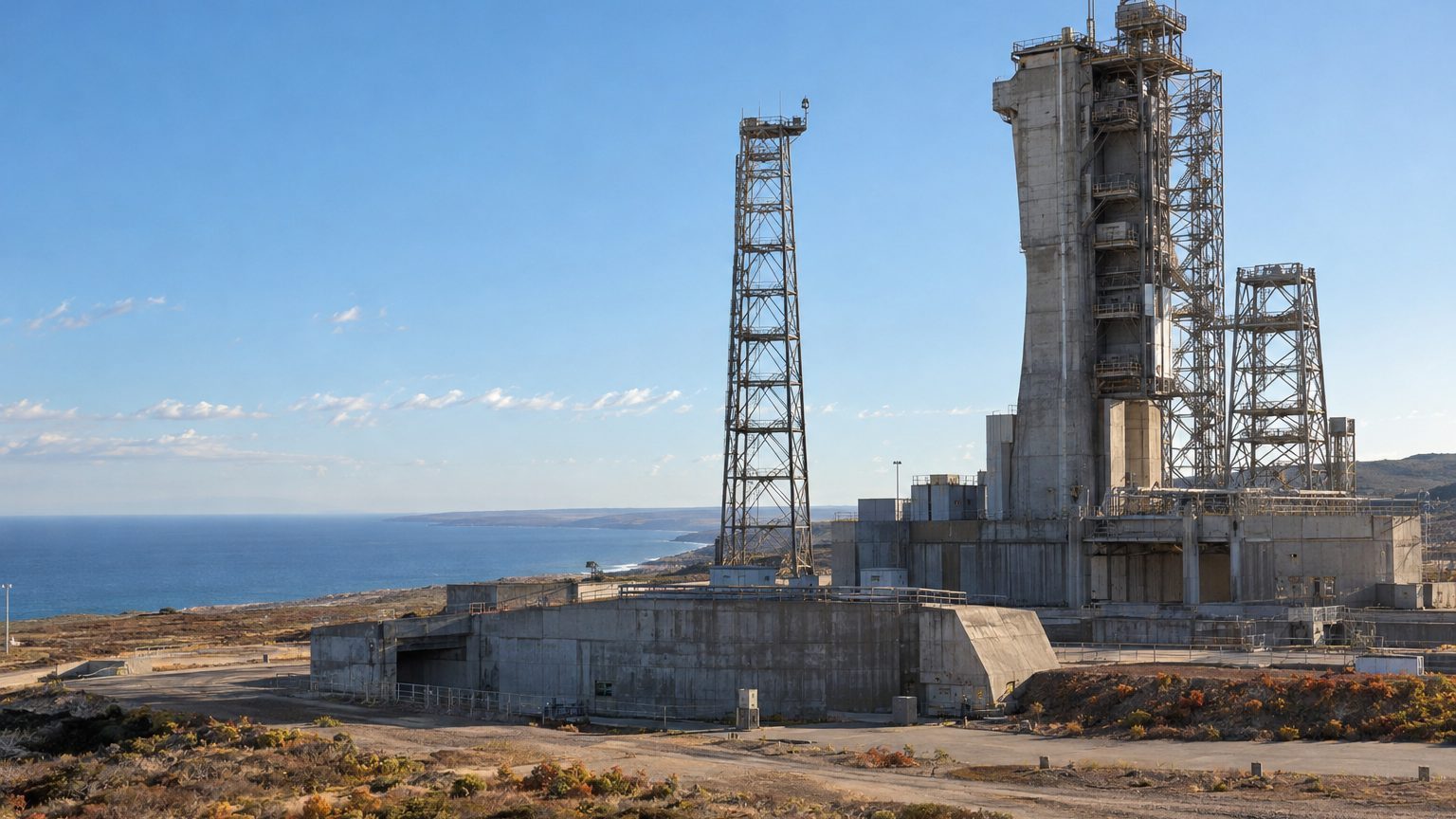
A flight was scheduled for the summer of 1986, set to inaugurate the U.S. Air Force shuttle era with large spy satellites placed into polar-orbiting paths. Bob Crippen, a member of the very first crew and commander of three subsequent missions, was to pilot this flight from Vandenberg, California. The launch pad was ready, or nearly so.
The shuttle never took off from that site.
- SLC-6 at Vandenberg cost between $3.3 billion and over $4 billion to adapt a site for the U.S. Space Shuttle
- The Challenger disaster in January 1986 led to the cancellation of the Vandenberg shuttle program four months before the planned first launch
- The launch pad was put into cocoon in 1989 and later served for Athena and Delta boosters before its demolition in 2026
A Launch Pad Born for a Military Station
The story of Space Launch Complex 6, nicknamed “Slick Six,” begins before the shuttle era. Construction started in March 1966 at South Vandenberg for the Manned Orbiting Laboratory (MOL). This program matched a Titan III launcher with a modified Gemini capsule attached to a laboratory in space. The U.S. Air Force acquired the land from the Sudden Ranch around 1966 for the project.
The MOL was canceled on June 10, 1969. No launch had taken place. In 1972, the site was selected for the shuttle and approved as a launch complex in 1975.
Billions Spent to Aim for the Poles
From Florida, polar orbits posed a security concern: the trajectory would pass over populated areas. Vandenberg offered a southwestward launch toward the Pacific. The reconstruction of the complex stretched from January 1979 to July 1986. The original mobile service tower was lowered and two new cradles were dug for the solid-fuel boosters. The 35 km separating the north end of the base from the launch pad had to be prepared for a 76-wheel transporter built in Italy.
Accumulated cost: between $3.3 billion and more than $4 billion.
The Washington Post cited $3.3 billion in its April 28, 1988 edition, when the Air Force announced that the shuttle program would be placed into cocoon. Wikipedia places the modifications to the complex and the associated infrastructure at more than $4 billion.
SLC-6 was declared operational during a reception ceremony on October 15, 1985. The Enterprise prototype was then assembled with an external tank and dummy boosters, for a series of fit checks. Much work and testing still remained to be done.
Challenger, Then the Cocoon
On January 28, 1986, Challenger exploded. On July 31, Air Force Secretary Edward Aldridge announced that the shuttle program at Vandenberg would move to “operational caretaker status.”
The rest took three years. On February 20, 1987, the site entered “minimum caretaker status.” On May 13, 1988, Aldridge ordered the transfer of shuttle equipment, notably to the Kennedy Space Center, by September 30, 1989. The work finished ten days early, on September 20, 1989, when SLC-6 was placed under cocoon. Never had a project of this scale waited so long for a flight that never occurred.
On December 26, 1989, the Air Force formally closed the shuttle program at Vandenberg.
A Second Life, Far from Its Original Ambitions
Nonetheless, the launch pad eventually found a secondary use, albeit modest. The first launch occurred on August 15, 1995, with an Athena I carrying GemStar-1. The first Delta IV followed on June 27, 2006. The final launch, a Delta IV Heavy for NROL-91, took place on September 24, 2022.
Meanwhile, other ventures failed to come to fruition. A modification for the Titan IV/Centaur, initiated in July 1990, was abandoned in March 1991 due to an insufficient number of Titan IV flights.
On June 16, 2026, demolition charges brought down the access tower, the mobile service tower, and what remained of the assembly building. SLC-6 is now set to host SpaceX’s Falcon 9 and Falcon Heavy. The structures designed for the shuttle will have disappeared without ever witnessing a shuttle launch.
Sources: en.wikipedia.org | space.com | nasa.fandom.com
