
Imagine rice and wheat fields that are completely devoured within a few weeks, without any excessive rainfall or drought to blame. This is precisely what happened in China at the very beginning of the 1960s, a country already unsettled by major political upheavals. The cause of this agricultural disaster did not come from the sky or the soil, but from a human decision made two years earlier, driven by an intention that seemed logical on paper: protect the crops by eliminating a small bird accused of stealing grain from peasants. What was meant to save Chinese agriculture ended up accelerating one of the greatest ecological and human catastrophes of the twentieth century.
- In 1958, Mao Zedong’s Four Pests Campaign led to the extermination of hundreds of millions of sparrows, blamed for eating grain stored in the fields.
- Deprived of this natural predator, locusts and other agricultural pests proliferated, causing rice yields to fall by 5.3% and wheat yields by about 8.7% in the affected areas.
- This ecological imbalance contributed to the Great Chinese Famine of 1959-1961, contributing roughly two million additional deaths, though not the sole cause.
- Two million sparrows killed in a few months
- The missing predator, the void no one had anticipated
- Locusts by the billions on defenseless fields
- An ecological mistake paid for in millions of lives
Two Million Sparrows Killed in a Few Months
In 1958, within the framework of the so-called Four Pests Campaign, Mao Zedong identified four enemies to be eradicated for the good of national agriculture: rats, flies, mosquitoes, and the sparrow (the small tree sparrow). The latter was accused of pecking grain directly in the fields, which made it, in the eyes of the authorities, a true plague for agricultural yields. The response matched the regime’s ambition: a nationwide mass mobilization of unprecedented scale was launched across the country.
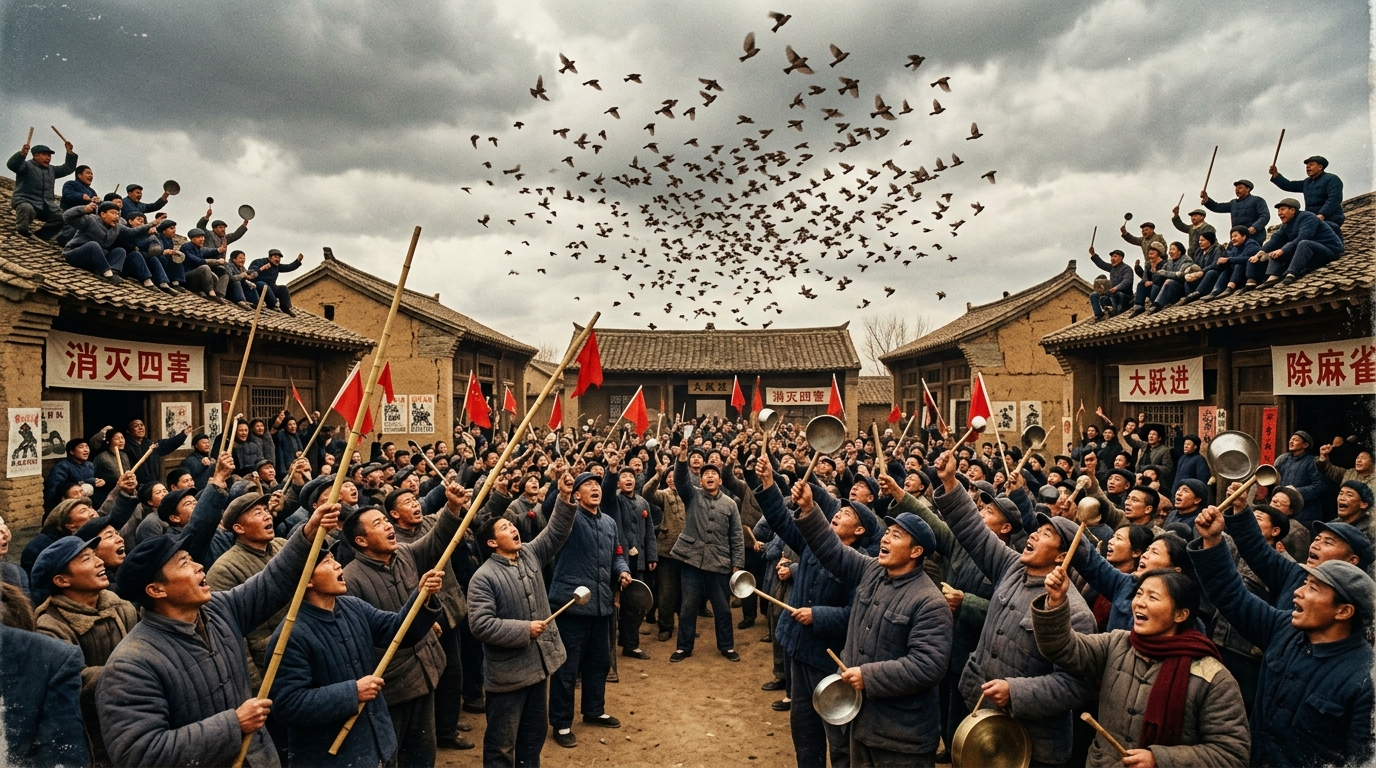
Millions of citizens, urged by local authorities, then undertook a methodical hunt. Drums were beaten, sticks waved, slingshots used, nests destroyed; everything was done to prevent the birds from landing or resting, until they collapsed from exhaustion mid-flight. In just a few months, hundreds of millions of sparrows vanished from the countryside, a figure that reflects the unprecedented scale of this eradication campaign.
The Missing Predator, the Void No One Had Anticipated
What the planners of the time had not measured is that the sparrow does not feed solely on grain. This small bird also consumes a substantial amount of insects, particularly during the breeding season when it must feed its nestlings. In short, the bird portrayed as an ally of crops was in fact playing the role of a natural regulator against agricultural pests.
Some Chinese scientists of the era did attempt to alert the authorities to this ecological connection known to the public, but their warnings fell on deaf ears in a regime focused on immediate results. As a result, with the near disappearance of this natural predator, a vacuum appeared in the agricultural ecosystem, a void that nature did not hesitate to fill in a way no one had anticipated.
Billions of Locusts on Defenseless Fields
Without their main predator, insect populations — especially locusts — began to proliferate dramatically in the two years that followed the eradication campaign. Recent data show that in the areas most favorable to sparrows before their disappearance, rice yields fell by 5.3% and wheat yields by nearly 8.7%. Those figures, measured on the scale of a whole country, represent a colossal loss of food when every harvest counted.
Facing the scale of the damage and the uncontrolled growth of pest insects, Chinese authorities eventually removed the sparrow from the list of pests in 1960, two years after the campaign began, symbolically replacing it with the aphid. China then, in a bid to repair the mistake, rushed to import nearly 250,000 sparrows from the Soviet Union, in hopes of restocking the now-vulnerable countryside. A move that underscored how critical the situation had become.
An Ecological Mistake Paid for with Millions of Lives
This episode sits within the broader tragic context of the Great Chinese Famine, which struck the country between 1959 and 1961, a disaster whose overall human toll is estimated at between 16.5 and 45 million deaths, depending on the estimate. Recent work establishes a link between the eradication of sparrows and an increase in mortality of up to 9.6% in certain areas, equivalent to about two million additional deaths directly related to the collapse in agricultural yields.
However, it would be simplistic to attribute the entire famine to the loss of sparrows alone. Researchers who studied this period agree that the agricultural decline does not fully explain the scale of the human catastrophe. The state-imposed forced requisitions of food, which continued to drain rural areas despite falling yields, significantly worsened an already critical situation. The eradication of sparrows thus acted more as an aggravating factor than as a sole cause, but a factor heavy enough to be cited today as a textbook example of ecological imbalance caused by large-scale human intervention against nature.
This story, however old it may be, still resonates whenever we discuss the delicate balance among species within an ecosystem. As autumn returns and concerns about crops and biodiversity in agriculture resurfaces, the sparrows episode reminds us of a simple yet often forgotten lesson: in nature, nothing exists in isolation, and attempting to remove a link in the chain, even one that seems harmful, can unleash consequences far more severe than the initial problem. A reflection that remains highly relevant as modern agriculture continues to seek a balance between productivity and respect for natural equilibria.
