
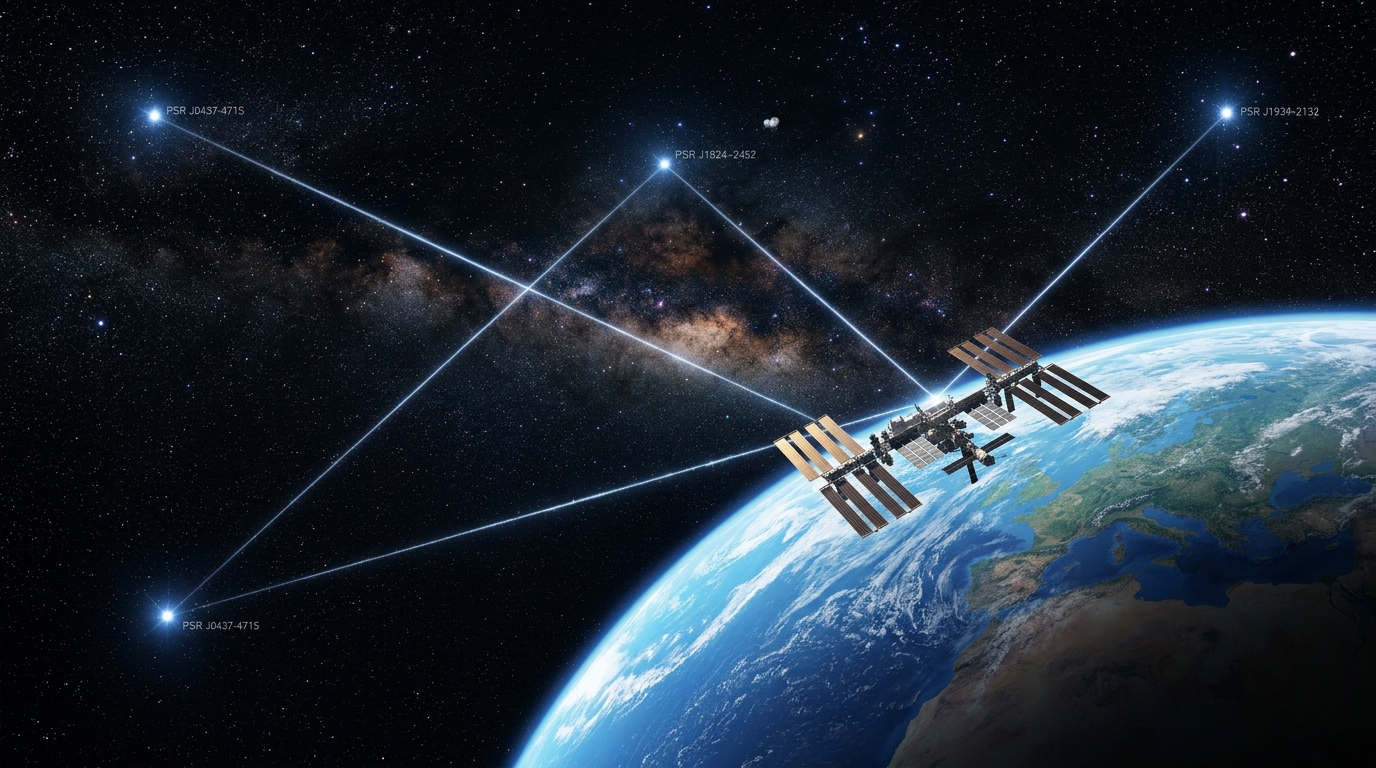
A spacecraft station racing at 28,000 kilometers per hour, cut off from any terrestrial signal, would alone recover its position in the vast blackness thanks to the light of stars extinguished for millennia. This scenario worthy of a science-fiction novel did, in fact, unfold aboard the ISS, and it could well redraw the future of space navigation.
- In January 2018, the NICER instrument enabled the ISS to calculate its position autonomously using X-ray signals from four pulsars, without GPS data.
- This technology, dubbed XNAV and tested through the SEXTANT project, achieved an accuracy of about 16 kilometers, sometimes down to 5 kilometers, in under 8 hours.
- This autonomous pulsar navigation method aims to free future spacecraft from the Deep Space Network for distant missions beyond Mars.
- Dead pulsars guiding living vessels still
- XNAV, GPS, pulsars: space navigation enters a new century
- When NASA tests XNAV-102 aboard the space station
- What this technology means for exploration beyond Mars
For decades, space exploration rested on a simple premise: to know where you are in space, you must stay in contact with Earth. Giant antennas, global communication networks, calculations carried out from ground control centers—everything depended on the ground. But what happens when that link breaks, or when a probe ventures so far that radio signals take hours to travel back and forth? That exact question is what NASA engineers sought to answer, betting on stars that some thought useful only for astronomical observation.
Dead Pulsars Guiding Living Vessels
A pulsar is the remnant of a massive star that collapsed in a supernova. What remains resembles a ball of ultra-dense matter, a neutron star, spinning on its axis at dizzying speeds and sweeping space with beams of X-rays, much like a lighthouse. Some of these cosmic beacons rotate with such extreme regularity that they rival the most precise atomic clocks built by humans.
It is this regularity that caught the researchers’ attention. If each pulsar emits its pulses at known, predictable intervals, then measuring the offset between the expected moment and the observed moment can, in theory, reveal one’s own position in space. The idea isn’t new: it was theorized as early as 1974, long before anyone had the technology to implement it. It would take nearly half a century to turn this hypothesis into a concrete demonstration.
XNAV, GPS, Pulsars: Space Navigation Enters a New Century
The principle closely resembles the GPS we all use daily to get to work or locate a destination. Except here, artificial satellites are replaced by natural pulsars, located thousands of light-years away. Each pulsar serves as a time beacon of astonishing precision, emitting a signal that can be likened to a cosmological metronome beat.
This technology bears the name XNAV, for X-ray Pulsar Navigation. Its most advanced testing ground was found in the SEXTANT project, acronym for Station Explorer for X-ray Timing and Navigation Technology, a cheeky nod to the maritime navigation instrument sailors have used for centuries to find their bearings thanks to the stars. The loop, so to speak, is closed: we navigate again using the stars, but with tools belonging to the twenty‑first century.
When NASA Tests XNAV-102 Aboard the Space Station
In January 2018, NASA announced the success of this demonstration, conducted aboard the NICER instrument, installed on the International Space Station. The NICER unit, the size of a washing machine, houses no fewer than 52 X-ray telescopes and silicon drift detectors, originally designed to study neutron stars from a purely scientific perspective. Engineers conceived of repurposing it for a far bolder experiment.
Four millisecond pulsars were preselected, designated J0218+4232, B1821-24, J0030+0451, and J0437-4715. To give the test genuine value, the ISS’s GPS data link was deliberately cut. The objective was clear: verify whether a completely autonomous navigation, based solely on the X-ray signals from these dead stars, could really work. In less than 8 hours, the system managed to determine its position with an accuracy of around 16 kilometers, while the initial target was 10 miles. Even more impressively, according to Jason Mitchell, project lead at NASA Goddard, a substantial portion of the measurements achieved an accuracy on the order of 5 kilometers, a remarkable result for a first real-world trial.
It should be noted that the Americans were not alone in this field. A month before this demonstration, China had already launched its own experimental satellite, XPNAV-1, targeting the Crab Pulsar, proof that the pulsar-navigation race captivated multiple major space powers at once.
What This Technology Means for Exploration Beyond Mars
Why all this effort for a system that, on paper, remains less precise than Earth-based GPS? The answer hinges on one word: autonomy. A probe sent to the outer reaches of the Solar System can no longer count on GPS, whose signals cover only Earth’s near environment. It then relies on the Deep Space Network, a network of ground-based antennas costly to operate and limited by the speed of light: the farther the probe travels, the longer the exchanges with ground teams take, sometimes several hours for a simple round trip.
With pulsar navigation, a spacecraft could determine its position on its own, in real time, without waiting for a response from Earth. It’s a bit like giving a spacecraft the ability to read the time on a universal clock visible from any point in the galaxy. More recent work conducted by NASA and the Naval Research Laboratory now explores using these same pulsars to synchronize clocks during future lunar and cislunar missions, a major challenge as several sustainable lunar exploration initiatives multiply.
Thus we can measure the progress since that ISS experiment: what began as a theory from the 1970s has become a solid technical building block for preparing crewed journeys to Mars and beyond. A galactic GPS, in short, whose satellites will never fail because they died millions of years ago.
This story reminds us how easily the boundaries between fundamental astronomy and applied engineering can blur when researchers dare to repurpose an instrument for its original function. Stars extinguished for an eternity by human timescales continue to serve contemporary space exploration. The question remains whether, in a few years, the very pulsars that guided early exploration will guide the first human crews on their long voyage to the red planet.
