
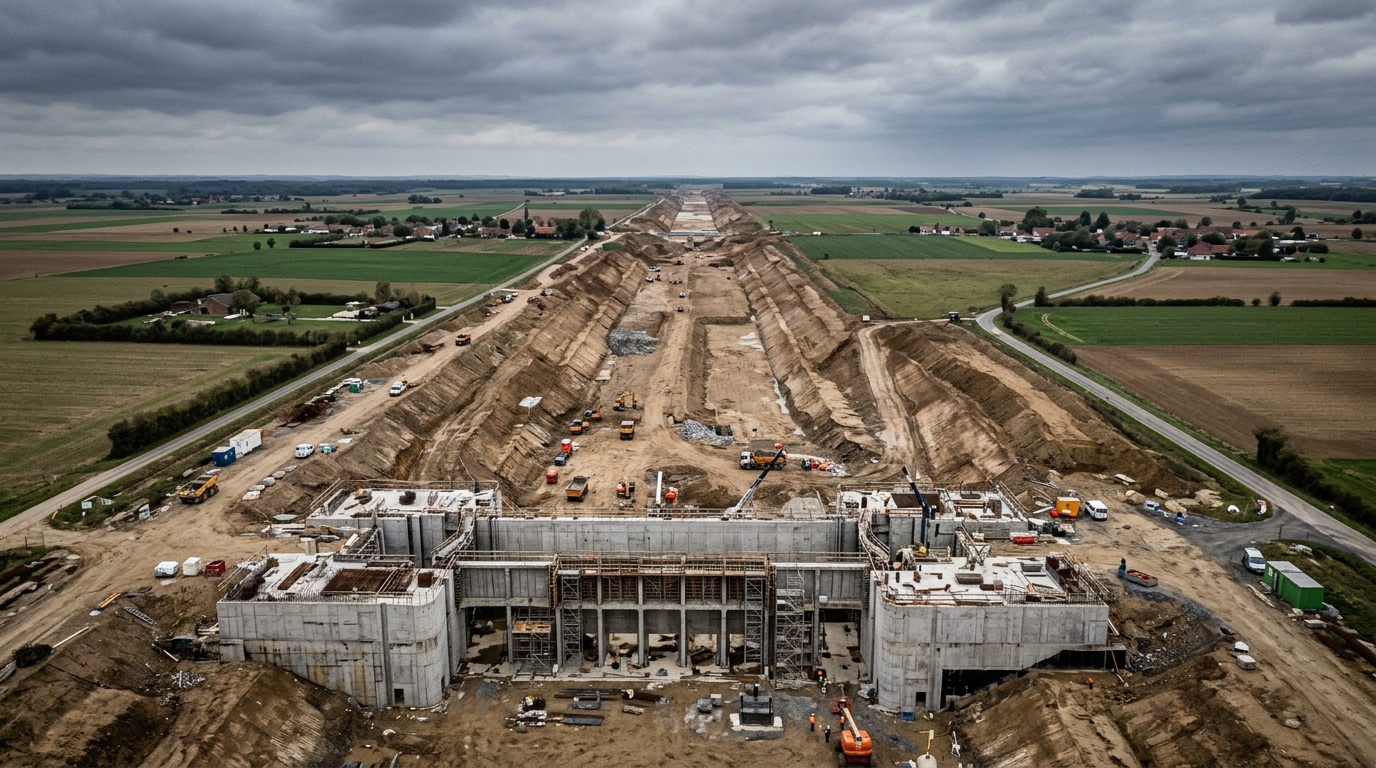
And what if France were currently building one of its largest river infrastructures, a pharaonic project meant to link two major hydrographic basins, without a single boat having ever navigated it? That is precisely the situation of the Seine-Nord Europe canal, this colossal undertaking stretching between the Oise and the Escaut over 107 kilometers. A work whose bill keeps climbing, prompting serious questions about the real mastery of such megaprojects in France.
- The cost of the Seine-Nord Europe canal has now reached 7.347 billion euros excluding taxes, up from 4.5 billion in 2017, a rise of 63%.
- The Court of Audit estimates a funding shortfall of 2.2 billion euros, while commissioning, initially planned for 2028, has been pushed back to 2032.
- Work began in 2025 in three Hauts-de-France sectors (Noyonnais, Santerre-Haute-Somme, Artois-Cambrésis), but no vessel has yet been able to use the canal.
- A phantom canal that has already cost 7 billion euros without a single boat passing
- A colossal construction site between the Oise and the Escaut, but not a drop of traffic yet
- From 4.5 to more than 7 billion: how the bill exploded over the years
- Giant barges, monumental locks: what this river highway is really meant to serve
- Pushback of the schedule, uncertain funding: the real reasons for the delay
- Seine-Nord Europe, the multi-billion gamble whose payoff France is still waiting for
A phantom canal that has already cost seven billion euros without a single boat having passed
Here is the paradox that alone sums up the story of this extraordinary project: a construction already valued at more than seven billion euros, while no barge, no tug, no inland-waterway convoy has yet been able to use it. The construction cost is today estimated at 7.347 billion euros in current prices excluding taxes, a figure that climbs further when one includes the costs tied to the loans taken to finance the whole. According to the latest estimates, the total bill could thus approach 10 billion euros, between the direct cost of the project and the associated financial interest.
A report by the Court of Auditors, conducted in association with the regional chamber of accounts of Hauts-de-France, came to confirm what many feared: a drift in costs and delays that is particularly marked. The Court even estimates a current funding shortfall of 2.2 billion euros, a sum that remains to be found to close the project’s budget.
A colossal construction site between the Oise and the Escaut, but not a single drop of traffic yet
On the ground, work is indeed progressing. The first infrastructures began in 2022 in the Oise region, before the works directly affecting the canal began in 2025 in three key sectors: the Noyonnais, the Santerre-Haute-Somme, and the Artois-Cambrésis. These areas will, in due course, host a channel capable of accommodating large-scale inland navigation.
But between the start of the first shovels and the actual circulation of ships, the gap remains immense. The declaration of public utility for this project dates back now to nearly twenty years, which gives an idea of the long time frame within which this kind of infrastructure unfolds. Twenty years of discussions, adjustments, budget reevaluations, for a project that has still not proven its tangible usefulness on the water.
From 4.5 to more than 7 billion: how the bill exploded over the years
The evolution of the figures is dizzying. In 2006, the file submitted to the public inquiry by Voies navigables de France estimated the total cost between 3.17 and 3.52 billion euros excluding taxes. A figure that has literally tripled since then. In 2017, when the project’s holding company was created, the estimate rose to 4.5 billion euros. Two years later, in 2019, it reached 5.1 billion euros.
Today, the bill stands at 7.3 billion euros excluding taxes, i.e., a 63% increase compared with 2017, a pace well above general price trends. A written question submitted to the National Assembly notes that the final cost could ultimately lie between 7 and 8 billion euros. Xavier Bertrand, president of the Hauts-de-France region, does not hide it: he himself said he was not surprised that one could “reach 8 billion by 2033.”
Giant barges, monumental locks: what this river highway is really meant to serve
Behind these dizzying figures lies a project whose initial ambition remains, indeed, perfectly clear: to create a navigable link between the Oise and the Escaut over 107 kilometers, with the aim of developing inland navigation between these two basins.
Such a project obviously requires substantial infrastructure, whose construction partly explains the scale of the budget, but which, for the moment, has served no one, due to the canal not yet being put into operation.
Pushback of the schedule, uncertain funding: the real reasons for the delay
If the project keeps slipping, it is not an isolated mishap but the result of a combination of several factors. The completion date, initially set for 2028, has been pushed back to 2032, a reassessment that alone represents an increase of 1.1 billion euros. A simple schedule delay, and the bill swells accordingly.
In addition, a funding shortfall now estimated at 2.2 billion euros by the Court of Auditors highlights a budgetary gray area that raises questions about the ability of the different public partners to close the financing plan within the expected timelines. A public inquiry, ordered by inter-prefectoral decree in February 2024, was supposed to clarify certain points of the project; it mainly confirms the scale of the uncertainty still hovering over the final cost of the work.
Seine-Nord Europe, the multi-billion gamble whose payoff France is still waiting for
There remains a fundamental question, almost dizzying: what will be the actual cost of this canal once completed? Between the 7.3 billion euros already set and the risk, raised by several political voices, of exceeding 8 billion euros, doubt persists. The project is indeed making physical progress on the ground, with works now well under way in several Hauts-de-France territories, but its tangible usefulness remains for now a promise.
This grand riverine bet could, in the long run, change the game for navigation between the Oise and the Escaut. But until the first barge finally goes through the locks of Seine-Nord Europe, the bill, for its part, continues to climb quietly.
So, a simple construction delay or a symptom of a deeper malaise in the management of France’s major infrastructures? One thing is certain: by the announced service date around 2032, it will be necessary to keep a very close eye on the evolution of this bill, which has so far never ceased to grow.
