
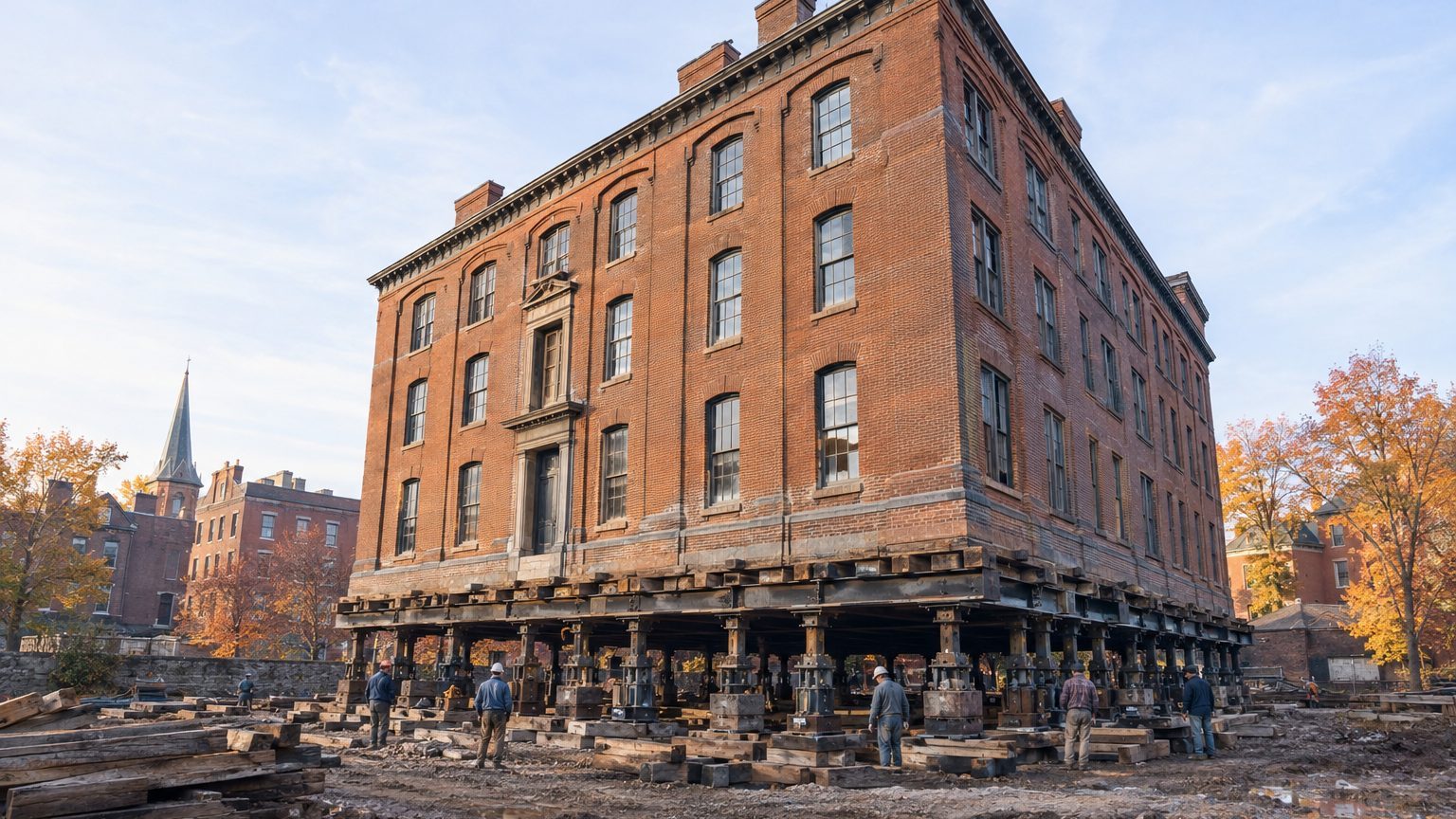
The Tremont House, a six-story brick hotel perched in Chicago, was lifted by six feet, or 1.83 meters, in 1861. It kept operating throughout the process, with guests inside.
No one had to pack their bags.
- Chicago raised its street levels in the 1850s-1860s to accommodate a sewer network, forcing owners and builders to adapt existing structures.
- The six-story brick Tremont House was raised by 1.83 meters in 1861 with hundreds of screw jacks, all without interrupting service.
- George Pullman, who led the operation, built his reputation as a building lifter before revolutionizing transportation with sleeper cars.
A city too low to drain its waters
Chicago was built up against the shores of Lake Michigan, and its waters could not flow away. The city chose to raise the street level in order to host a sewer network. The urban ground was thus elevated street by street throughout the 1850s and 1860s.
For property owners, the bill soon arrived. Once the roadway was raised, ground-floor spaces ended up lower, sometimes with no direct access or visibility from the street. There were two options remaining: demolish to rebuild, or lift the existing building. Many chose to lift, provided the masonry was sound, and the jack became the city’s tool.
The first successful test occurred in January 1858: a masonry building raised by 6 feet 2 inches, about 1.88 meters.
The principle can be summed up in a few words. Hundreds of screw jacks are slid under the walls, and at a signal, each worker gives them a half-turn. Buildings rise thus in small increments, all together, and the masonry beneath is gradually taken up as they ascend.
An entire block of Lake Street in five days
In 1860, the scale of the operations increased. On Lake Street, a block of about 98 meters of frontage, nearly the length of a football field, was raised by 4 feet 8 inches (roughly 1.42 meters). The project mobilized 600 workers and 6,000 jacks, and it lasted five days.
Among the contractors, one name would later recur in railroad history: George Pullman. He was part of the consortium that lifted this block of four- and five-story brick and stone buildings. The operation was deemed so spectacular that artist Edward Mendel produced a large lithograph, later used as a promotional tool.
The demonstration was clear: a block of houses could be lifted as a single unit.
The Tremont House, or the hotel that rises without closing
What remained was to lift an actual hotel. The Tremont House stood at the corner of Lake Street and Dearborn Street, brick-built, six stories tall, occupying more than an acre (over 4,000 square meters). The contract in 1861 went to the Ely, Smith & Pullman firm. The aim was to raise it by 6 feet, or 1.83 meters, to align it with the new street grade. Various sources place the workforce in the hundreds and the jacks in the thousands.
According to some accounts, a United States senator stayed there without realizing it.
The workers labored in covered trenches beneath the building, keeping what guests could see or hear to a minimum. A frequently told anecdote, which I could not verify, spoke of a guest puzzled by the entry stairs that grew steeper from day to day. Upon his departure, the windows at his eye level were said to be above his head.
Pullman, for his part, reportedly promised to carry out the work without disturbing a guest or breaking a single pane. He earned his reputation as a building lifter before turning to sleepers cars, the first of which was completed in 1864. Three years separate the raised hotel from the sleeping car in which one travels while the wheels roll along.
The Chicago Daily Tribune covered the operation on its front page on February 26, 1861. Reported manpower figures vary across accounts, which is why only approximate orders of magnitude are cited here.
Sources: en.wikipedia.org | classicchicagomagazine.com
