
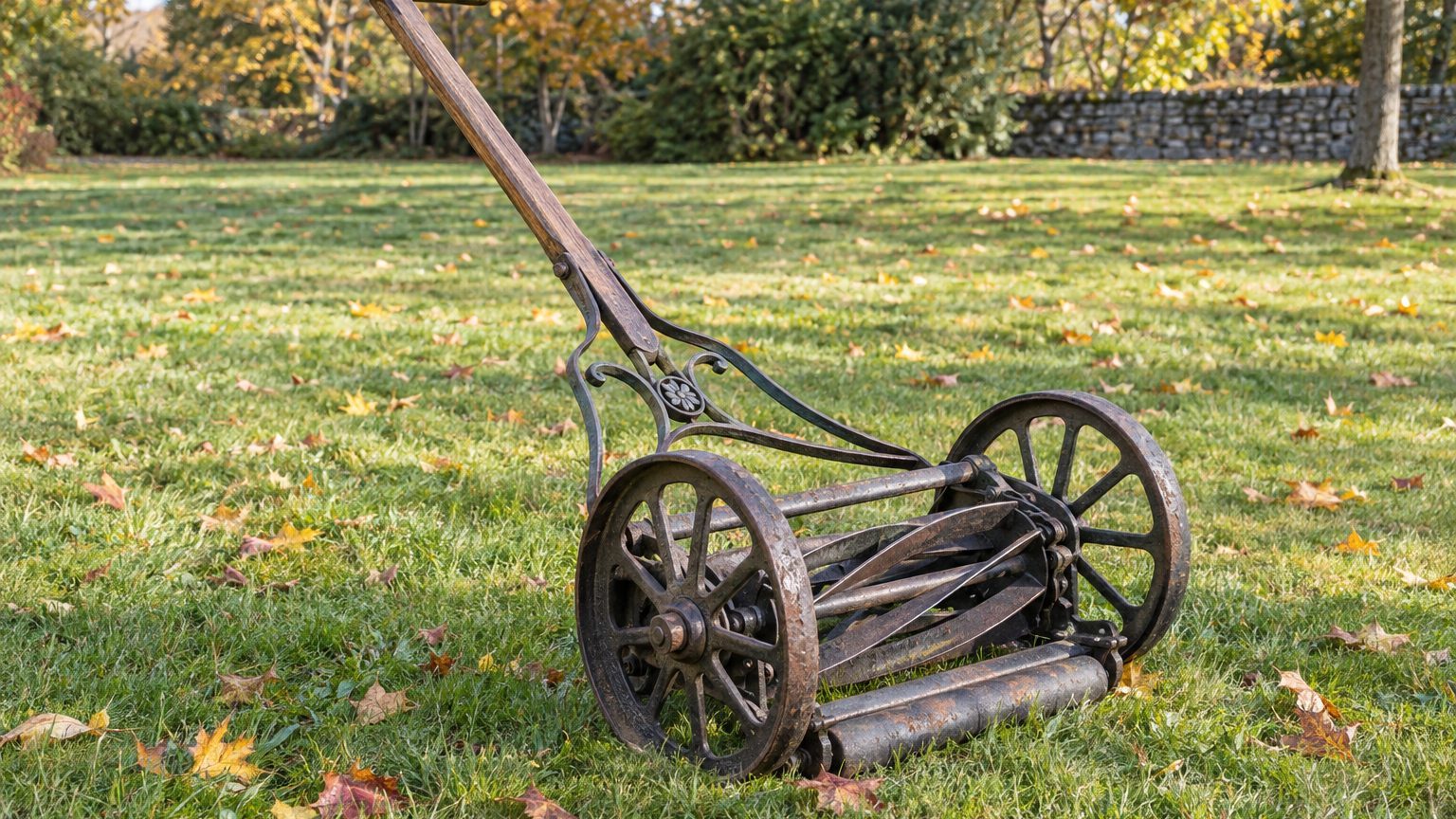
The first patented lawn mower, in 1830, was not conceived for a lawn. It was copied from a wool-winding machine, one that shaved the uneven nap from woolen cloth to give it a smooth finish. Edwin Beard Budding, an engineer from Stroud in Gloucestershire, transformed this fixed machine into a hand-pushed, mobile tool for grass with only minor changes to its principle.
The starting point was not a lawn, but a piece of cloth.
- The 1830 mower was copied from a textile-finishing machine that shaved the nap off woolen cloth
- Edwin Beard Budding transformed this stationary device into a hand-pushed, mobile mechanism in under three months
- The first units were installed at Regent’s Park Zoo and on the lawns of the Oxford colleges
A machine for shaving woolen cloth
In a woolen fabric mill in his region, Budding watched a blade cylinder mounted on a bench. The machine’s purpose was to shave the irregular nap that protrudes from woolen cloth, giving it a smooth finish. The motion resembles that of a barber evening up a cut, but applied to meters of fabric. Nothing in that workshop yet concerns the garden.
Budding realized that a mechanism of this kind could cut grass if it ran close to the ground. He therefore converted the fixed machine into a frame-mounted device that could be pushed by hand.
The calendar for 1830 was tight. On May 18, he secured financing with John Ferrabee. On August 31, the British patent was granted.
Nineteen inches of wrought iron, for large grounds
The first machine measured 19 inches in width, about 48 cm, and its frame was wrought iron. This was no garden parlor toy. It was designed for sports grounds and large gardens, where it would replace the scythe, a tool whose handling demanded hours of practice.
Two of the earliest units were sold to places that still appear on today’s tourist maps. The first went to Regent’s Park Zoo in London. The others were sent to the Oxford colleges, whose lawns served as showcases for the institution.
The small suburban garden was not part of the brief.
This weekend, on the lawn
For many gardeners, the last mowing of the season falls this weekend, before the grass slows. If you own a hand-cranked reel mower, you are almost holding the artifact of 1830. Its design hasn’t changed in essence: a rotating cylinder of blades driven by the device’s motion.
Take a close look at that cylinder, and you’ll see the textile-finishing mechanism. It is the same cutting element taken from the cloth workshop and placed on wheels.
Between the May 18 agreement with Ferrabee and the patent on August 31, 105 days elapsed. It is barely more than three months to go from a fabric machine to the ancestor of all lawnmowers.
A repurposing of use that became the norm
Budding did not invent from nothing. He moved a solution from one sector to another, something engineers have been doing for ages and which is rarely celebrated. The lawnmower is one of the most visible examples, since today it sleeps in millions of garages.
One might also regret that history records so little about the cloth mill itself. The name of the mill where Budding saw the machine does not appear in the sources consulted, and it is better not to invent one. We only know that it was in his region, Stroud, where the cloth industry was a commonplace business.
Here’s a practical takeaway for your next mowing. If the blade on your device cuts poorly, think of the cloth analogy: a clean cut depends on a well-adjusted cylinder and a steady pass, not on how hard you push. A patient adjustment will yield better results than brute effort, as in the 1830 workshop.
The wrought iron of the first machine had enough to deter enthusiasts. Its 19-inch width also prevented it from slipping between flowerbeds, which was not its aim.
No record in the consulted dossier of a slogan promising pleasure to buyers, so none will be quoted. What remains, however, is a patent dated August 31, 1830 and a cutting principle that remains recognizable on September lawns.
Sources: archive.lib.msu.edu | madeupinbritain.uk | historyatlas.com
