
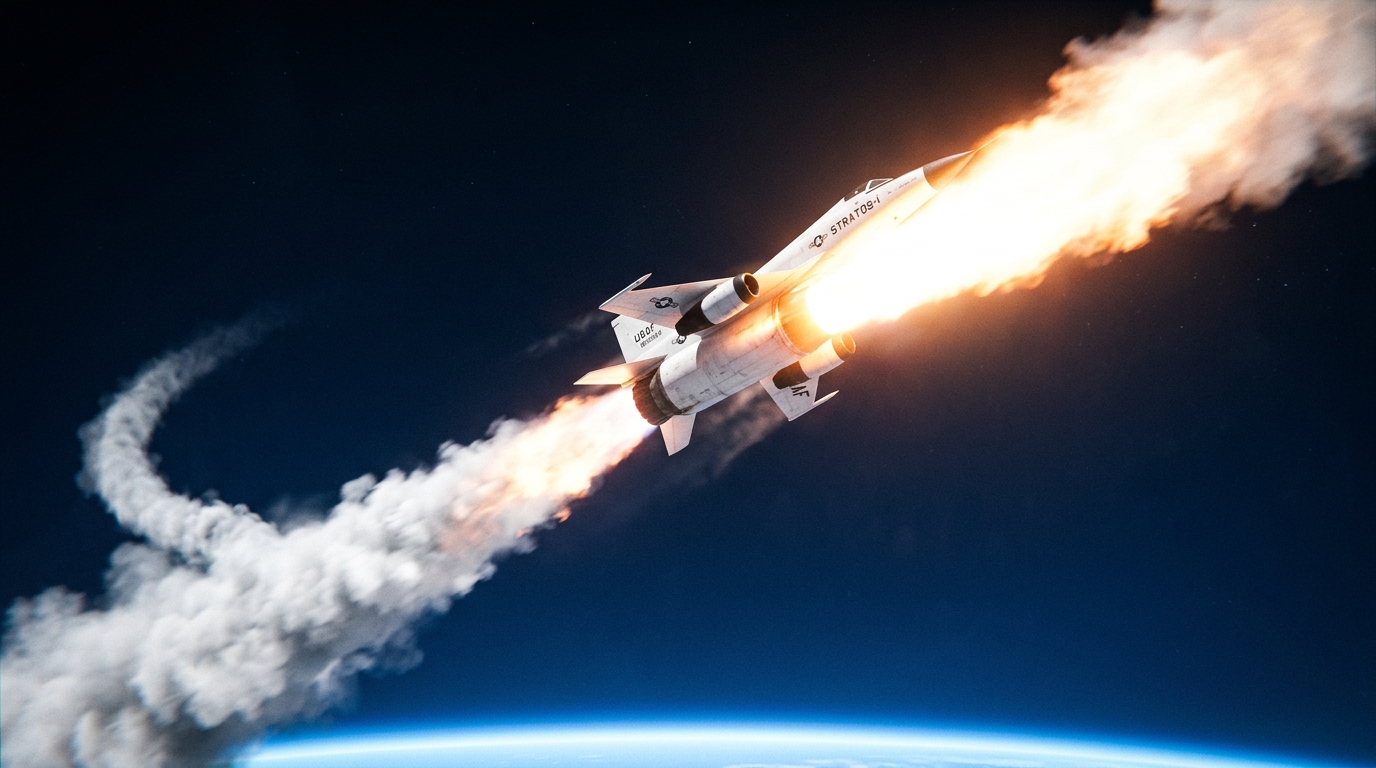
A weather balloon can reach heights beyond 30,000 meters, but it has never had to dodge enemy radar or intercept anything. An aircraft that is piloted, propelled, and armed, capable of reaching such altitudes in a matter of minutes, represents an entirely different challenge. Yet this was the feat France achieved in the midst of the Cold War, with a machine that has since faded from the public memory. In the spring of 1958, a hybrid prototype blending turbojets and a rocket engine climbed to 24,217 meters, seizing a world record as it went. A performance that should have opened a new chapter in French military aviation. Except that a few days before this achievement, the decision to terminate the entire program had already been made. It was not an accident nor a technical weakness that caused it. The answer lies elsewhere, in the hushed corridors of French military and industrial strategy of the era.
- The SNCASO SO.9050 Trident II, a hybrid interceptor with turbojets and a rocket motor, established a world altitude record of 24,217 meters on May 2, 1958
- The program was officially terminated on April 26, 1958, before the record was set, for budgetary and strategic reasons
- The Dassault Mirage III was chosen as the French armed forces’ standard fighter, leaving only one example of the Trident II, exhibited at the Air and Space Museum
- An interceptor designed for the Cold War era
- Rocket and turbojets, the technical gamble of the Trident II
- 24,217 meters, the achievement that should have changed everything
- The Mirage III, the decision that stopped it all
An interceptor designed for the Cold War era
In the 1950s, the threat haunting Western militaries bore a precise name: the Soviet strategic bomber flying at very high altitude. To counter this threat, aircraft capable of climbing incredibly fast and extremely high were required, far beyond what conventional fighters of the time could achieve. It is in this context that the SNCASO SO.9050 Trident II was born, a French interceptor program designed for a single mission: rise sharply, strike, and depart.
The first flight of this singular aircraft took place on July 19, 1955, at Melun-Villaroche Air Base, with test pilot Charles Goujon at the controls. From its early tests, the Trident II impressed with its radical design philosophy, utterly different from the conventional fighters of its era. Its objective was not versatility but pure performance in a highly specific flight domain: high-altitude interception, where every second gained during the climb could mean intercepting an enemy bomber or watching it slip toward its target.
Rocket and turbojets, the technical gamble of the Trident II
What makes the Trident II so distinctive is its hybrid propulsion architecture, almost experimental for the era. The aircraft combined two turbojets mounted at the wingtips and a SEPR rocket motor housed directly in the fuselage. This configuration allowed reaping the benefits of both technologies: the turbojets provided sustained propulsion for takeoff and cruise, while the rocket offered a brutal, nearly instantaneous burst of power for the critical phases of rapid climb or final acceleration.
This technical gamble was not without risk. The rocket fuel, particularly volatile, demanded extremely precise handling. The program suffered a painful setback on May 21, 1957, when a prototype exploded in flight near Melun-Villaroche. This accident claimed the life of Charles Goujon himself, the pilot who had led the aircraft’s first flight two years earlier. The investigation attributed the tragedy to an accidental mixture of rocket-fuel components, underscoring how closely this hybrid technology hovered to the safety limits of engineering at the time.
24,217 meters, the achievement that should have changed everything
Despite the tragedy, testing continued, and the results spoke for themselves. In less than three years of test programs, the Trident II reached a speed of Mach 1.9 and seized several international ascent records. The early part of 1958 saw a dramatic sprint in performance: shortly after the first flight of prototype number 6, prototype number 5 achieved a first world altitude record, at 22,800 meters.
This record would not stand long, not even for the aircraft itself. On May 2, 1958, the Trident II climbed even higher and officially claimed the world altitude record at 24,217 meters. To put such an achievement in perspective, contemporary commercial aviation typically operates between 10,000 and 12,000 meters. The Trident II thus flew at more than double that altitude, in a layer of the atmosphere where the air thins dangerously and where every maneuver demanded exceptional technical mastery.
The Mirage III, the decision that stopped it all
Here lies the paradox that gives this story its full weight: the Trident II program was officially halted on April 26, 1958, just a few days before the world altitude record was established. In other words, the aircraft continued to fly and push the limits while its administrative fate was already sealed. This decision had nothing to do with a technical failure or a lack of performance. It resulted from a set of more prosaic factors: growing budget constraints, an evolution of air-defense doctrines that gradually moved away from the concept of a pure interceptor, and above all the rise of a formidable competitor, the Dassault Mirage III.
Industrial context had also shifted the balance. In March 1957, SNCASO merged with SNCASE to form Sud-Aviation, which then took over the Trident program. But facing state budgetary arbitrage, it was the Mirage III that was chosen as the French air force’s standard fighter, relegating the Trident to the status of an abandoned project. Only twelve examples were ultimately built, and a more advanced version, the Trident III, even faster on paper, never left the drawing board. Today, a single example remains, the SO.9000-01, on display since 1956 at the Air and Space Museum near Paris, a silent witness to an audacious technological gamble sacrificed not on the altar of technique, but on that of strategic choices.
The story of the Trident II encapsulates the tensions inherent in Cold War military aviation, where technical excellence did not always secure a program’s future. The Mirage III ultimately embodied the future of French fighter aviation, while the Trident II remained a curious hybrid, capable of flirting with the stratosphere yet unable to convince decision-makers of its era. One question continues to echo through aviation history: how many other promising aircraft have been sacrificed not for their technical limits, but for purely strategic or budgetary reasons?
