
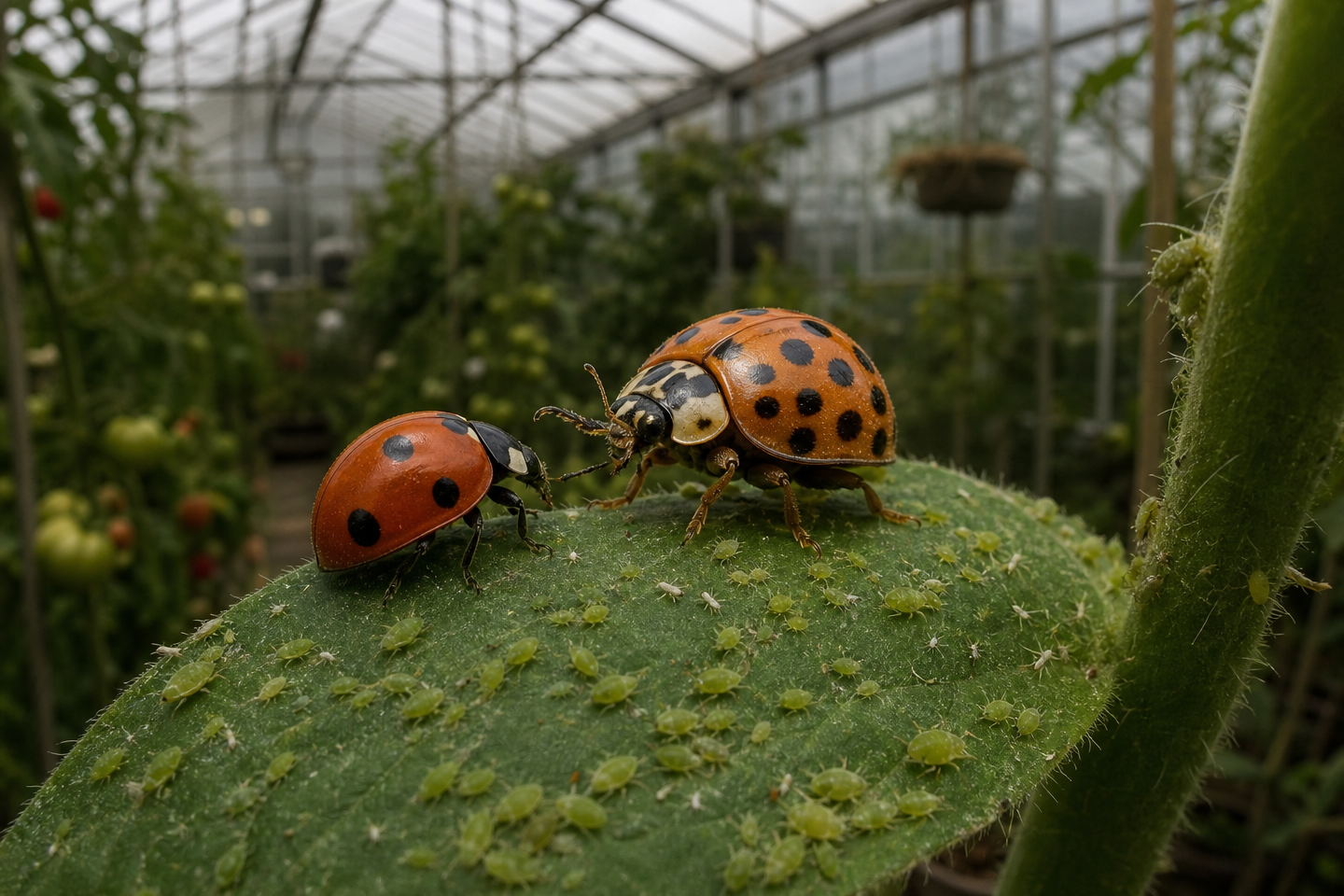
Picture the scene: in a southern French greenhouse at the dawn of the 1980s, an entomologist carefully opens a small box that holds a few dozen ladybugs straight from China. The motive is noble, even poetic: to employ natural predators to defeat aphids that ravage crops. No one at the time suspects that this gesture would permanently upset the country’s entomological balances. Forty years later, the outcome is bitter: our seven-spotted ladybugs, the ones we used to doodle in school notebooks, are increasingly scarce, while a cousin from Asia is taking over our gardens, our façades, and even our interiors. This is a story of a biological invasion that perfectly illustrates the limits of pest control.
- Imported in 1982 by INRA for biological control, Harmonia axyridis, the Asian lady beetle, colonised essentially all of Europe in under two decades.
- Driven by extraordinary appetite and fecundity, it also preys on the eggs and larvae of native lady beetles, triggering the decline of the seven-spotted lady beetle.
- Every autumn, it massively invades façades and homes in search of winter shelter.
- 1982, France imports a killer without realising it
- The failed bet on biological control
- A feeding machine without equal
- The silent invasion of our homes
- Seven points against twenty-two: the match that goes wrong
1982, France unknowingly imports a killer
It is Dr. Gabriel Iperti, a researcher at INRA in Antibes, who first brings Harmonia axyridis onto French soil in 1982. The objective is strictly scientific: to study the biological and ecological characteristics of this Chinese lady beetle, renowned for its voracious appetite for aphids. The initial specimens are confined to greenhouses, in a tightly controlled experimental setting. Nothing at this stage suggests an ecological catastrophe. Yet this small insect with its orange elytra carries a potential for nuisance that no one anticipated at the time.
The failed wager of biological control
Buoyed by the results obtained in confined environments, the use of the Asian lady beetle gradually expands. By 1990, it is deployed as a biological control against aphids in orchards in the Mediterranean region. Three years later, in 1993, releases are organised in five Parisian squares to combat the rose aphid, then in 1994 and 1995 in northern France, this time to protect hop crops. Each operation seems successful in the short term: aphids retreat, crops prosper.
Starting in 1995, enthusiasm becomes commercial. French, Dutch and Belgian companies enter the market, selling Asian lady beetles to professionals and to individuals who see a natural and appealing alternative to chemical insecticides. By the late 1990s, a French company even attempts to curb risks by lab-selecting a flightless strain, thought to remain confined to treatment zones. Paradoxically, this precaution would have actually facilitated the expansion of the invader population by increasing contact points with the natural environment.
An eating machine without equal
If Harmonia axyridis enjoyed such commercial success, it is because its appetite is literally extraordinary. A single larva can decimate more than 100 aphids per day, while an adult devours nearly 300 daily. Coupled with an impressive fertility, a female can produce up to 2,500 larvae over a two- to three-year lifespan. This formidable combination of appetite and fertility allowed the species to colonize the entire European territory in less than two decades, a propagation speed rarely observed in an introduced insect.
The problem is that this diet does not stop at aphids. When typical resources become scarce, the Asian lady beetle does not hesitate to attack the eggs and larvae of other lady beetles, including our native species. In other words, the tool intended to fight a pest became, itself, the predator of our natural allies.
The silent invasion of our homes
As autumn arrives, many French people witness this phenomenon more closely than they would wish. With the first frosts, Harmonia axyridis seeks shelter to overwinter and clusters by the hundreds on sunlit façades, before slipping into houses through the smallest cracks. Reports of these domestic invasions multiply every year, between bent shutters and interiors colonised by these little creatures that emit, when crushed, a sharp, unmistakable odour.
This autumnal aggregation behavior, entirely natural in its native biotope, takes on a far more dramatic turn when it occurs in an environment where the species’ population has exploded without any natural check.
Seven points against twenty-two: the match that goes wrong
The seven-spotted beetle, a familiar symbol in our gardens, clearly cannot hold its own against its Asian rival, similar in size, equally voracious and adorned with around twenty spots depending on the coloration it can display. A British study documented a marked decline of native lady beetles in the United Kingdom following the arrival of Harmonia axyridis on the territory. In France, field observations point in the same direction: in several regions, the seven-spotted beetle has become markedly rarer, supplanted by a better-armed species for competition over food and reproduction.
Researchers today agree on one point: it was indeed the releases carried out as part of biological control that greatly contributed to this invasion at the continental scale. A farming tool designed to protect our crops thus transformed, without warning, into a direct threat to our entomological biodiversity.
This story sums up the paradoxes of biological control fairly well: a solution that seems ideal on paper can turn, once released into the wild, into something completely uncontrollable. As autumn returns each year with its parade of Asian lady beetles on our walls and inside our homes, it is hard not to revisit the decision made in 1982, carried out with the best intentions in the world. Should we, for that reason alone, renounce these natural methods of crop protection, or learn to anticipate their long-term consequences better? The question remains open, and it concerns far more than the fate of our seven-spotted lady beetles.
