
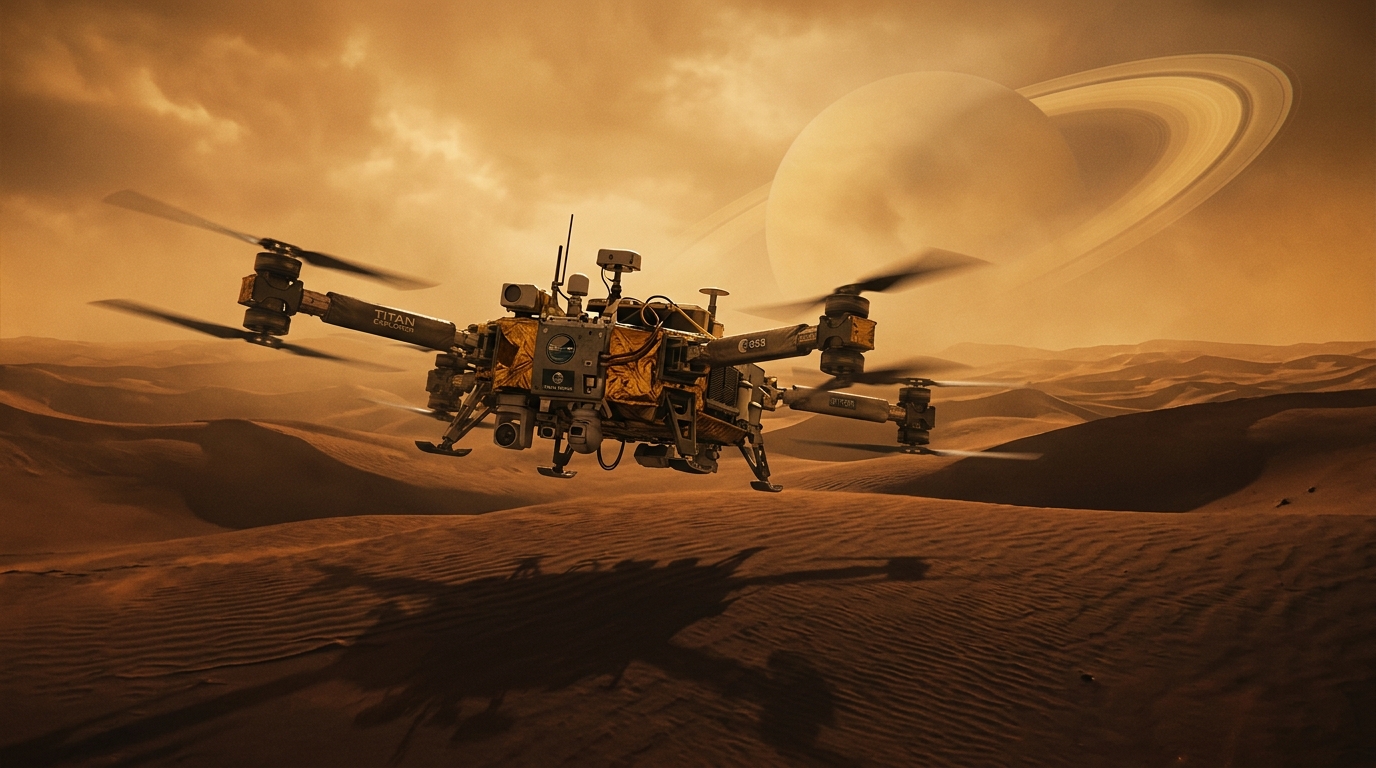
Imagine a machine capable of vaulting over dunes of organic sand, skimming above methane lakes of ice, and settling softly on a surface where the “snow” is liquefied natural gas. This science-fictionish panorama is on track to become a documented scientific reality within a few years. NASA is currently preparing one of the most audacious missions in its history: dispatching an octocopter drone to Titan, the giant moon of Saturn, to perform repeated flights across a world beyond Earth. The project, named Dragonfly, aims not only to push the boundaries of engineering but also to shed light on the mechanisms that may have given rise to life on our own planet.
Key Takeaways
– Dragonfly will be the first autonomous octocopter to fly on another world in the solar system, with launch planned for 2028 and arrival at Titan in 2034.
– The dense atmosphere and low gravity on Titan allow a 450 kg vehicle, powered by a Pu-238–based generator, to fly with modest energy use, capable of covering up to 8 km per hop.
– Budgeted at about 3.35 billion dollars, this mission seeks to study Titan’s prebiotic chemistry, its methane-ethane lakes, and its meteorological cycle—features reminiscent of early Earth—in order to illuminate the origins of life.
Sommaire
– Dragonfly, the mission that will set space exploration in motion
– Why Titan is the only world in the solar system where flight is so feasible
– 450 kg of technology powered by plutonium: the anatomy of an extraterrestrial octocopter
– Eight years of travel for eight kilometers of leaps: NASA’s bold bet
– What Dragonfly will reveal about the origins of life
Dragonfly, the mission that will set space exploration in motion
Since the dawn of space exploration, the craft sent to other worlds moved mainly along the ground, trudging across often hostile terrains. Rovers on Mars, as capable as they are, remain bound to wheeled movement, forced to maneuver around obstacles and gaps. Dragonfly flips the script. It is set to be the first motorized and truly autonomous aircraft to fly over another world in the solar system beyond Earth, with mobility and endurance never before attempted on another planet.
The schedule is solidly defined. Launch is slated for the summer of 2028, with a SpaceX Falcon Heavy launcher officially designated by NASA in late 2024. After a lengthy journey through the Solar System, the probe is expected to reach Titan in 2034. The project is led by Elizabeth Turtle, nicknamed Zibi, the chief engineer at Johns Hopkins Applied Physics Laboratory, who coordinates the teams responsible for bringing this bold extraterrestrial octocopter to life.
Why Titan is the only world in the solar system where flight is so feasible
Taking to the skies on another celestial body may appear to be a nearly insurmountable challenge at first glance. Yet Titan offers almost providential conditions for such an achievement. Its atmosphere, composed mostly of nitrogen, is about four times denser than Earth’s atmosphere, while its gravity is only about one-seventh of ours. This unique combination means that far less energy is required to sustain flight than on our planet.
In other words, a rotor that would struggle to lift a drone on Earth becomes more than sufficient on Titan. This paradox is precisely what convinced NASA engineers to emphasize flight rather than ground travel for exploring this moon. Instead of laboring to surmount dunes or icy blocks on the surface, Dragonfly can literally take to the air above obstacles, saving time and offering unprecedented flexibility in landing-site selection.
450 kg of technology powered by plutonium: the anatomy of an extraterrestrial octocopter
Weighing in at 450 kilograms and with a fuselage nearly four meters long, Dragonfly is far from a mere hobby drone. The craft was delivered ahead of the schedule envisioned by the Johns Hopkins APL teams, following an entire month of structural tests designed to ensure it would survive the rigors of the voyage and the landing.
On Titan, where sunlight delivers only about one one-hundredth of the light that reaches Earth, solar power is out of the question. Engineers therefore chose a radioisotope thermoelectric generator fueled by plutonium-238. This compact nuclear power source provides roughly 70 watts—about the output of a small light bulb—but that is more than enough to run the eight rotors and the scientific instruments. It is a technological feat illustrating how space engineering must juggle energy constraints that are radically different from those on Earth.
Eight years of travel for eight kilometers of leaps: NASA’s bold bet
The math may seem puzzling: Dragonfly will take nearly six years to reach Titan after launch, and will then perform only short hops spanning a few kilometers. Yet this is precisely the mission’s strength. Each Titan day, which lasts roughly 16 Earth days, the craft will have the opportunity to fly once, with each hop reaching up to eight kilometers. Over the 3.35-year science mission, hundreds of kilometers could be traversed, enabling exploration of dozens of sites.
Of course, such ambition comes at a price. The mission’s total lifecycle budget is estimated at about 3.35 billion dollars, a figure NASA has confirmed. It is a substantial investment, but commensurate with the scientific stakes. The mission is also decidedly international, with contributions from CNES of France, the German DLR, and JAXA of Japan. This collaboration echoes the Cassini-Huygens mission, which sent an orbiter and a lander to Titan around two decades ago and paved the way for this next generation of exploration.
What Dragonfly will reveal about the origins of life
Titan captivates scientists because, like Earth, it is one of only two known worlds in the solar system with liquids on its surface. But Titan’s seas and rivers are not water; they are methane and ethane, chilled to around minus 179 degrees Celsius. The moon also experiences its own seasons and a genuine meteorological cycle, with clouds, rainfall, and active erosion shaping its landscape over time.
These striking similarities to our planet’s early days make Titan an ideal laboratory for studying prebiotic chemistry—the suite of chemical reactions that could have preceded life. By analyzing the composition of Titan’s soils and liquid reservoirs, Dragonfly could yield vital clues about the conditions that could have fostered, or hindered, the emergence of complex organic structures. This scientific challenge extends far beyond technical prowess; it could ultimately help us better understand our own origins.
In this autumn season, as eyes turn toward the stars during long evenings, the Dragonfly mission reminds us of how space exploration relentlessly pushes the horizon of what is imaginable. Between technical triumph and the existential quest to understand life’s origins, Dragonfly embodies the enduring curiosity that drives humanity to explore worlds ever farther away. The question remains: what secrets will this icy moon, so eerily similar to early Earth yet so different, reveal once the aircraft lands on its enigmatic surface?
