
€11.8 billion. This is the cost now acknowledged for the cross-border section of the Lyon–Turin railway link, compared with €5.2 billion estimated in 2019. The European Court of Auditors scrutinized eight major European transport megaprojects, whose cumulative cost rose from €36.3 billion at the initial planning stage to €66.5 billion by the end of 2025, and Lyon–Turin is among the two projects that pull this bill upward. And while the bill climbs, the project itself advances at a pace that invites scrutiny.
In autumn 2025, the verdict is unequivocal. TELT announced that 19.2 of the 115 km (57.5 km times 2 tubes) of the main tunnels have been dug, along with 26.1 km of auxiliary, smaller-diameter galleries. Less than a fifth of the base tunnel under Mont-Cenis is completed, more than a decade after excavation work truly began. No passenger train has ever traversed this facility.
- The project cost for the cross-border section has risen by 127%, from €5.2 to €11.8 billion in six years.
- Only 19.2 of the 115 kilometers of main tunnels have been dug after more than a decade of work.
- The French access routes will not be ready until 2045, twenty years after the tunnel’s originally planned completion.
A colossal project, a schedule that keeps slipping
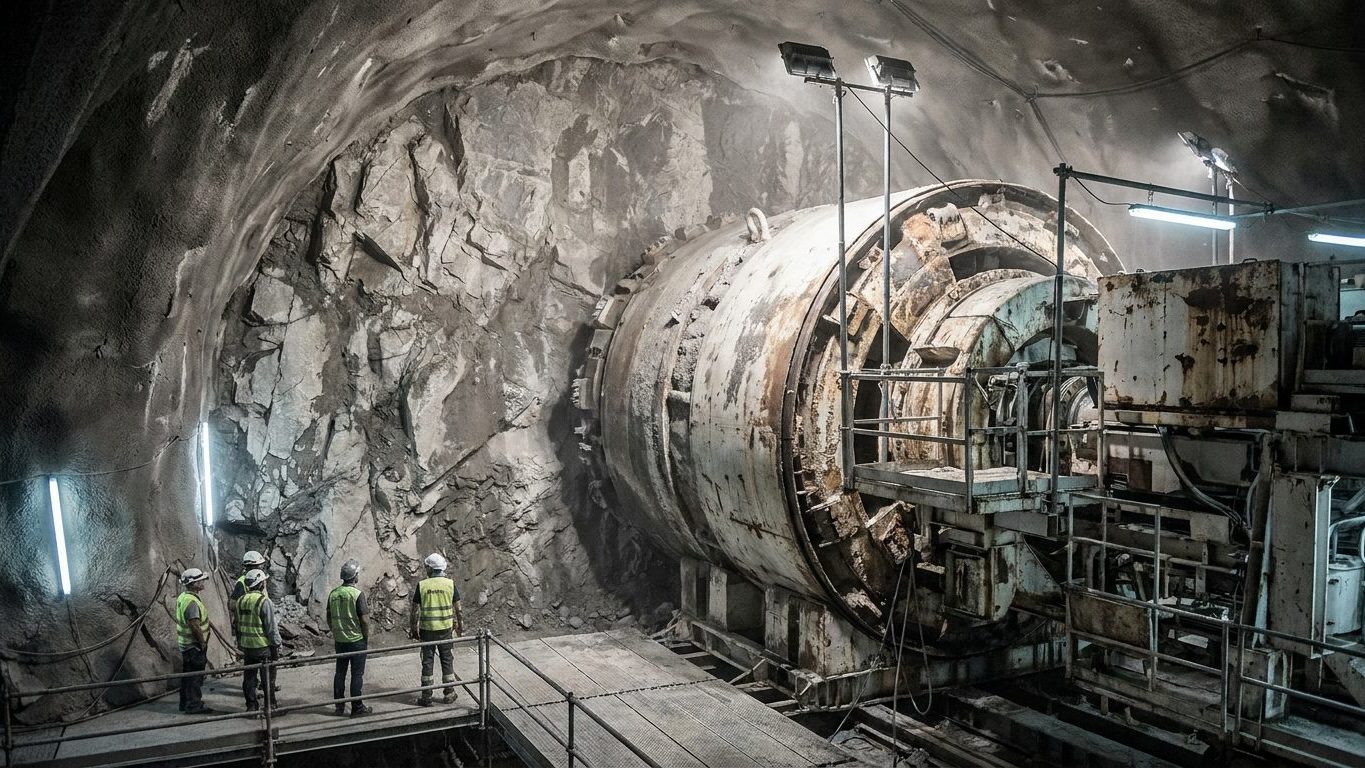
In 2025, roughly 3,000 workers rotate around the clock—24 hours a day, 7 days a week—to excavate 37 million tonnes of rock. Eighteen active excavation fronts, giant tunnel-boring machines that advance inch by inch beneath the mountain, a raise boring machine digging a 500‑meter-deep ventilation shaft at Avrieux. The scene is impressive. Yet the scale of the resources deployed does not bridge the gap between the initial promise and the field reality.
And the schedule, precisely, has kept unraveling. The originally envisioned completion year was 2015, pushed to 2030 during the 2020 audit, and is now estimated at 2033, a delay of 18 years from the original plan. Three revisions in ten years. This isn’t a simple technical adjustment; it is a pattern repeated at each new deadline announced.
The construction site has not been without human tragedy. In less than two years, three people died on the site by February 2025. A 51-year-old worker, a 31-year-old technician, and a 64-year-old engineer—these losses remind us that digging 115 kilometers under the Alps is far from routine work.
The cross-border section, the heart of the overspend
The base tunnel alone concentrates most of the financial drift. The Court rounds the revised cost at €11.828 billion for this section in November 2025, versus €5.203 billion in the 2019 estimate, a rise of 127%. More than a doubling in six years for a portion that represents only part of the overall project. The rest of the bill is spread across French and Italian access routes, new stations, and related works.
This slip is not unique in the landscape of Europe’s large rail projects. This link stands among the two projects responsible for significant cost increases that lift the total of the eight flagship TEN-T transportation infrastructures. Lyon–Turin is thus not an isolated case of local mismanagement. It illustrates a structural tendency in large cross-border infrastructure projects, where initial estimates mainly serve to secure political acceptance for projects whose real costs only emerge years later.
On the French side, the wait continues
If the cross-border tunnel progresses, even slowly, the French access routes remain markedly behind. They are not expected to be ready before 2045. That is twenty years from now. This deadline concretely means that a train could someday cross the Alps under Mont-Cenis without being able to operate at full capacity on the French side, due to a lack of suitable infrastructure between Lyon and Saint-Jean-de-Maurienne.
That disconnect between the international tunnel and its national connections is not new in the project’s history. Debates over the route, funding, and the very usefulness of these new tracks have fueled discussions for years among local authorities, environmental groups, and advocates of shifting freight from road to rail. Meanwhile, trucks continue to traverse the Alps by road, and the schedule for the French access remains stretched beyond the tunnel’s own timeline.
One concrete question remains for users and taxpayers: what will a completed tunnel be worth if the access roads on the French side are not ready for another two decades? The Lyon–Turin project, undertaken for more than thirty years, illustrates the difficulty of synchronizing cross-border works where each link depends on budgetary and political choices by two countries, and an European Union that funds without always being able to impose a single timetable.
Sources: assemblee-nationale.fr | deplacementspros.com | reporterre.net
