
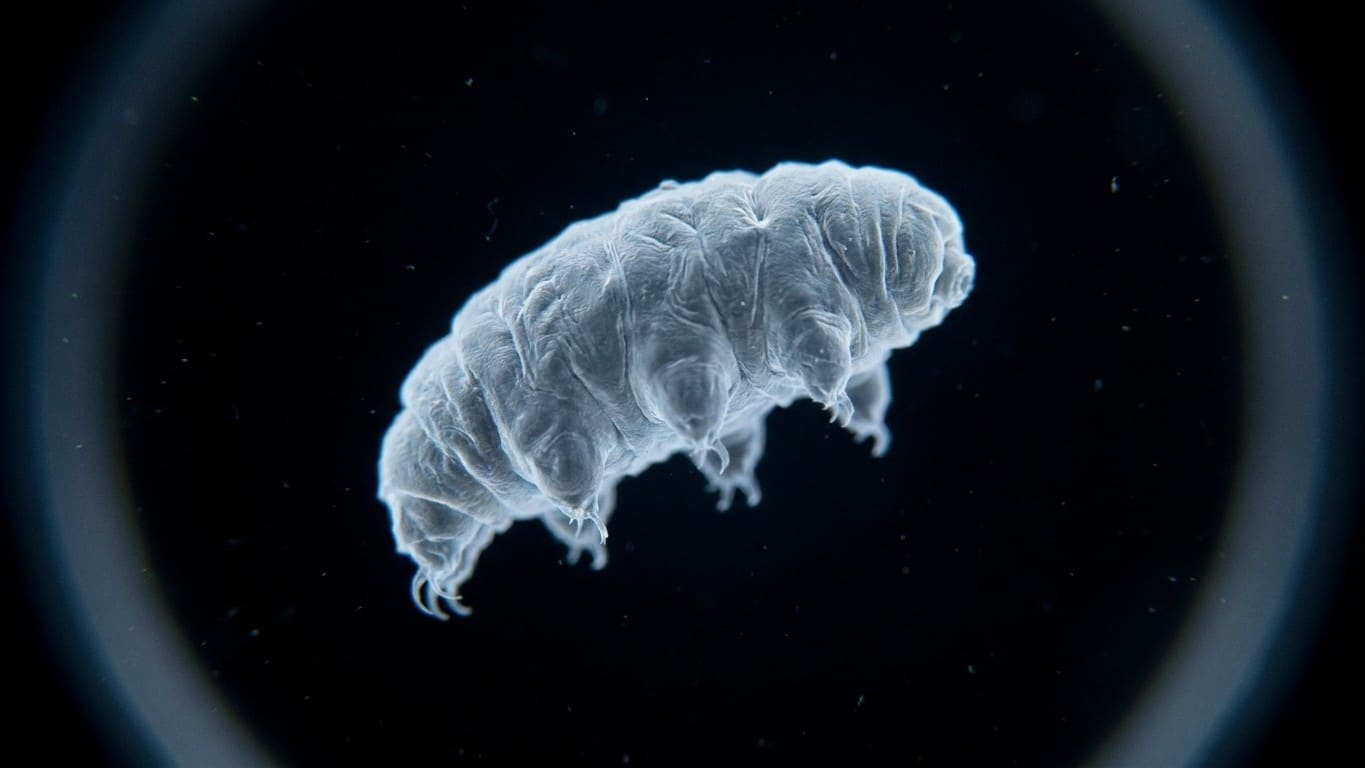
A microscopic animal, dried like a raisin, laid bare to cosmic radiation and the vacuum of space for ten days in orbit. The result? It comes back to life in less than half an hour once rehydrated. This is exactly what happened in September 2007 when tardigrades boarded the European Space Agency’s Foton-M3 mission, and the outcome literally stunned the scientific community.
Before this experiment, it was believed that no animal organism could withstand simultaneously space vacuum and raw solar radiation. The vacuum, which imposes extreme dehydration, and solar or cosmic radiation prevent the survival of most organisms in space. Only anhydrobiotic organisms, which have developed adaptations to survive desiccation to varying degrees, have potential to endure the space vacuum. Until then, open-orbit tests mainly involved bacterial spores, seeds, or lichens. An eight-legged animal resembling a jelly-like bear had never been on the list.
To note
- Thousands of micro-animals sent naked into space: what really happens when they return?
- Space vacuum alone does not kill them: it is the combination with radiation that changes everything
- The survivors transmit no mutations to their offspring: how is that possible?
An experiment designed like a surgical protocol
The Swedish biologist Ingemar Jönsson, from Kristianstad University, conceived the TARDIS experiment (Tardigrades in Space), which took place on a platform named Biopan-6, built by the ESA and mounted outside the Foton-M3 capsule at an altitude of 270 kilometers. Tardigrades from several different species, in anhydrobiotic state, were arranged in four series of containers open to space for ten days. One group was shielded from all radiation, two others received either UVA or UVB, and the last had no protection. The control group endured everything: the unfiltered sun and the vacuum.
The exposure’s intensity is dizzying. At that altitude, ultraviolet radiation reaches 7,000 kilojoules per square meter, a thousand times higher than at sea level. They did not attempt to spare these microscopic critters. They were placed in the worst imaginable conditions, unprotected, to see how far their legendary resilience could go. The tardigrades used belonged to species Milnesium tardigradum and Richtersius coronifer, two regulars in studies of extreme tolerance in invertebrates.
On September 14, 2007, the rocket lifted off from Baikonur in Kazakhstan. The capsule completed 189 orbits around Earth before returning. On September 26, the Foton-M3 capsule landed safely on the Kazakh steppes. It then headed to Swedish and German laboratories for the moment of truth.
68% of survivors and a discovery that changes the game
The figures, published in September 2008 in Current Biology, are striking. The two tardigrade species survived exceptionally well to exposure to vacuum alone, with no significant difference in survival compared to controls. In other words, vacuum by itself did almost nothing to them. It is the combination with UV that changes everything.
Among the samples exposed to UVA and UVB, a large proportion (68%) of M. tardigradum specimens came back to life within less than 30 minutes, while only a single specimen of R. coronifer exposed to the same rays revived. Mortality remained high among some individuals, but the mere fact that they revived after such an ordeal was already an unprecedented feat. Under the most lethal conditions, with exposure to the entire solar spectrum, only three M. tardigradum specimens survived. Three individuals. Of thousands exposed. Yet three were enough to rewrite the manuals of extreme biology.
It was the first time a animal showed the ability to survive simultaneously in space vacuum, cosmic radiation, and direct solar ultraviolet light. A global first that earned tardigrades a special place in astrobiology research, since they had previously been encountered mostly in damp garden moss or sidewalk lichens.
The real tour de force: viable eggs after the return
Surviving is one thing. Reproducing normally afterward is another. And precisely this is what some survivors of the mission achieved. Back on Earth, the samples were rehydrated to assess their activity, their egg-laying, and the viability of these eggs. The surviving females laid eggs, and some of these eggs hatched into perfectly normal juveniles.
A complementary part of the mission, named TARSE and conducted in parallel on other tardigrade samples, confirmed this reproductive robustness. During the mission, the tardigrades molted, and females laid eggs. Several eggs hatched, and the newborns displayed normal morphology and behavior. Not only did the adult organism endure the shock, but its offspring bore no visible signs of damage.
This absence of sequelae was later confirmed, almost ten years after the initial experiment. A follow-up study published in 2016 by the same research team traced several generations of descendants of the tardigrades exposed to space. The generations descended from Milnesium tardigradum tardigrades exposed to space showed no reduced performance, indicating that the individuals that survived exposure to extreme space conditions and were able to reproduce did not transmit any harm to subsequent generations. The researchers propose a nearly binary hypothesis: the repair of environmental damage would follow an all-or-nothing rule, a damaged animal either failing to repair and dying, or repairing perfectly without leaving mutations for descendants.
Why these micro-animals endure where everything else fails
The secret does not hinge on a single miracle mechanism, but on an accumulation of biological strategies. It all begins with cryptobiosis: deprived of water, the tardigrade almost halts all metabolic functions and retracts into a small ball called a “tun,” a kind of biological sleep mode that drastically limits damaging chemical reactions triggered by vacuum and radiation. This state also explains their resistance to conditions as varied as extreme heat, freezing cold, or high pressures, documented by several research teams in the years following the Foton-M3 mission.
What stands out in hindsight is the modesty of the setup in the face of the magnitude of the discovery. No dedicated rocket, no pharaonic budget: just a small platform attached to the outside of a capsule already scheduled for other experiments, and a few thousand microscopic creatures invisible to the naked eye. Since then, other teams have tested tardigrade resistance to ionizing radiation far higher than those experienced in low Earth orbit, pushing the known limits of biological tolerance even further. The question that continues to trouble astrobiologists remains: if a terrestrial animal can weather the harshest conditions space has to offer without flinching, what other life forms, elsewhere in the solar system, might have developed this kind of biological armor?
Sources: researchgate.net | spacedaily.com
