
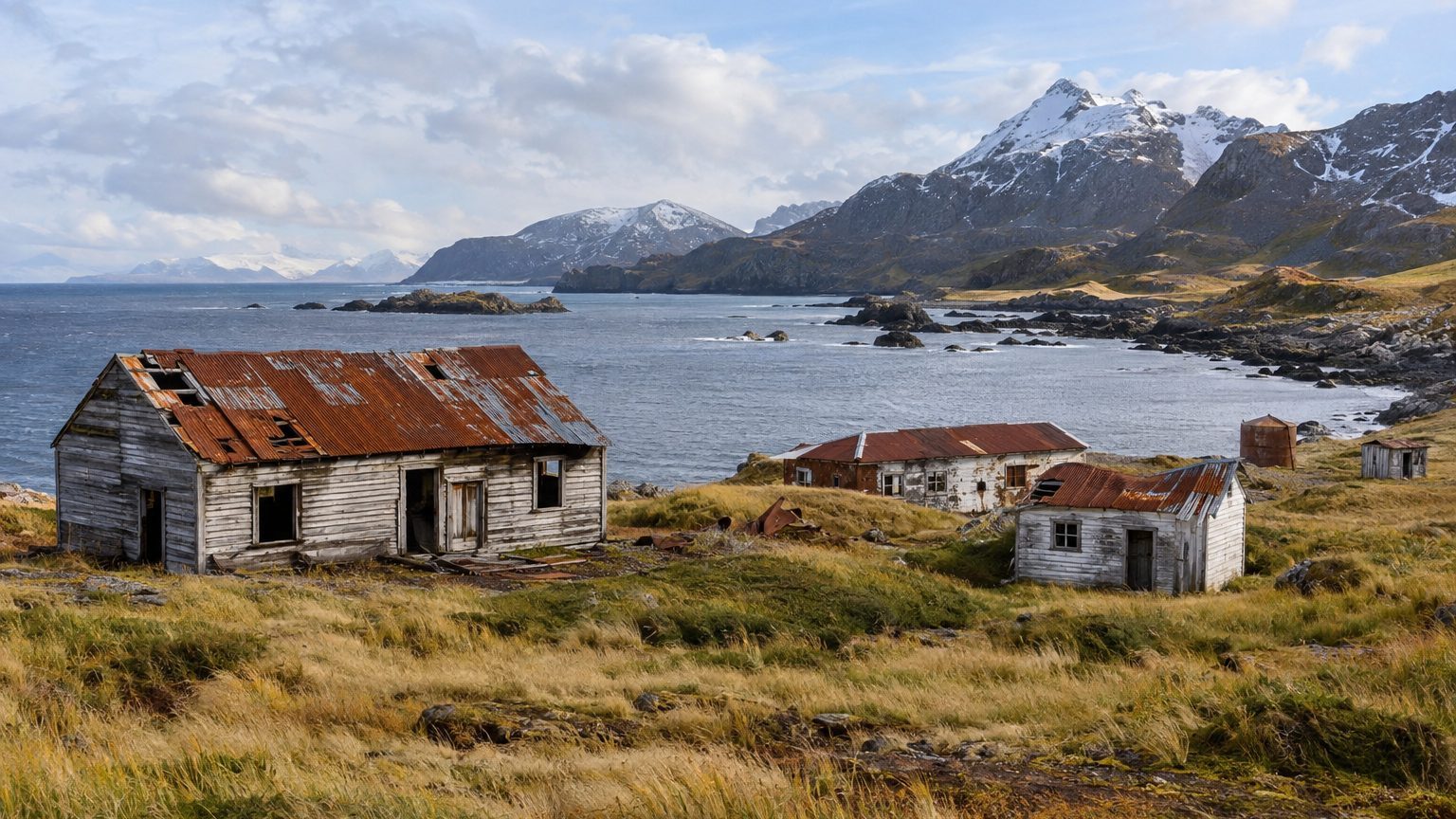
Port-Couvreux occupied the innermost part of Hillsborough Bay, in the farthest reaches of the Gulf of the Whalers, on the Grande Terre of the Kerguelen archipelago. This hamlet of the French Southern and Antarctic Lands (TAAF) has been abandoned since 1931. Its population was 0 inhabitants in 2025.
Out of 1,600 sheep embarked, about 600 reached land alive.
- Port-Couvreux a été fondé en 1900 sur les Kerguelen par les armateurs havrais Bossière pour l’élevage de moutons.
- Sur 1 600 moutons embarqués en 1913, seulement 600 ont survécu à la traversée et débarqué vivants.
- Le village a été définitivement abandonné en 1931 suite à une épidémie de béribéri sur l’île Saint-Paul qui a forcé l’évacuation du personnel.
A Bet Modeled on the Falklands
The story begins in 1893, when the state granted the Bossière brothers, Henry and René-Émile, a 50-year concession on the Kerguelen. The two Le Havre shipowners studied sheep farming and founded the Compagnie des Îles Kerguelen in 1900. The project replicates what the British had done at the Falkland Islands—establishing a permanent population around sheep farming.
In 1912, Baron Pierre Decouz chose the site, brought in sheep from Durban, and carried out a first overwintering. The name Port-Couvreux dates to 1915: the Hydrographic Service of the Navy gave it to the Bossière facilities, in honor of Abel Couvreux, the main supporter of their first expedition.
The landscape is far from the pastoral postcard. The Gulf of the Whalers stretches 37 km long and up to 54 km wide, and the hamlet sits at 49° south latitude, roughly the same latitude as Paris in the northern hemisphere. The comparison stops there: winds, rain, and isolation are not Parisian.
600 Survivors, Then Nothing More
In 1913, René Bossière loaded 1,600 sheep at the Falklands onto the schooner Jacques, which left the archipelago on July 10. The vessel reached Port-Couvreux on August 16, after a turbulent crossing. It landed only about 600 animals, a little more than one in three, entrusted to three shepherds housed in a provisional shelter.
A year later, war breaks out.
In August 1914, the shepherds are evacuated and the sheep are left on site. In 1920, it is discovered that the flock did not survive. René Bossière returns and finds that all the sheep have died and that the buildings are damaged.
Nevertheless, he leaves behind one shepherd, fifty sheep, and a few pigs. From 1920 to 1927, the Bossières ship more animals to compensate for high mortality.
The Le Havre Families, Final Act
At the end of 1927, three Le Havre families settle in Port-Couvreux. The Ménager arrive with their daughter Léone, 12, and the Le Galloudec with their daughter Georgette, 9. The Petit couple completes the troupe.
The newcomers renovate the buildings and set up a small factory for elephant seal oil. The farming, however, declines for lack of adequate pasture. Some inhabitants die on site, though the sources consulted do not give the number. At the height of occupation, the village counted about ten people.
The end comes from Saint-Paul Island, thousands of kilometers away. An outbreak of beriberi strikes the Bossière lobster cannery, and the last shepherds of Port-Couvreux are rushed aboard the ship that is sent to help the personnel. Wikipedia dates the evacuation to 1931, while a wintering resident who documented the site places the outbreak in 1930.
The concession was withdrawn by decree in 1937.
What the Wind Left Standing
The site is today uninhabited, but not erased. One can see the remains of the factory, the enclosures, the farm, and a small cemetery maintained by the TAAF. The shepherds’ hut survives, enclosed in a metal sheath that has protected it since 2004. Fence posts still litter the ground, and on the beach one can find a boiler used to melt elephant seal fat.
Yet one grave tells a different story from the Bossières’. It is that of the German sailor Bernhard Herrmann, who died during a stopover of the auxiliary cruiser Atlantis in 1940. The ship had lain at Kerguelen to take shelter, and its crew buried their comrade in the village’s cemetery.
Sources: alexauxkerguelen.blogspot.com | gettyimages.com
