
En captaining two signals emanating from the same galaxy in 2017, American and European observatories literally timed gravity itself
A brief caveat before diving into this story: what follows may well redefine your relation to spacetime. Brace yourself, because we are going to talk about speed, gravity, and a measurement precision that is truly dizzying.
- The merger of neutron stars GW170817 produced gravitational waves and a gamma-ray burst detected 1.74 seconds apart after traveling 130 million light-years
- This dual detection allowed measuring the mismatch between the speed of gravity and the speed of light with a precision of 10⁻¹⁵, confirming that they are identical
- This result ruled out several alternative theories to general relativity, such as Horndeski gravity or Hořava-Lifshitz gravity, and validated Einstein’s predictions
- A neutron star collision that changes everything
- Two seconds of delay for a 10⁻¹⁵ precision
- Did Einstein get it right all along?
- What GW170817 changes for modern physics
Picture two runners starting at the same moment from a starting line located 130 million light-years from Earth. One takes the light path, the other the gravity path. After a journey as long as it is improbable across the cosmos, they cross the terrestrial finish line with less than two seconds between them. This scenario, worthy of a cosmic athletic event, actually occurred and allowed physicists to answer a question that had haunted them for a century: does gravity truly propagate at the same speed as light, as Einstein predicted?
A Neutron Star Collision That Changes Everything
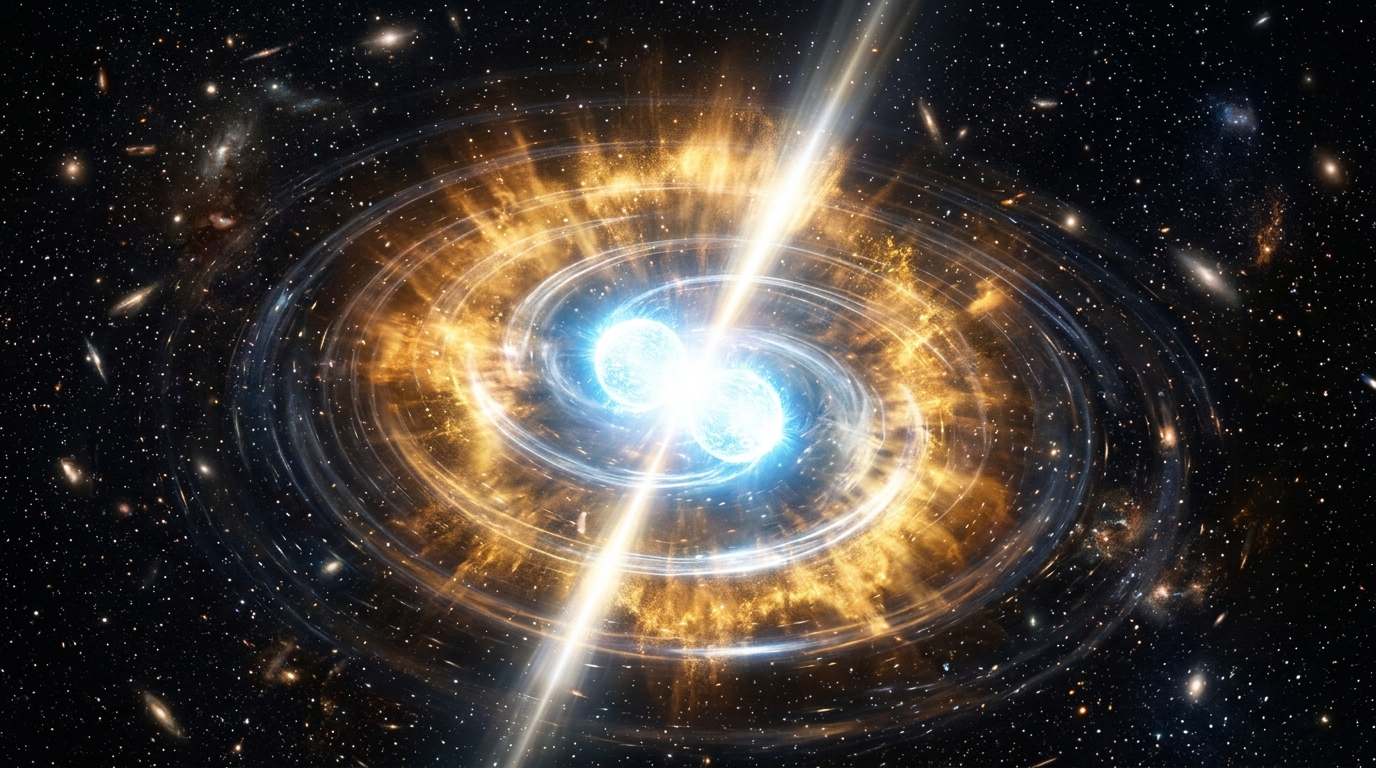
Everything begins with an extraordinarily violent event: the merger of two neutron stars, these ultra-compact objects where matter is so dense that a single teaspoon would weigh billions of tons. When these two stellar corpses collide, they unleash colossal energy in the form of gravitational waves, the distortions of spacetime that Einstein had theorized but had never been observed directly before 2015. This signal, specifically named GW170817, was captured simultaneously by the American LIGO interferometers and the European Virgo instrument.
But the real surprise was that this collision didn’t merely shake the fabric of the universe: it also produced light, more precisely a gamma-ray burst. This flash of radiation, GRB 170817A, was detected by the Fermi and INTEGRAL satellites almost at the same moment as the gravitational wave. For the very first time, scientists had a cosmic event observed by both the gravitational “ears” and the electromagnetic “eyes” of our instruments. The probability that this double detection was a mere coincidence was calculated at about 5 in 100 million, which definitively validated the connection between the two phenomena.
Two Seconds of Delay, Achieving a 10⁻¹⁵ Precision
Here is the pivotal moment of this story. Between the gravitational wave and the gamma-ray burst, researchers measured an interval of roughly 1.74 seconds. Over a distance of 130 million light-years, this time gap is simply negligible on a cosmological scale. Yet, it is precisely this infinitesimal difference that made possible an extraordinary precision in determining the speed of gravity.
By meticulously comparing the arrival times of the two signals, the teams were able to constrain the difference between the speed of gravity and the speed of light to a scale of 10⁻¹⁵, a precision ten orders of magnitude greater than anything previously measured. Concretely, the allowed range places the fractional difference between the two speeds at between -3×10⁻¹⁵ and +7×10⁻¹⁶ times the speed of light. To grasp what this precision means, it’s as if one measured the difference in marathon times for two runners, across the entire observable universe, with an offset of less than a millisecond. A feat of cosmic timing.
Did Einstein Get It Right All Along?
This measurement is not merely a matter of scientific curiosity: it has direct consequences for our understanding of the cosmos. By confirming that gravity travels at the speed of light with such formidable exactness, scientists were able to rule out several alternative theories to general relativity. Among them are certain variants of Horndeski’s tensor–scalar theory, as well as Hořava-Lifshitz gravity, two theoretical frameworks that had been proposed, among other aims, to explain the accelerated expansion of the universe without invoking the mysterious cosmological constant, in other words, without dark energy.
These competing theories, which attracted a portion of the physics community seeking alternative explanations to dark energy, were swept aside by this simple observation. The GW170817 event also allowed testing what is known as the Shapiro delay, a phenomenon describing how light and gravity can be slightly slowed by the presence of substantial masses along their path. Once again, the results matched Einstein–Maxwell predictions perfectly, with no detectable deviation.
What GW170817 Changes for Modern Physics
Almost a decade after its detection, GW170817 holds a very special place in the history of astrophysics. It remains to date the only gravitational-wave event observed in coincidence with a confirmed electromagnetic counterpart. All mergers detected since, whether involving black holes or other neutron stars, have not produced this double for science.
This very rarity underscores the event’s importance: it opened the door to what researchers now call multi-messenger astronomy, the ability to cross multiple kinds of cosmic signals to refine our understanding of the universe. GW170817 also confirmed that neutron star mergers are indeed the source of certain short gamma-ray bursts, a hypothesis that until now was difficult to demonstrate so directly. In short, this distant collision provided in a few seconds more information about the nature of gravity than decades of theoretical calculations.
Reflecting on this pair of signals from a distant galaxy, one realizes how fundamental physics can sometimes hinge on infinitesimal margins. A two-second gap, a 10⁻¹⁵ precision, and an entire swath of alternative theories are swept aside, while general relativity emerges once more strengthened. As gravitational observatories continue to refine their instruments, one question remains: will the next neutron star merger ever reveal a crack, even a tiny one, in Einstein’s theoretical edifice?
