
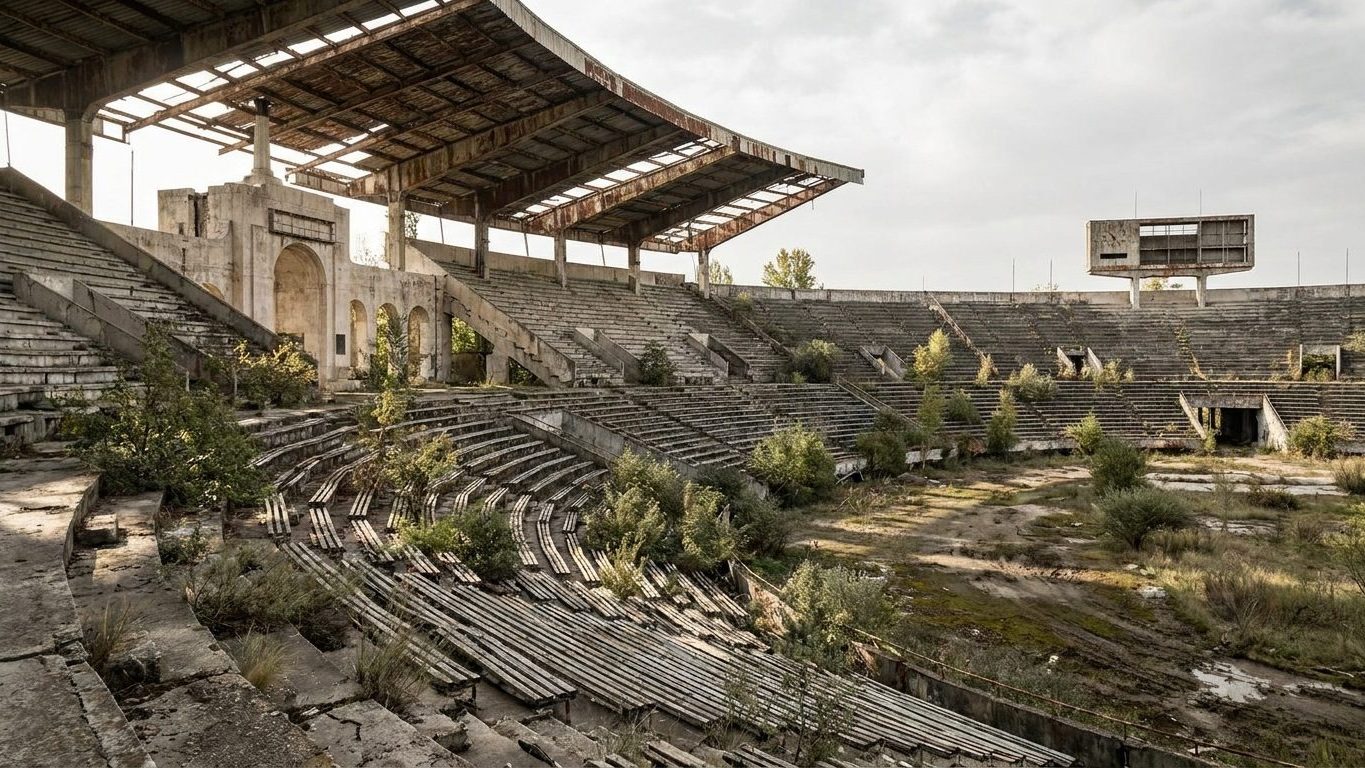
Eight years after the Athens Games of 2004, many Olympic facilities built at great expense remain abandoned or barely used, and the situation is even more evident today, more than twenty years after the flame. Of the 22 sites from the Athens Olympic Games, 20 are abandoned and have not been used or maintained since 2012, turning them into true white elephants. The bill, meanwhile, keeps accumulating.
- Twenty of the twenty-two Olympic Athens 2004 stadiums have been completely abandoned and unused since 2012
- The Games cost between €8.5 billion and €14 billion, doubling the initial budget and representing 2 to 3% of Greece’s external debt
- Annual maintenance of the abandoned sites costs Greece between €50 and €100 million, without generating revenue
A Pharaonic Project for Sixteen Days of Competition
The Greek Ministry of Finance estimates the total cost of the Games at €8.5 billion, while other estimates, including ancillary infrastructures such as roads and the metro, exceed €14 billion. This amount doubles the budget initially approved by the Greek government, before the debt crisis later reminded, a few years on, of the true price of this extravagance in concrete.
Certain estimates exceed €14 billion.
Cathedrals of Concrete Abandoned
The Hellinikon complex, built on the site of the old Athens international airport, alone embodies the symbol of this waste. The softball stadium, the baseball stadium, the field hockey track and the canoe-kayak basin hosted Olympic competitions for two weeks, before sinking into oblivion. In recent years’ footage, vegetation has reclaimed even the locker rooms, and homeless occupants have sometimes settled in the deserted stands. Only 30% of the Olympic venues ended up finding a new owner after the event, a rate that sums up the scale of the fiasco.
The Faliro Bay beach volleyball center, along the seafront, illustrates the same drift. The interior of the building is now covered in graffiti, strewn with debris, and stripped of anything portable, down to the corridors where moldy documents pile up. The International Olympic Committee ultimately delivered an unequivocal assessment: of the 124 Olympic sites worldwide that have fallen into uselessness, 36 are completely abandoned, and eight of them come from the Athens 2004 Games alone.
Twenty-two years after the flame, most have never hosted an athlete again.
The Bill Greece Is Still Paying Today
According to reports from the Hellenic Court of Accounts, the maintenance and security of the abandoned Athens Olympic sites would have cost between €50 million and €100 million each year since the end of the 2004 Games. This budget covered only upkeep and securing the installations, with no major event ever paying back the expense. Jacques Rogge, then-president of the IOC, himself acknowledged that between 2% and 3% of the country’s external debt could be attributed to the cost of the Games. The Greek debt rose by more than €71 billion between 2000 and 2005, then by a further €145 billion by 2010, a trajectory the Hellenic Court of Accounts has repeatedly highlighted in its successive evaluations.
Some sites have finally found a second life: the Agios Kosmas sailing center now operates as a private marina, the former International Broadcasting Center has become one of the busiest shopping centers in Athens, and a portion of the Olympic Village has been resold as private housing. But the Olympic Stadium itself, the emblem of the Games, had to close its doors in 2024 after safety tests on its 18,000-ton roof failed.
Paris chose to adapt existing structures rather than build new arenas.
The Hellinikon site, long the symbol of the waste, is today the subject of a private real estate project estimated at €7 billion, intended to become a residential, commercial, and leisure district. The Markopoulo Shooting Center, for its part, has found a more modest use: it has come under the stewardship of the Greek police, which now uses it as a training facility.
Sources: questions.assemblee-nationale.fr | shango.media | fr.wikipedia.org
