
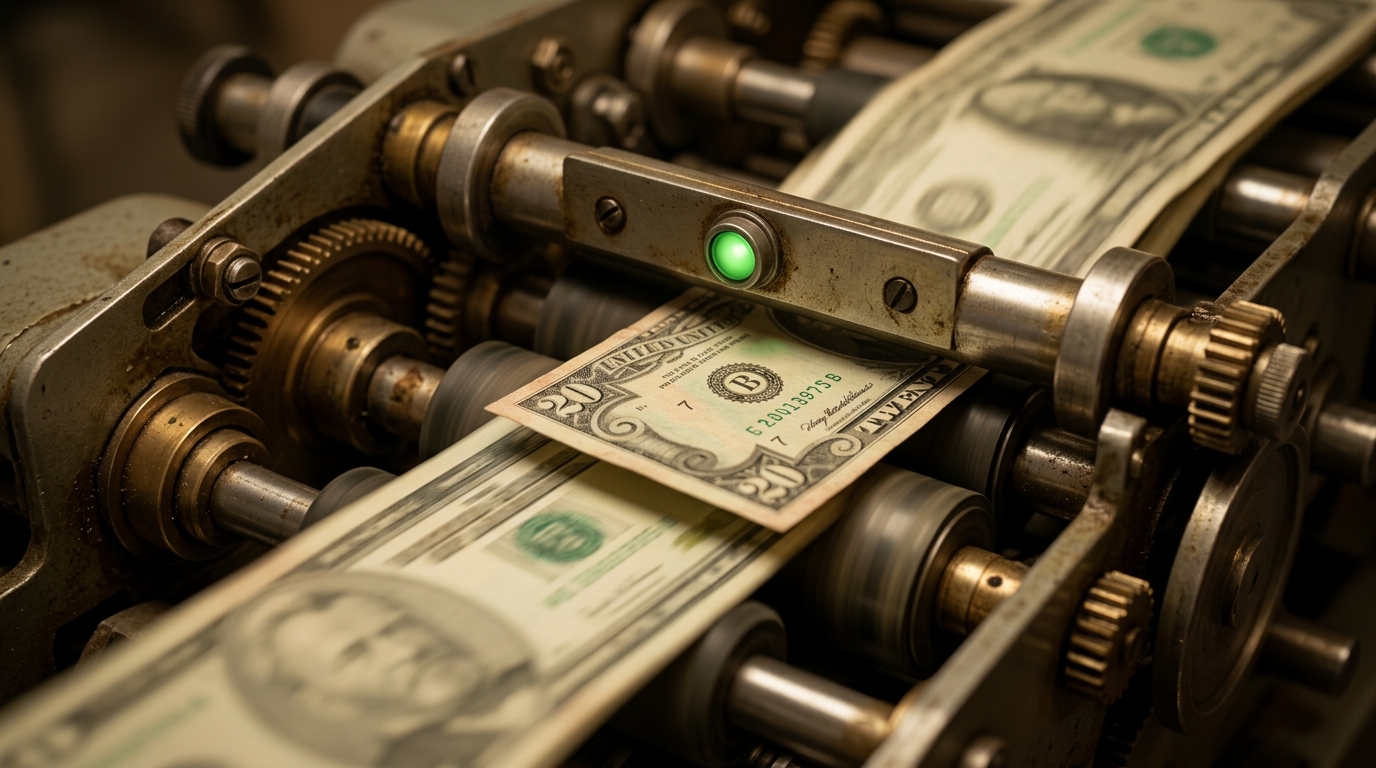
Picture pulling a bundle of cash from an ATM and, months later, discovering that part of that money was counterfeit, slipping past detection without anyone—neither the bank nor the machine—noticing. This isn’t a theoretical scenario: it happened in Germany in the late 1960s when the country unveiled one of the earliest machines capable of sorting banknotes in a fully automated way. For more than a decade, this technological feat operated under everyone’s watch without anyone noticing what it quietly let slip. The story of this belated discovery, largely unknown to the general public, speaks volumes about the hidden limits of early banking automation and about our relationship, even today, to the trust we place in machines.
- In 1968, Nixdorf Computer AG launched in Germany one of the first machines able to sort banknotes automatically.
- It was not until 1979, eleven years later, that it emerged the machine had allowed counterfeit bills to slip through undetected.
- The legacy of this technology, today carried by Diebold Nixdorf, remains vulnerable, as shown by jackpotting attacks and the continued use of Windows XP in 2015.
- A machine ahead of its time: Nixdorf’s audacious bet
- Eleven years of blindness: how the flaws stayed hidden
- 1979, the year everything changes: the discovery that rewrote the rules
- What this forgotten failure teaches us about blind trust in machines
A machine ahead of its time: Nixdorf’s audacious bet
Everything begins in 1968, in Paderborn, Germany, with the birth of Nixdorf Computer AG, born from the merger of Labor für Impulstechnik, founded by engineer Heinz Nixdorf, and Wanderer-Werke. At a moment when giants like IBM banked on bulky mainframes—central computers that were expensive and reserved for the largest organizations—Nixdorf chose the opposite route: offering lighter, more affordable electronic data processing solutions, and above all, making them accessible to medium-sized enterprises. This strategic choice, almost bold for the era, would prove profitable almost immediately.
From its inception, the young firm secured a major contract valued at 100 million Deutsche marks, a deal that allowed early Nixdorf computers to cross Germany’s borders and reach foreign markets. Growth was meteoric: ten years later, in 1978, Heinz Nixdorf AG reported revenues of 1 billion Deutsche marks and employed over 10,000 people worldwide. It is within this climate of feverish expansion that one of the most emblematic symbols of this success emerged: a machine capable of sorting banknotes automatically, without human intervention, an innovation that at the time seemed almost futuristic.
Eleven years of blindness: how the flaws stayed hidden
On paper, the idea is appealing: entrust to a machine the tedious and error-prone task of verifying banknote authenticity. In practice, the technology of the era relied on relatively rudimentary sensors, unable to detect subtleties that a trained cashier might spot. The problem is that no one at the time questioned the reliability of this new tool. The machine inspired confidence precisely because it was new, precise, and embodied progress.
This blind trust fits into a broader context: post-war Europe experienced, between 1966 and 1980, several notable cases of currency counterfeiting, as recalled by the archives of the French museum of counterfeit money. The phenomenon is therefore not incidental. Yet, for eleven long years, no alarm sounded to disrupt the operation of this German machine. Counterfeit notes continued to circulate, quietly absorbed by a system that everyone believed to be infallible, simply because it was electronic.
1979, the year everything changes: the discovery that rewrote the rules
It would take until 1979 for the truth to finally come to light. That year revealed that the Nixdorf dispenser, put into service in 1968 as Germany’s first automated banknote sorting system, had allowed counterfeit notes to slip through undetected for more than a decade. The revelation sent shockwaves through the German banking sector, which had until then believed it had found, with this technology, a definitive solution against counterfeiting.
This late discovery illustrates a reality common to every major technological breakthrough: an innovation can appear flawless as long as no one actively seeks its flaws. Yet, in the case of this pioneer sorter, no independent verification procedures regularly checked the reliability of the automated sorting. The machine operated, produced results, and that sufficed to reassure everyone, until someone finally took a serious look at the issue. Heinz Nixdorf, the visionary founder of the company, would pass away in 1986 at the CeBIT trade show in Hanover, never seeing his firm become the global giant in automated banking systems that it would later turn into under different names.
What this forgotten failure teaches us about blind trust in machines
After this discovery, the Nixdorf brand would undergo several consecutive changes: it became Siemens Nixdorf Informationssysteme between 1990 and 1999, then Wincor Nixdorf, before being acquired by the American group Diebold to form Diebold Nixdorf, as we know it today. Yet this direct lineage from the 1968 machine remains, more than fifty years later, a prime target for cybercriminals. Diebold Nixdorf ATMs frequently fall victim to so-called jackpotting attacks, computer techniques aimed at forcing ATMs to dispense cash without authorization.
Even more troubling, an investigation into the world’s ATM fleet revealed that in 2015 a very large share of these machines were still running on Windows XP, an operating system no longer updated for at least a year. This technical laxity is not a random anomaly: it reveals a structural problem in the banking sector, where ATM manufacturers enjoy a dominant position that significantly suppresses competitive pressure to promptly fix detected vulnerabilities. In other words, the 1968 scenario replays itself, in a different form, every time a financial technology is adopted on a large scale without sufficient independent oversight.
From the first German machine capable of sorting notes to our modern, electronics-laden ATMs, the through line remains the same: an impressive innovation can conceal invisible flaws for years, simply because its reputation for reliability discourages any challenge. The story of the 1968 Nixdorf dispenser reminds us that no machine, however revolutionary, deserves unconditional trust without regular verification. At a time when artificial intelligence is entering many financial security systems, this half‑century‑old lesson may be more relevant than ever.
