
There are breakups that arrive at the worst possible moment. In the American space sector, the rift now looming between NASA and its longtime partner strongly resembles one of those ill-timed splits. While the U.S. space agency was quietly preparing to rely on a trusted vessel to ferry its astronauts to the International Space Station, SpaceX has just told it that this comfort has an expiration date. A decision that, structurally, pushes NASA into the arms of the only other player capable, on paper, of taking over: Boeing. The problem is that the latter carries along an embarrassing track record, having left two of its astronauts stranded in orbit for several months. A recap of a twist that is sure to worry space enthusiasts.
- SpaceX announced the planned retirement of Crew Dragon, despite 13 crewed missions completed without a single failure, though a $946 million contract extends its operation through 2030
- The Boeing Starliner, the sole American alternative, experienced a failing test flight in 2024 that left two astronauts stranded on the ISS for nine months, with losses surpassing $2 billion
- The Atlas V rocket used by Starliner will soon be retired by ULA, forcing Boeing to certify its spacecraft on a new launcher before it can undertake future crewed missions
- Crew Dragon, the capsule that should never have stopped
- Starliner: the story of a spacecraft that costs more than it flies
- Atlas V fades, and Boeing loses its rocket before it ever flies
- NASA’s risky bet: betting on the one that has already failed
Crew Dragon, the capsule that should never have stopped
Hard to find a better pupil in the United States’ lineup of crewed spacecraft. Since its commissioning, Crew Dragon has logged thirteen crewed missions to the ISS with no failures, a reliability record that has almost become monotonous in its flawless execution. It is precisely this success that makes the announcement of its retirement so destabilizing: SpaceX isn’t ditching a faulty vessel, but a tool that works. NASA did attempt to buy time by awarding SpaceX a contract worth $946 million for three additional missions, which should keep Crew Dragon in service through 2030. But that reprieve changes nothing at the heart of the matter: in the long run, the capsule will depart, whether NASA is ready to hand over the baton or not.
Starliner: the story of a spacecraft that costs more than it flies
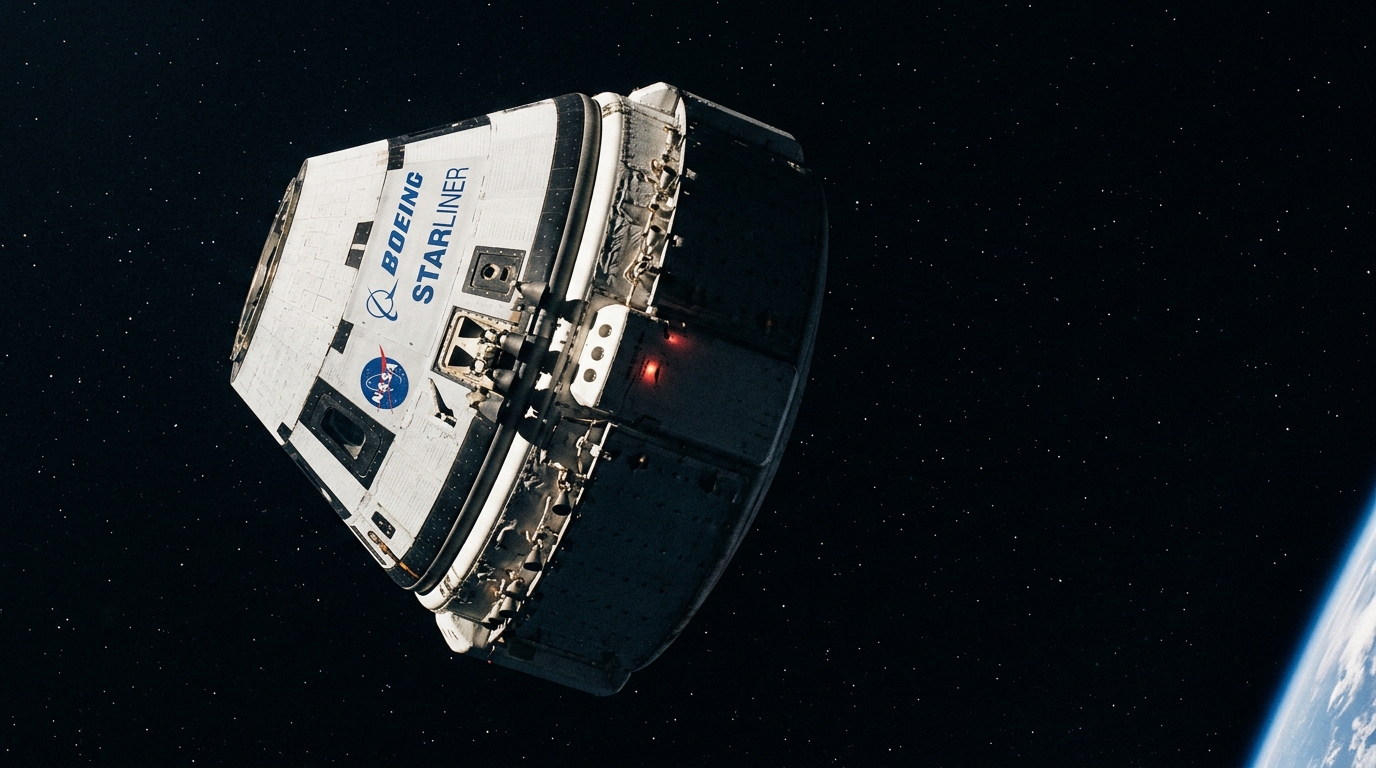
Facing this announced gap, only one American capsule remains in the running: Boeing’s Starliner. On paper, it’s a logical alternative. In practice, it stands as a symbol of a recurring industrial fiasco. Its crewed test flight in June 2024 devolved into a technical headache, with helium leaks and propulsion failures, preventing the return of astronauts Sunita Williams and Barry Wilmore as initially planned after eight days. The result: the two astronauts ended up staying nine months on the ISS before returning, not aboard their own capsule, but thanks to… a Crew Dragon. The irony is hard to ignore. Financially, the bill is just as steep: Boeing’s losses on this program now exceed $2 billion, and NASA ended up spending more on this capricious vessel than on its far more capable rival.
Atlas V fades, and Boeing loses its rocket before it ever flies
As if technical woes weren’t enough, another issue complicates the equation: Starliner currently launches on the Atlas V rocket, built by United Launch Alliance. Yet, ULA plans to retire this launcher once the remaining six units are exhausted, all of which are already booked for Starliner flights. In other words, even if Boeing managed to stabilize its spacecraft, it will have to certify it on a new rocket quickly, adding an extra, costly, and uncertain step to an already lengthy list of challenges. In February, NASA still struck a cautious, measured tone, speaking of progress and aiming for an uncrewed flight named Starliner-1 in April. That flight ultimately did not take place, and the schedule remains, in the agency’s own words, under review. A polite way to say that, for the moment, no one truly knows when this vehicle will take off again.
NASA’s risky bet: betting on the one that has already failed
That is where the situation becomes genuinely interesting, even a bit dizzying. According to the information available, NASA is expected to soon order two additional crewed missions with Starliner, while partially funding repairs to the failing thrusters and backing the spacecraft’s certification on a new rocket. If Starliner-1 finally succeeds, five more crewed flights would then be authorized. Gwynne Shotwell, SpaceX’s CEO, has even acknowledged that Boeing should be able to use its spacecraft, funded by public money. A graceful reminder that competition doesn’t exclude a certain solidarity, especially when the stakes go beyond the interests of a single company. For the moment, Starliner remains the only viable alternative to Crew Dragon to sustain an American crewed presence in low Earth orbit, turning a simple industrial wager into a matter of space sovereignty.
By announcing the planned retirement of Crew Dragon, SpaceX has thus inadvertently extended a hand to Boeing, offering it a role that it had not yet managed to fill. It remains to be seen whether Starliner will finally fly up to the expectations placed upon it, or whether NASA will have to seek a backup solution at the last minute once more. One thing is certain: in this spacecraft saga, reliability is not decreed; it is proven, flight after flight.
