
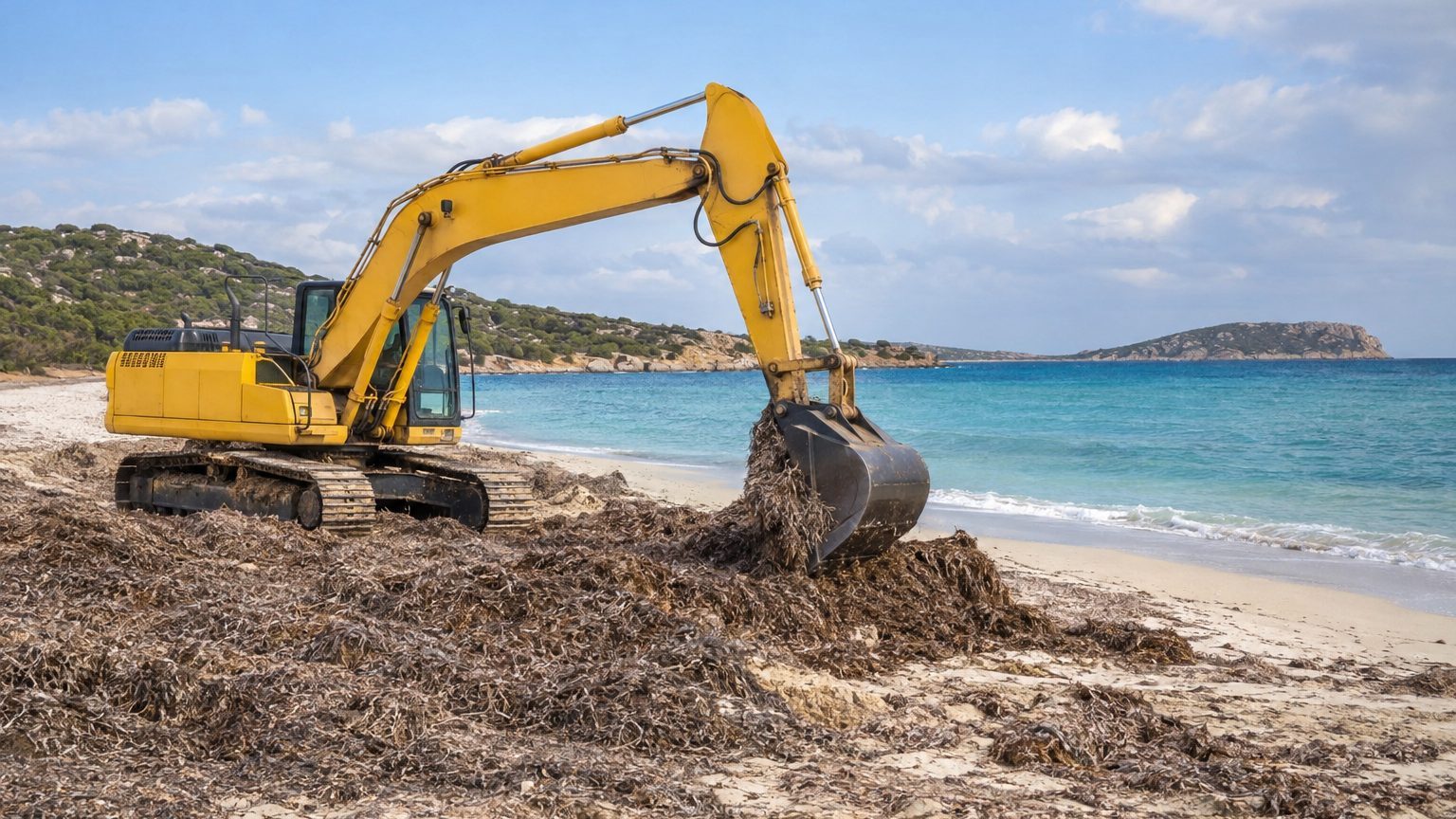
Each autumn, posidonia loses its brown leaves, and the waves fling them into compact piles along the shore. They are known as the banquettes. As summer approaches, excavators scrape them away to clear beaches for swimmers, unaware that they are also removing part of the very sand itself.
Posidonia is not an alga but a flowering underwater plant, native to the Mediterranean. Its dead leaves accumulate on the coast in winter, forming mats that can be several tens of centimeters thick. For coastal authorities, these accumulations long carried a reputation as a bulky, foul-smelling nuisance to be cleared before the tourist season.
- Posidonia banquettes remove between 78 and 93 kilograms of sand per cubic meter of leaves removed
- In Sardinia, 106,180 cubic meters of posidonia were removed in 2004, taking away essential sand as well
- These dead leaves form a natural barrier that protects beaches from coastal erosion
- The progressive erosion of beaches only becomes visible several years after repeated removal of the banquettes
Invisible sand trapped in dead leaves
In Sardinia, a team of researchers sought to quantify this phenomenon for the entire island. Published in 2008 in the Journal of Coastal Research, the study relied on a survey sent in 2004 to coastal municipalities and to the companies responsible for beach cleaning. The removal of posidonia banquettes proved widespread, applied on 44 beaches out of 116, with the total volume removed in 2004 estimated at 106,180 cubic meters.
Heavy machinery was typically used to remove these banquettes. The problem is that the sand is not visible to the naked eye. It is tangled within the rhizomes and fibers of the leaves, mixed with the sediments that waves have deposited over months. The researchers measured an average sediment concentration of 92.8 kilograms per cubic meter of banquette. Across all the beaches studied, each site lost between 0.5 and 1,725 cubic meters of sand, simply carried away with the piles of leaves.
80% of this removed volume ended up in unauthorized landfills.
A sand-poor beach, a real-world test
Fourteen years later, another Italian team aimed to refine the calculation on a specific case: a beach already poor in sediment supply, where every grain of sand matters more than elsewhere. The study, published in 2022 in the journal Water, tracked banquette deposits over the course of a year through five sampling campaigns. The sediment contained within the banquette structures varied from 0 to 339 kilograms per cubic meter.
On average, the sediment content stood at 78 kilograms per cubic meter. The researchers then simulated several removal scenarios, up to 5,000 cubic meters of banquette removed in a single season. In this 5,000 cubic meter removal scenario, the sensitivity analysis showed sediment loss ranging from 0.31% to 1.34% of the available budget. A figure that seems modest in isolation. But it represents a definitive loss, year after year, on a beach that receives almost no new sand to compensate.
Posidonia banquettes are often removed from the beach using different methods, and when these accumulations reach sizable volumes, heavy machinery is widely used, causing a substantial sediment loss through nonselective removal. It is this accumulation, season after season, that eventually becomes visible on the ground.
The paradox of piles deemed dirty
Here is a twist that few vacationers imagine when stepping over these brown mounds: far from being waste, the banquette protects the beach that hosts it. The intertwined leaves form a kind of vegetative barrier that cushions the impact of the waves and limits coastal erosion, a role echoed by the regional directorate for the environment, planning and housing (DREAL) of Provence-Alpes-Côte d’Azur in its recommendations to coastal managers.
A similar case has been documented elsewhere in the Mediterranean. On the Croatian island of Dugi Otok, the repeated removal of banquettes from the Sakarun beach coincided with progressive erosion of the sandy sector, which eventually partly disappeared. The results indicate that ongoing removal of posidonia banquettes loaded with sediment can create a deficit in the beach’s sediment budget, with effects possibly only noticeable after several years. This time lag helps explain why the link between raking and beach retreat remains so little perceived by local officials and by tourists alike.
In Catalonia, researchers reached comparable conclusions in 2025, with lower sediment contents but the same mechanism: local authorities evacuate these deposits using heavy machinery, thereby weakening the coastline they aim to safeguard for the summer.
Alternatives exist, but remain minority
Some Mediterranean municipalities have begun to experiment with less destructive methods: seasonal relocation of banquettes rather than complete removal, sieving to return sand on-site, or simply tolerating piles in portions of the beach that are less frequented. These practices remain minority compared with the appeal of an immaculate beach for promotional brochures.
For France, no data equivalent to Sardinia’s have been identified nationally to date. Posidonia enjoys protected status in the French Mediterranean, but the gathering of its dead leaves on beaches continues under locally set conditions. A simple question to ask the next time a bulldozer cleans a beach before tourists arrive: what if the real problem isn’t the pile of leaves, but the machine that removes it?
Sources: books.fupress.com | frontiersin.org
