
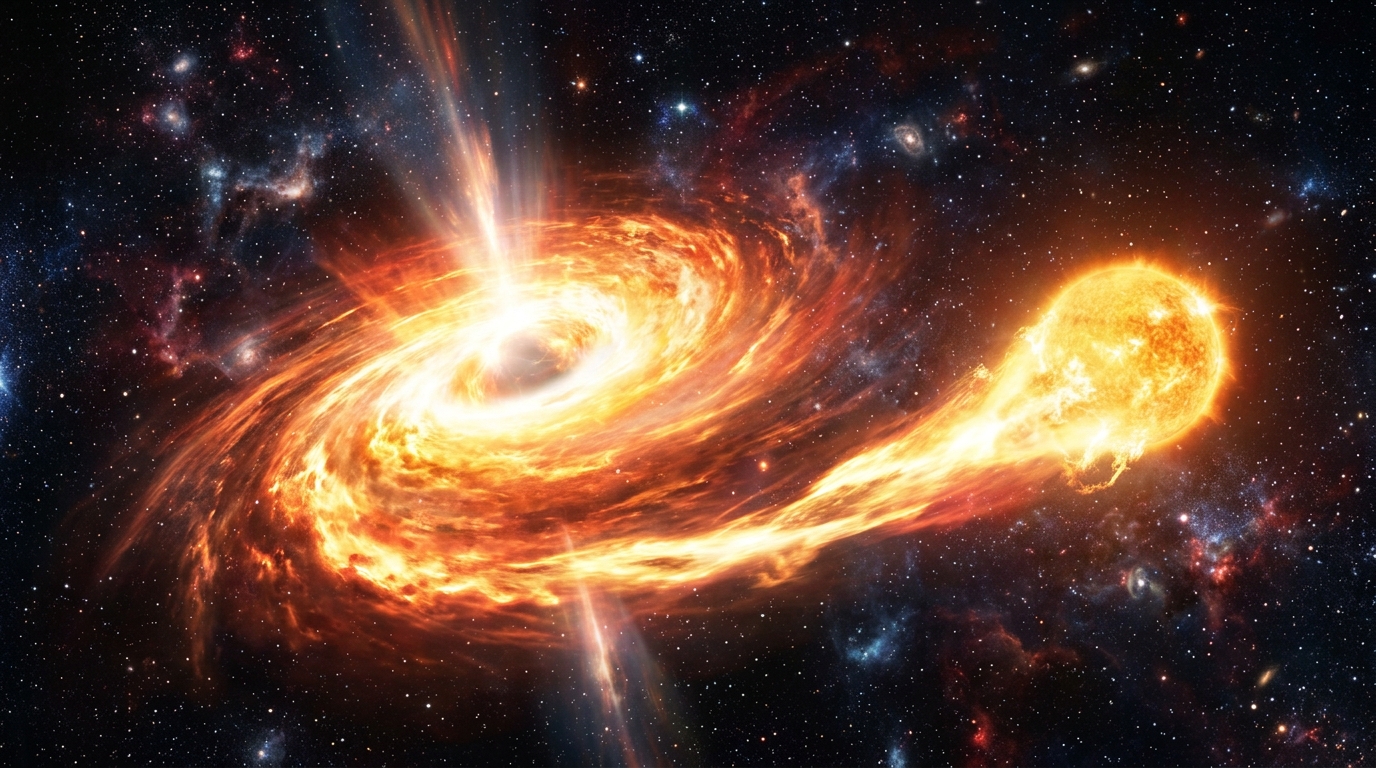
Every day somewhere in our galaxy, stars are born, shine, and fade in cycles that astronomers know all too well. But billions of light-years away from our little corner of the cosmos, a phenomenon defies logic: a celestial body capable of swallowing the equivalent of our Sun in a single day. Not in a year, not in a century, but in 24 hours. That number alone is enough to provoke vertigo, and yet it represents only a fraction of what scientists have uncovered about this extraordinary object.
- The quasar J0529-4351, located about 12 billion light-years away, consumes daily the equivalent of one solar mass via an accretion disk spanning seven light-years in diameter
- It hosts a supermassive black hole of 17 to 19 billion solar masses and shines more than 500 trillion times brighter than the Sun, making it the most luminous object ever observed
- Discovered in the 1980s and wrongly ruled out by an automated analysis in 2022, the object was confirmed as a quasar in 2023, ahead of a Nature Astronomy publication led by Christian Wolf
- A cosmic appetite beyond comprehension
- J0529-4351, the brightest monster ever observed
- How can a black hole devour so much matter?
- A discovery that redefines the limits of the known universe
A Cosmic Appetite Beyond Comprehension
Imagine for a moment having to swallow an entire planet for breakfast, then doing the same the next day, and the day after, without ever stopping. That is roughly the scale of what this celestial body achieves, except that it is not a planet but a star the size of the Sun. This feeding rhythm, entirely unprecedented in the annals of astronomy, places this star in a league of its own—the most voracious cosmic devourers ever cataloged.
What makes this ravenous behavior even more puzzling is that it shows no sign of slowing. Standard physical models typically predict a limit to how much matter a celestial object can absorb without destroying itself under the pressure of its own radiation. Yet this monster seems to brush up against, or even exceed, that theoretical threshold, prompting researchers to revisit some certainties about extreme stellar physics.
J0529-4351, the Brightest Monster Ever Observed
Named J0529-4351, this object was publicly announced in February 2024, based on observations with the European Southern Observatory’s Very Large Telescope, perched in the Chilean desert. Its light, captured by the era’s most sensitive instruments, took more than 12 billion years to reach us, meaning we are viewing it as it appeared when the universe was only a fraction of its current age.
But distance isn’t the sole record this quasar holds. Its luminosity is simply staggering: it shines more than 500 trillion times brighter than the Sun, making it the most luminous object observed in the known universe. To grasp the scale, if this object were placed where the Sun is, its brightness would instantly eclipse all life on Earth. This extreme luminosity stems directly from the colossal energy released by matter being drawn into the supermassive black hole nestled at its core.
How Can a Black Hole Devour So Much Matter?
To understand this unprecedented cosmic feast, one must look at the mechanism that fuels it: the accretion disk. This gigantic structure, composed of gas and dust spiraling around the center, spans roughly seven light-years in diameter, about 45,000 times the Earth–Sun distance. In other words, this rotating disk of matter is larger than our entire solar system.
The material swirling in this disk is not absorbed calmly. It experiences extreme friction caused by the rubbing of gas particles moving at staggering speeds. This friction generates colossal heat, reaching millions of degrees, turning the material into an incandescent plasma that emits a phenomenal amount of light before finally crossing the event horizon. It is precisely this radiant energy, released just before the final swallowing, that makes the quasar J0529-4351 so dramatically bright.
At the center of this chaos sits a supermassive black hole with an estimated mass between 17 and 19 billion solar masses. This monstrous mass, combined with its record-breaking rate of accretion—about one solar mass per day—marks it as the fastest-growing black hole measured to date.
A Discovery That Redefines the Limits of the Known Universe
What is perhaps most surprising is that this object was not always regarded as exceptional. Traces of its existence appeared in observations dating back to the 1980s, but its luminosity was judged too unusual to identify it correctly. Even more, in 2022 an automated analysis using data from the European Space Agency’s Gaia satellite had simply ruled it out, wrongly classifying it as a star with near certainty.
It was only in 2023 that the truth emerged, thanks to a 2.3-meter telescope at the Siding Spring Observatory in Australia. Astronomers finally confirmed what the dataset had suggested for decades: this was indeed a distant quasar, not a star in our own galaxy. This decades-long mix-up illustrates how even the universe’s most extreme objects can hide in plain sight, misinterpreted or overlooked for years.
This discovery, published in Nature Astronomy under the leadership of astronomer Christian Wolf of the Australian National University, goes beyond setting a new luminosity record. It provides scientists with a rare opportunity to study how supermassive black holes can grow so rapidly in the early universe—a question that remains one of cosmology’s great mysteries. Understanding this mechanism could illuminate how primitive galaxies formed and how these colossal structures shaped the cosmos as we know it today.
Between its insatiable appetite, its overwhelming brightness, and its turbulent history of missed but later recovered discoveries, quasar J0529-4351 embodies the mysteries that continue to drive modern astrophysics. It serves as a reminder that the universe, even after decades of careful observation, still harbors giants capable of upending our most established certainties. How many more monsters like this await discovery, quietly lurking in the data already collected by our telescopes?
