
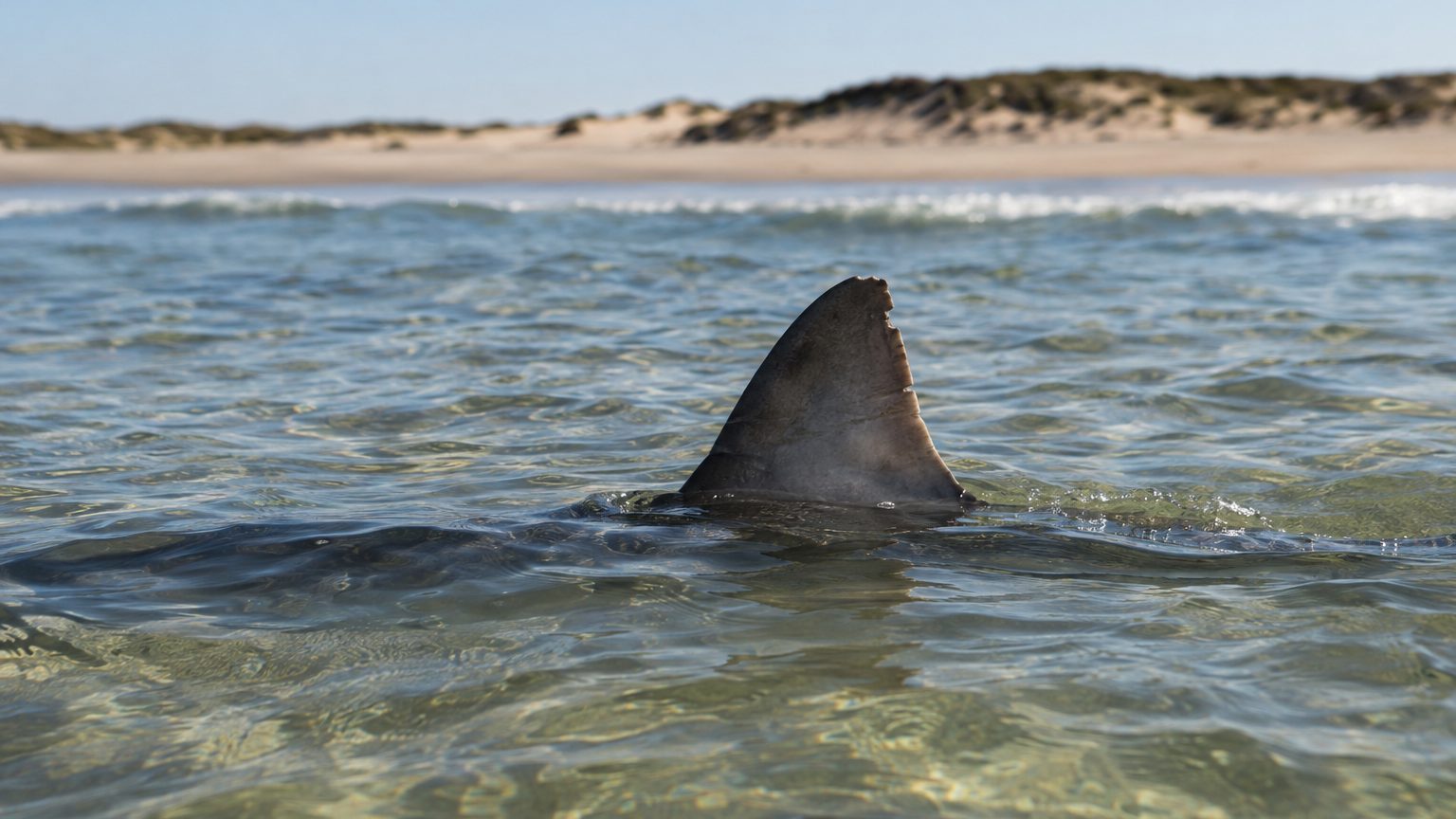
Five hundred sharks. On a beach on Île de Ré frequented by surfers, water barely 50 centimeters deep was enough for them to move, just a few meters from the shore. Nobody, neither scientists nor witnesses, can presently explain this gathering.
It all began with a report from surfers, in August 2026, near a beach at Portes-en-Ré, at the tip of the island. Alerted, photographer and sailing instructor Gaël Contal enters the water thinking he might glimpse one or two sharks. He goes on site, perhaps to spot one. But in the water, dozens of sharks lie in wait, realizing that “if I’d seen one, that would have been something… but there, it was truly crazy.” Faced with the magnitude of the scene, he shoots with a drone and then returns underwater to photograph the animals up close.
The images circulate quickly. Shared with the Association for the Study and Conservation of Selachians (Apecs), based in Brest, they allow the species to be confirmed: basking sharks, also known as milandre, with a streamlined body and a long snout. It falls to marine biologist Éric Stéphan, the association’s coordinator, to count the silhouettes visible in the aerial photos. His estimate: at least 500 individuals, a figure that remains an estimate derived from the photos of a single photographer, not an exhaustive census.
- At least 500 basking sharks gathered for five days in 50 cm of water off Île de Ré in August 2026
- This is the largest known gathering of this species ever recorded in French waters
- Scientists point to three hypotheses: feeding, reproduction, or the location’s tranquility
Five days at surface level, under surfers’ gaze
The shoal remained for several days in the immediate vicinity of the beach. Five hundred individuals gathered for five days near a beach on Île de Ré that surfers normally frequent. The sharks swam along a strip 500 meters long along the coastline and 100 meters out to sea, sometimes in water so shallow that their backs broke the surface. According to Sud Ouest, these sharks measured between 1 and 2 meters and appeared rather harmless to humans.
Other witnesses observed the same phenomenon. Surfers and lifeguards present on the site confirmed the occurrence, without understanding the underlying cause. The episode is not entirely isolated: the previous summer a small colony of basking sharks surprised bathers at Lizay and Grand-Marchais beaches in Portes-en-Ré. An even older precedent exists: a few years ago about twenty sharks remained stuck in a fish lock at Sainte-Marie-de-Ré.
By mid-August 2026, the Charente waters of the Atlantic Ocean witnessed one of the most significant gatherings of basking sharks ever documented along the Hexagon’s coast. The Apecs, which has conducted tagging since 2018 and has tracked nearly 250 basking sharks in the Atlantic and the English Channel, notes that such a gathering had never been observed, or at least reported, in French waters. A statement that carries substantial weight within the tightly circumscribed scientific community studying selachians.
A species on the brink, poorly understood by researchers
The paradox is almost cruel: the rarer the species becomes, the more valuable its observation. Its status is alarming: listed as critically endangered worldwide by the IUCN in 2020, and vulnerable in Europe and the Mediterranean, it enjoys international protection through the CMS, the Barcelona Convention, and the Sharks MoU. This coastal shark of temperate waters descends to depths of up to 800 meters and feeds on fish, cephalopods, and crustaceans.
Why such vulnerability? The Marine Protected Area of the Gironde estuary and the Pertuis explains it through its biology. This shark is considered extremely vulnerable because it reaches sexual maturity late and has relatively low fecundity. A depleted population takes decades to recover, when recovery is possible at all.
Scientists lack crucial visual data on this species. As a threatened species, there remain many unknowns: “We conduct tagging to try to determine their range,” notes Éric Stéphan. “But it’s a discreet, shy species. We don’t have many underwater images of them.” Therefore, seeing 500 individuals gathered in the same location constitutes a rare, nearly unprecedented resource for an association that typically works from a few isolated tags.
Three hypotheses, no certainty
Why did they congregate in this manner? Too soon to decide, according to Éric Stéphan. “It could be an area favorable to feeding, but the basking shark isn’t really known for living in groups.” This first possibility thus fails to convince the biologist himself.
The reproduction hypothesis remains. Aggregations are common among sharks and rays, often linked to mating, but the male-to-female ratio in this shoal remains completely unknown, which prevents any hurried conclusion on this point.
A third possibility, more down-to-earth: the place’s tranquility. A third theory concerns the low human presence. On the day of the observation, access to the beach had already been closed for about two weeks due to fire risk. People had to walk a kilometer to reach the shore, a constraint that may have limited human traffic without establishing a direct cause-effect relationship with the sharks’ presence.
The shoal eventually dispersed as quietly as it had appeared. Apecs has already announced its intention to study Charente-Maritime waters more closely in the coming months and invites anyone who encounters a shark along our coasts to report it via its online form. A way to turn every passerby or surfer into an involuntary sentinel for a species that science is still striving to understand.
Sources: facebook.com | aquitaineonline.com
