
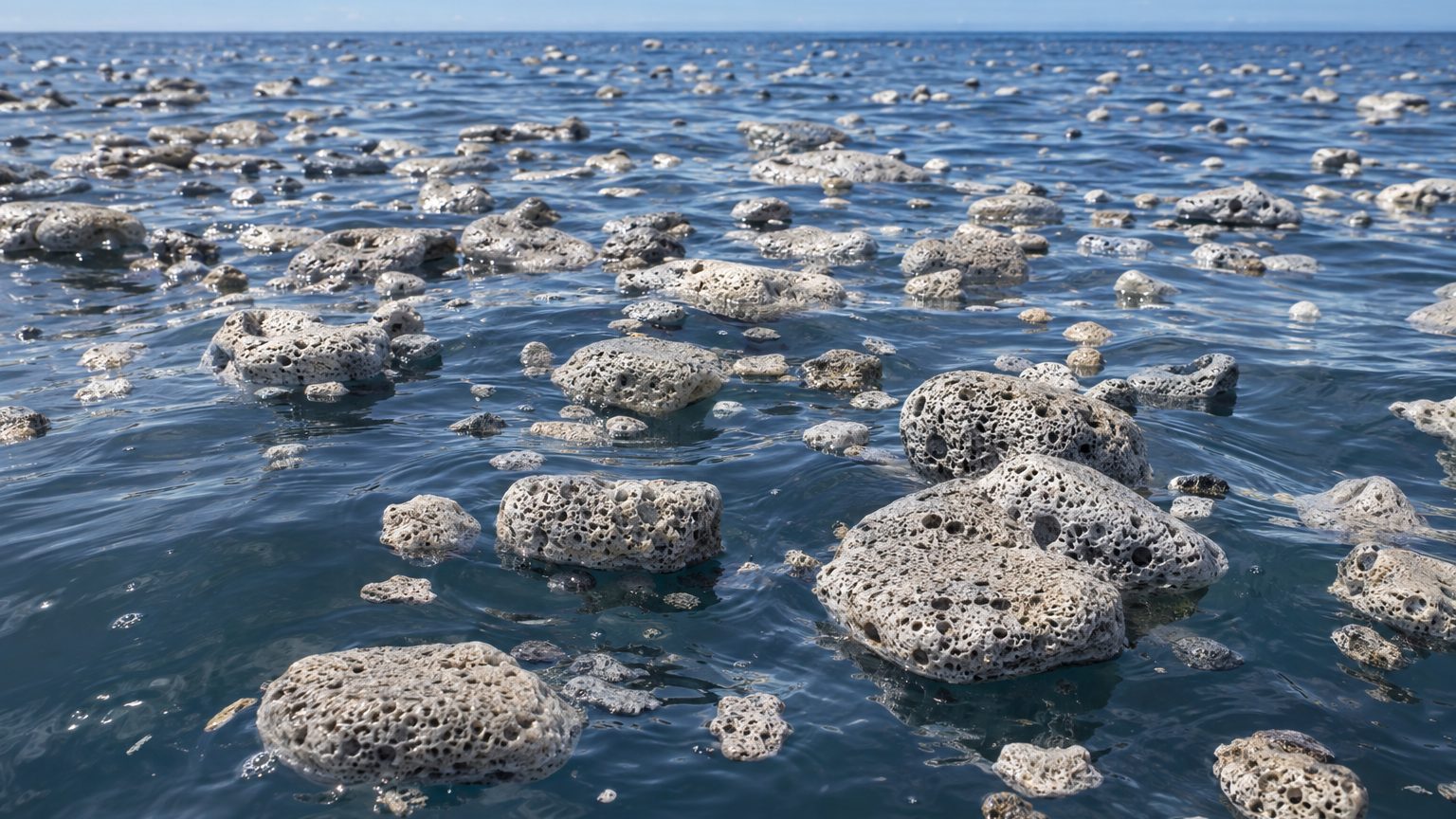
A pumice stone, unlike most rocks, contains so many air bubbles that it can float like wood. In July 2012, the Havre submarine volcano, tucked in the Kermadec arc north of New Zealand, expelled enough pumice to form a raft of 400 km² at the surface of the Pacific, in a single day. The eruption occurred underwater, between 900 and 1,220 meters deep, across at least fourteen distinct volcanic vents.
The most astonishing thing isn’t the size of the raft. It’s that nobody, at the time, realized that anything had happened. Volcanologists didn’t even know Havre was an active volcano.
- The Havre volcano generated a 400 km² pumice raft in a single day in July 2012
- Pumice floats because it contains enough air bubbles to be less dense than water
- More than eighty marine species colonized the floating blocks, traveling thousands of kilometers
- The eruption occurred at a depth of 900–1,220 meters without real-time detection
How an invisible eruption ended up surfacing
No one witnessed the eruption itself.
It was satellite imagery, revisited afterward, that revealed the scene: a volcanologist and a NASA expert detected, in MODIS sensor data, a plume and grayish water dated July 19, 2012. Three weeks later, on August 9, a Royal New Zealand Air Force Orion patrol aircraft photographed a whitish stretch while flying over the area between Samoa and New Zealand. The pilots relayed the information to the warship HMNZS Canterbury, which crossed the raft that same day, about 160 kilometers southwest of Raoul Island. The crew then measured a pumice layer roughly 0.6 meters thick, one kilometer wide, stretching as far as the eye could see.
The sailors collected samples directly from the ship’s water filters, before New Zealand geologists traced the trail back to the Havre volcano using seismic data from July 17 and 18. Fragments ranging from golf-ball to football-size floated in thousands.
Why this pumice defies logic
Pumice forms when gas-rich magma rapidly solidifies upon contact with cold water, trapping countless microbubbles inside the rock. This porosity reduces its density so much that the fragment floats, sometimes for years, before it becomes waterlogged and sinks.
At Havre, more than 75% of the total volume released during the eruption ended up in this floating form, compared with a minority transformed into lava or seabed deposits. Scientists estimate the overall volume erupted at about 1.5 km³ of rhyolitic magma. The event is officially classified as VEI-1, the lowest on the Smithsonian scale, but its volume actually corresponds to VEI-5, evidence that this scale remains poorly suited to deep submarine eruptions.
A raft turned into a mobile ecosystem
The pumice raft did not simply drift in place. By August 19, 2012, the sheet stretched over roughly 270,000 km² of the Pacific, driven by winds and currents. The pumice filaments continued to drift for months, some spreading into ribbons too thin to be detected by satellites. Some fragments eventually stranded on the shores of Tonga and northern New Zealand, while other pieces reached Australia’s eastern coast nearly a year after the eruption.
This multi-thousand-kilometer journey transformed every pumice block into a tiny lifeboat. Researchers recorded more than eighty different marine species that colonized these floating rocks, from barnacles to corals, including bryozoans and various algae.
This biological voyage is far from anecdotal for scientists. Pumice, resistant to wear and nearly indestructible in seawater, proves to be an unnervingly effective vector for dispersing marine life over long distances, far more than a mere floating debris. A 2015 expedition using an autonomous underwater vehicle allowed detailed mapping of the Havre caldera’s floor, revealing giant pumice blocks up to 9 meters in diameter left behind by what remains the largest silicic eruption in deep water ever documented.
Sources: volcano.si.edu | ncbi.nlm.nih.gov | osti.gov
