
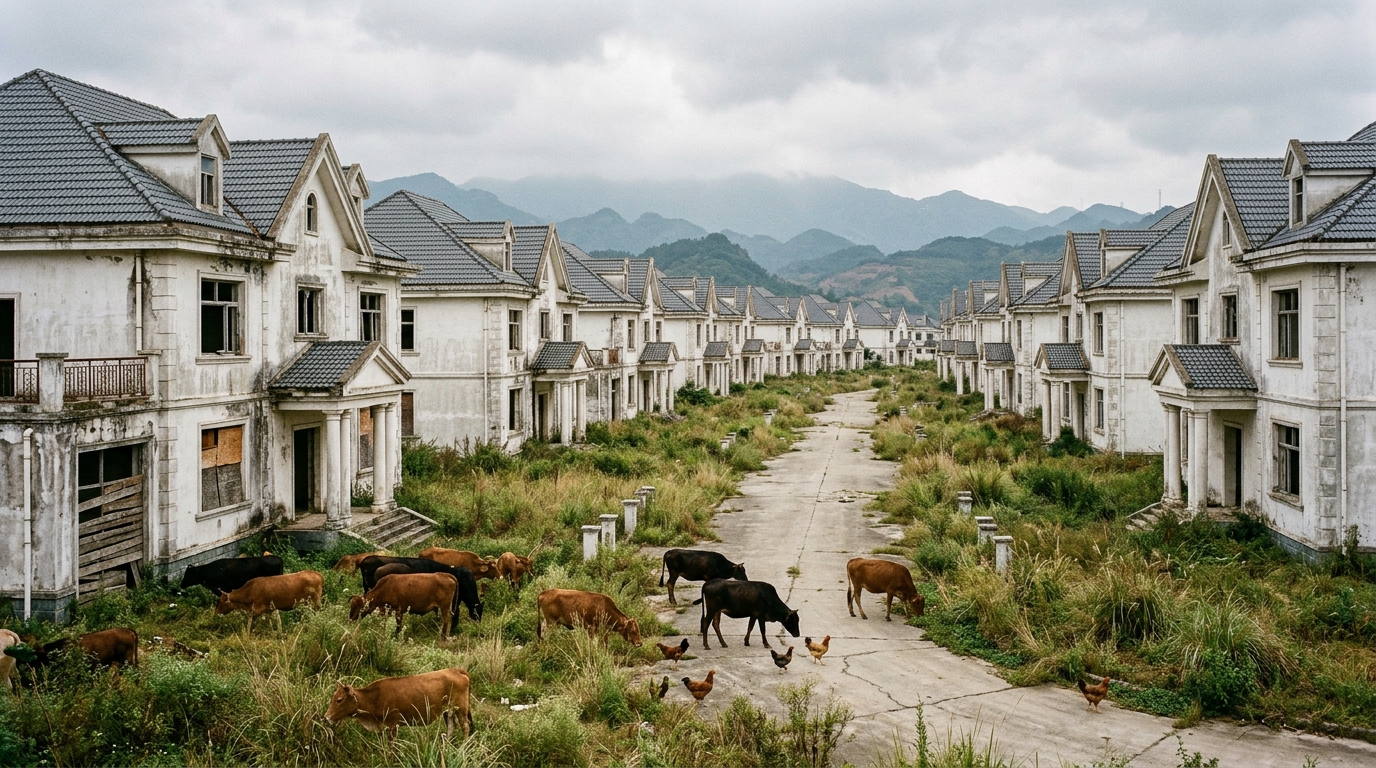
Imagine for a moment having to choose among two hundred and sixty brand-new villas, each boasting marble floors, towering chandeliers, and coffered ceilings worthy of a European palace. An outright real estate dream, in short. Yet in China, this dream morphed into a scene frozen in time, where no buyer or tenant ever stepped through the doors. Today, cows graze quietly on the lawns that were meant to welcome the political elite of an entire province. A stark, almost absurd contrast that speaks volumes about the excesses and the flaws of a sector that once shone.
- Built in 2010 by Greenland Group near Shenyang to house official delegations of Liaoning, the 260 villas never had any occupants before construction halted in 2018.
- No official explanation was ever given, but locals speak of a corruption case tied to Xi Jinping’s anticorruption campaign launched in 2012.
- The site is today overrun by farmers and livestock, illustrating a national phenomenon since roughly 65 million homes in China would remain vacant.
- A project designed for the provincial elite
- The official welcome that never occurred
- Years of silence on lawns reclaimed by the wild
- What this ghost town reveals about the Chinese housing model
A project designed for the provincial elite
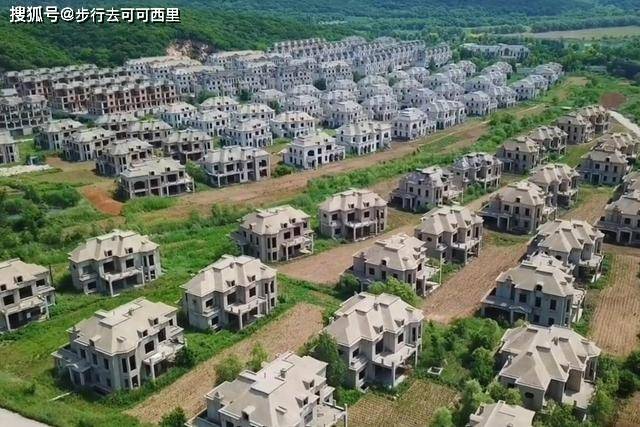
Everything begins in 2010, on the rolling hills surrounding Shenyang, an industrial city in northeast China that now counts almost nine million residents. The developer Greenland Group, then expanding rapidly amid a national real estate boom, launched an ambitious project dubbed State Guest Mansions. The plan on paper was straightforward: to build a high-end residential complex not for the general public, but for official visitors to the Liaoning provincial government. Two hundred and sixty European-style villas would rise, each intended to impress passing delegations and symbolize the region’s economic success.
The architects spared no detail: robust façades, landscaped gardens, spacious garages, and interiors worthy of the finest Western homes. This project, located roughly 400 kilometers from Beijing, was meant to embody a Chinese mode of living that blended international prestige with institutional hospitality.
The official welcome that never occurred
That is where the story takes a turn. Just as everything appeared ready to receive its first occupants, construction halted abruptly in 2018, after eight years of work. No official explanation was ever issued by Greenland Group, leaving room for every kind of speculation. According to testimonies gathered by the AFP from local residents, many believe it is a corruption affair linked to Xi Jinping’s anticorruption drive that began in 2012 and shook numerous financial schemes in China’s real estate sector.
The result is unequivocal: not a single villa ever welcomed an official visitor. The project, meant to embody the province’s regained grandeur, became a silent symbol of a system where public money and political ambitions sometimes collided with economic reality.
Years of silence on lawns reclaimed by the wild
Since the stoppage, the site gradually transformed into a ghost town. Nature claimed its territory, but not alone: local farmers began cultivating the land originally slated for ornamental gardens. Livestock now roam freely between the unfinished buildings, sometimes even inside houses and garages converted into makeshift chicken coops. Stray dogs patrol the silent avenues, and the artificial lake, once designed as a central decorative element, now serves merely as a water source for the farmers.
This surreal landscape, hovering between frozen luxury and the plainest rurality, attracts a new generation of urban explorers hungry for places abandoned like this. On social networks, photos of these villas overrun with tall grass and cattle circulate regularly, feeding the fascination with what the Chinese sometimes call houses with a rotten tail, a reference to projects launched with pomp and then abandoned without explanation.
What this ghost town says about the Chinese housing model
Shenyang’s case is far from isolated. China’s real estate market enjoyed its most vigorous years until the late 2010s, riding a frenzy of urban growth and massive investments. But in 2020 the government halted this momentum by sharply curbing developers’ access to credit, sending a shockwave across the country.
A report by a research group affiliated with an official Shanghai association estimated that by June 2022, almost 4% of the country’s housing projects had been abandoned mid-build, equating to a surface area of about 231 million square meters. More broadly, the vacancy phenomenon would now affect roughly 65 million homes across China, a staggering figure that underscores the misalignment between supply and demand in certain regions.
These ghost towns, with their unfinished walls and lawns returned to wilderness, are not mere tourist curiosities. They tell, in their own way, of the excesses of a growth model that prioritized construction over the actual use of buildings, often leaving landscapes frozen in time behind.
At a moment when discussions in France and elsewhere emphasize the need to rethink urban models in light of economic and ecological challenges, the example of these abandoned Chinese villas resonates as a warning. What remains of a real estate project when ambition outruns ground realities? Perhaps simply empty façades, a few curious cows, and the stubborn silence of lawns no longer cared for.
